Exploring the World of Turtles

Generated from prompt:

Create a Google Slides presentation about turtles

This presentation introduces turtles' characteristics, anatomy, differences between sea and land species, evolutionary timeline, fascinating stats, wisdom quotes, and vital conservation efforts, empha

November 25, 202511 slides
Slide 1 of 11

Slide 1 - Exploring the World of Turtles

The slide's title, "Exploring the World of Turtles," introduces a presentation on these remarkable creatures. Its subtitle highlights the discovery of fascinating facts about turtles as ancient reptiles.

Exploring the World of Turtles

Discover fascinating facts about these ancient reptiles.

Source: Google Slides presentation about turtles

Slide 1 - Exploring the World of Turtles
Slide 2 of 11

Slide 2 - Presentation Agenda

The presentation agenda outlines key sections on turtles, starting with an introduction to their overview and objectives. It covers types of turtles and their features, habitats and adaptations, conservation efforts, and ends with fun facts and a conclusion.

Presentation Agenda

  1. Introduction
  2. Overview of turtles and presentation objectives.

  3. Types of Turtles
  4. Exploring different turtle species and their features.

  5. Habitats and Adaptations
  6. Turtle living environments and survival mechanisms.

  7. Conservation
  8. Efforts to protect turtles from endangerment.

  9. Fun Facts and Conclusion

Engaging trivia and summary of key insights. Source: Google Slides presentation about turtles

Slide 2 - Presentation Agenda
Slide 3 of 11

Slide 3 - What Are Turtles?

This section header slide introduces the topic "What Are Turtles?" as the first in a series. It provides a subtitle overview describing turtles as reptiles characterized by their shells, with origins tracing back 220 million years.

What Are Turtles?

01

What Are Turtles?

Overview of turtles as reptiles with shells, dating back 220 million years.

Slide 3 - What Are Turtles?
Slide 4 of 11

Slide 4 - Key Characteristics

Tortoises feature a hard protective shell that shields their body from predators, while their slow-moving nature on land allows for efficient energy conservation. They can adapt to both aquatic and terrestrial lifestyles and have diverse diets ranging from herbivorous to carnivorous or omnivorous.

Key Characteristics

  • Hard protective shell shields body from predators
  • Slow-moving on land conserves energy efficiently
  • Adapt to aquatic or terrestrial lifestyles
  • Diet includes herbivores, carnivores, or omnivores
Slide 4 - Key Characteristics
Slide 5 of 11

Slide 5 - Turtle Anatomy

The slide on Turtle Anatomy features an image highlighting key body parts, including a protective shell that covers vital organs and provides camouflage, as well as powerful flippers for efficient swimming and land movement. It also describes the head with a beak-like mouth for feeding on various foods, and the plastron and carapace forming a bony, box-like structure.

Turtle Anatomy

!Image

  • Protective shell covers vital organs and provides camouflage.
  • Powerful flippers enable efficient swimming and land movement.
  • Head features beak-like mouth for feeding on various foods.
  • Plastron and carapace form the bony box-like structure.

Source: Image from Wikipedia article "Turtle"

Slide 5 - Turtle Anatomy
Slide 6 of 11

Slide 6 - Sea Turtles vs. Land Turtles

Sea turtles are oceanic migrants that travel vast distances to feed and breed, with females nesting on beaches to lay eggs before returning to the sea, ensuring species survival amid predation threats. In contrast, land turtles, or tortoises, inhabit terrestrial environments where they burrow for protection and leverage slow metabolisms for lifespans exceeding 100 years in the wild or captivity.

Sea Turtles vs. Land Turtles

Sea TurtlesLand Turtles (Tortoises)
Sea turtles are oceanic nomads, migrating thousands of miles across oceans to reach feeding and breeding grounds. Females haul themselves onto beaches to dig nests and lay clutches of eggs, which they cover with sand before returning to the sea. This remarkable journey ensures species survival despite predation risks.Land turtles, often called tortoises, thrive in terrestrial habitats by burrowing into soil or under rocks for shelter from extreme weather and predators. Their slow metabolism contributes to exceptionally long lifespans, with some individuals living over 100 years in the wild or captivity.
Slide 6 - Sea Turtles vs. Land Turtles
Slide 7 of 11

Slide 7 - Evolution of Turtles

The evolution of turtles began around 220 million years ago in the Late Triassic period, when the earliest ancestors appeared in fossils. By 100 million years ago in the Cretaceous era, species started diversifying, leading to the present day where 356 diverse species thrive worldwide.

Evolution of Turtles

220 Million Years Ago: First Turtles Emerge Earliest turtle ancestors appear in the Late Triassic period fossils. 100 Million Years Ago: Turtle Diversification Begins Species start to diversify during the Cretaceous era. Present Day: 356 Species Worldwide Modern turtles thrive with 356 diverse species across the globe.

Slide 7 - Evolution of Turtles
Slide 8 of 11

Slide 8 - Fascinating Turtle Stats

Turtles have evolved over more than 200 million years, with some species, like the leatherback sea turtle, reaching weights of up to 2,000 pounds and undertaking epic annual migrations spanning 12,000 miles. Alarmingly, nearly half (49%) of turtle species are endangered, highlighting the urgent risks they face.

Fascinating Turtle Stats

  • 200M+: Oldest Species Age
  • Evolved over 200 million years

  • 12,000 miles: Longest Migration
  • Epic annual journeys undertaken

  • 2,000 lbs: Largest Turtle Weight
  • Leatherback sea turtle maximum

  • 49%: Endangered Species Rate
  • Nearly half of species at risk

Slide 8 - Fascinating Turtle Stats
Slide 9 of 11

Slide 9 - A Turtle's Wisdom

The slide, titled "A Turtle's Wisdom," features a quote from a Native American Proverb. It states: "The turtle carries his home on his back; he only needs to find a sunny spot to rest."

A Turtle's Wisdom

> The turtle carries his home on his back; he only needs to find a sunny spot to rest.

— Native American Proverb

Slide 9 - A Turtle's Wisdom
Slide 10 of 11

Slide 10 - Conservation Efforts

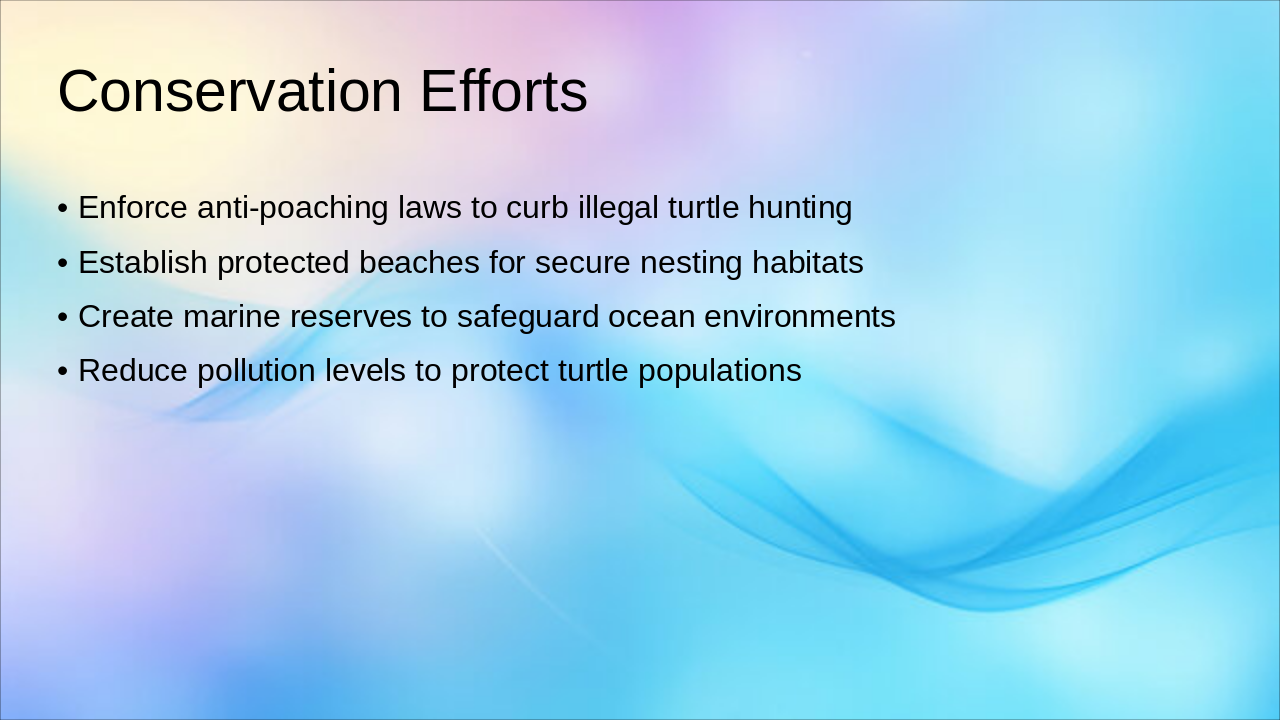
Conservation efforts for turtles focus on enforcing anti-poaching laws to prevent illegal hunting and establishing protected beaches for secure nesting habitats. Additional measures include creating marine reserves to safeguard ocean environments and reducing pollution levels to protect turtle populations.

Conservation Efforts

  • Enforce anti-poaching laws to curb illegal turtle hunting
  • Establish protected beaches for secure nesting habitats
  • Create marine reserves to safeguard ocean environments
  • Reduce pollution levels to protect turtle populations
Slide 10 - Conservation Efforts
Slide 11 of 11

Slide 11 - Why Turtles Matter

The conclusion slide, titled "Why Turtles Matter," urges viewers to protect turtles for a thriving future. Its subtitle emphasizes supporting conservation organizations to safeguard ecosystems.

Why Turtles Matter

Protect Turtles for a Thriving Future!

Support conservation organizations to safeguard ecosystems.

Slide 11 - Why Turtles Matter

Discover More Presentations

Explore thousands of AI-generated presentations for inspiration

Browse Presentations
Powered by AI

Create Your Own Presentation

Generate professional presentations in seconds with Karaf's AI. Customize this presentation or start from scratch.

Create New Presentation

Powered by Karaf.ai — AI-Powered Presentation Generator