British Literature: A Journey Through Time

Generated from prompt:

Make a presentation about Britain literature

This presentation explores the rich history and enduring influence of British literature, guiding the audience through key literary periods from Old English and Medieval times, through the Renaissance, the Age of Reason, the Romantic Era, and the Victorian Age, up to modern and contemporary works. It highlights significant authors, iconic texts, and the evolving cultural, historical, and social developments reflected in the literary tradition.

May 22, 202620 slides
Slide 1 of 20

Slide 1 - British Literature: A Journey Through Time

British Literature: A Journey Through Time

Exploring the Rich History and Influence of English Literary Tradition

---

Photo by Peter Herrmann on Unsplash
Slide 1 - British Literature: A Journey Through Time
Slide 2 of 20

Slide 2 - Presentation Outline

  • Introduction to British Literature
  • Old English & Medieval Periods
  • The Renaissance & Elizabethan Era
  • 17th and 18th Century Literature
  • The Romantic Era
  • Victorian Literature
  • Modern and Contemporary British Literature
  • Enduring Legacy

---

Photo by Pixelbuddha Studio on Unsplash
Slide 2 - Presentation Outline
Slide 3 of 20

Slide 3 - Introduction to British Literature

Introduction

A Glimpse into Britain's Literary Heritage

---

Photo by engin akyurt on Unsplash
Slide 3 - Introduction to British Literature
Slide 4 of 20

Slide 4 - What is British Literature?

  • Encompasses literary works originating from the United Kingdom, including England, Scotland, Wales, and Northern Ireland.
  • Spans over a millennium, from Anglo-Saxon epics to contemporary novels.
  • Reflects diverse cultural, historical, and social developments.
  • A global influence, shaping literary traditions worldwide.
Slide 4 - What is British Literature?
Slide 5 of 20

Slide 5 - Old English & Medieval Periods

2

Old English & Medieval Periods

From Epic Poems to Chivalric Romances

---

Photo by Tony Findeisen on Unsplash
Slide 5 - Old English & Medieval Periods
Slide 6 of 20

Slide 6 - Beowulf: An Anglo-Saxon Epic

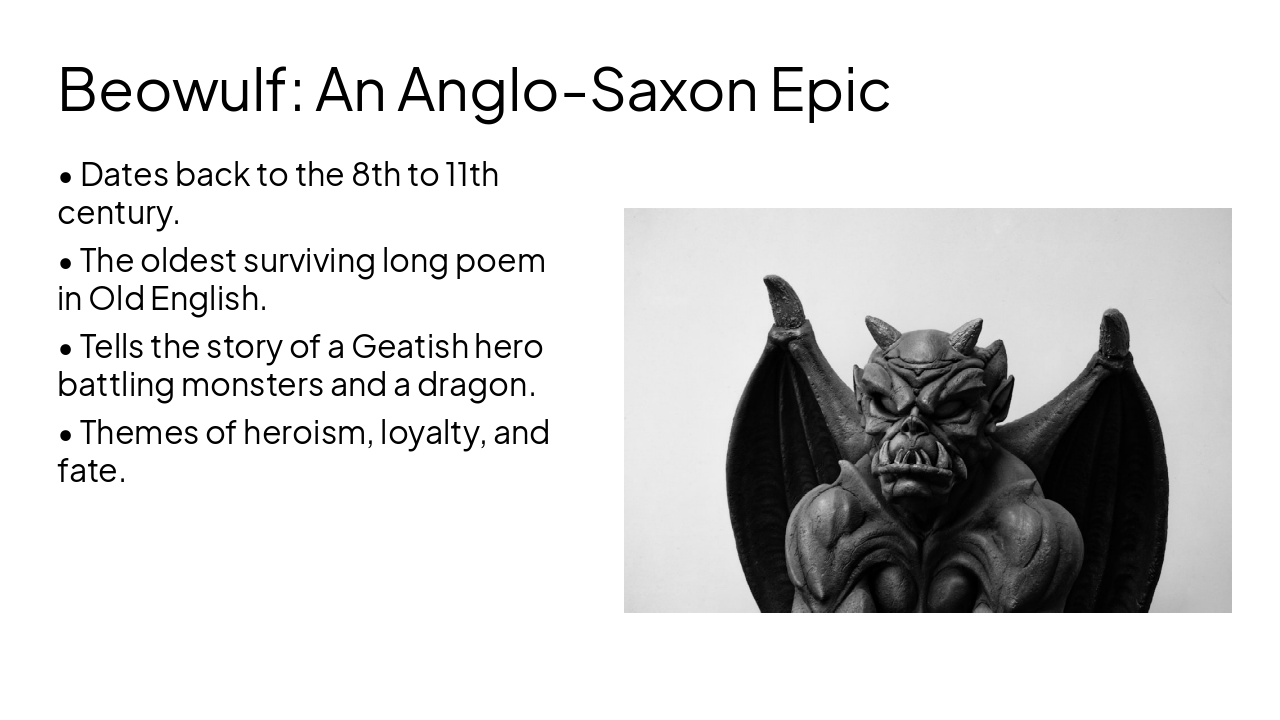
  • Dates back to the 8th to 11th century.
  • The oldest surviving long poem in Old English.
  • Tells the story of a Geatish hero battling monsters and a dragon.
  • Themes of heroism, loyalty, and fate.

---

Photo by Donovan Reeves on Unsplash
Slide 6 - Beowulf: An Anglo-Saxon Epic
Slide 7 of 20

Slide 7 - Key Medieval Works

  • Geoffrey Chaucer's The Canterbury Tales (late 14th century): A collection of stories told by a group of pilgrims.
  • Arthurian Romances: Legends of King Arthur and his knights (e.g., Sir Gawain and the Green Knight).
  • Mystery and Morality Plays: Early forms of drama with religious themes.
Slide 7 - Key Medieval Works
Slide 8 of 20

Slide 8 - The Renaissance & Elizabethan Era

3

The Renaissance & Elizabethan Era

A Golden Age of Drama and Poetry

---

Photo by Library of Congress on Unsplash
Slide 8 - The Renaissance & Elizabethan Era
Slide 9 of 20

Slide 9 - William Shakespeare: The Bard of Avon

  • Widely regarded as the greatest writer in the English language.
  • Penned approximately 39 plays, 154 sonnets, and other poems.
  • Masterpieces include Hamlet, Romeo and Juliet, Macbeth, and A Midsummer Night's Dream.
  • Explored universal themes of love, loss, ambition, and humanity.
Slide 9 - William Shakespeare: The Bard of Avon
Slide 10 of 20

Slide 10 - A Timeless Quote

> All the world's a stage, and all the men and women merely players; They have their exits and their entrances; And one man in his time plays many parts.

— William Shakespeare, As You Like It

---

Photo by Rob Laughter on Unsplash
Slide 10 - A Timeless Quote
Slide 11 of 20

Slide 11 - 17th and 18th Century Literature

4

17th and 18th Century

Reason, Revolution, and the Rise of the Novel

---

Photo by ola szkolda on Unsplash
Slide 11 - 17th and 18th Century Literature
Slide 12 of 20

Slide 12 - Literary Trends

  • The Enlightenment: Emphasis on reason, individualism, and scientific thought.
  • Neoclassicism: Revival of classical styles and forms, valuing order and balance.
  • Rise of the Novel: Emergence of long-form prose fiction as a dominant genre.
Slide 12 - Literary Trends
Slide 13 of 20

Slide 13 - John Milton's *Paradise Lost*

  • Epic poem published in 1667.
  • Retells the biblical story of the Fall of Man.
  • Explores themes of free will, disobedience, and redemption.
  • Considered one of the greatest works in English literature.

---

Photo by Craig Pattenaude on Unsplash
Slide 13 - John Milton's *Paradise Lost*
Slide 14 of 20

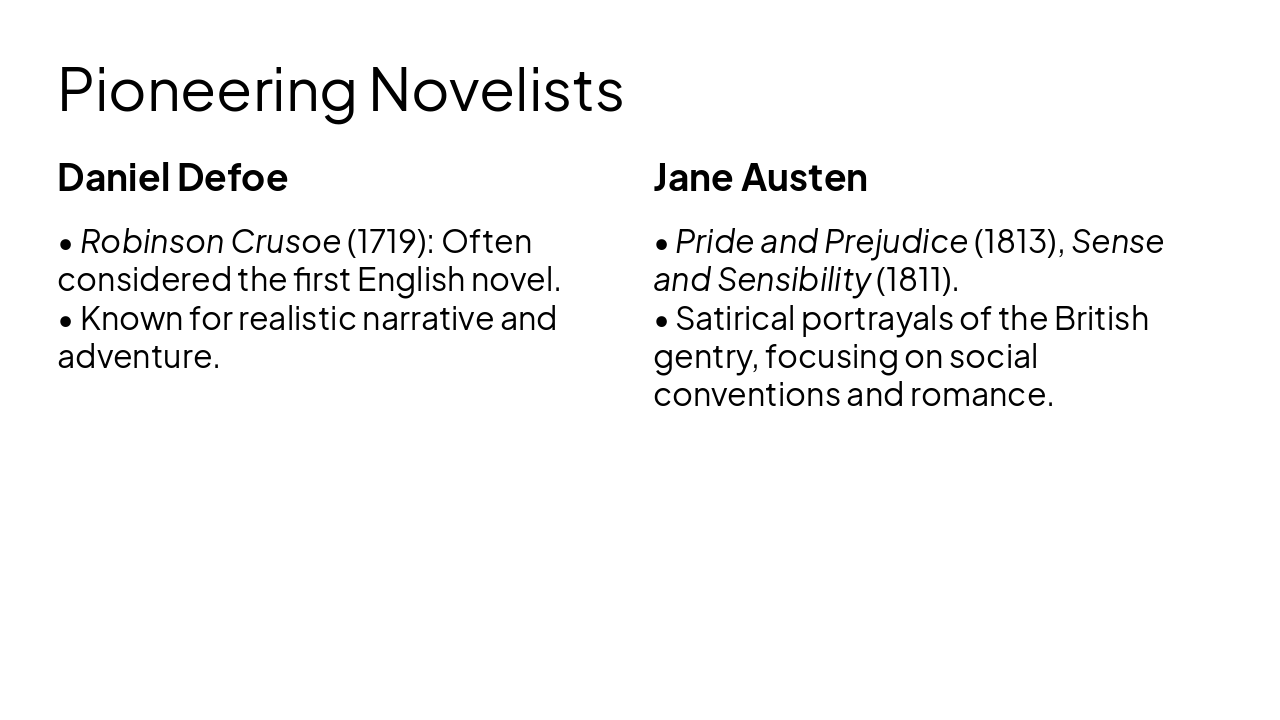
Slide 14 - Pioneering Novelists

Daniel Defoe

  • Robinson Crusoe (1719): Often considered the first English novel.
  • Known for realistic narrative and adventure.

Jane Austen

  • Pride and Prejudice (1813), Sense and Sensibility (1811).
  • Satirical portrayals of the British gentry, focusing on social conventions and romance.
Slide 14 - Pioneering Novelists
Slide 15 of 20

Slide 15 - The Romantic Era

5

The Romantic Era

Emotion, Nature, and Individualism (Late 18th - Mid-19th Century)

---

Photo by Alessio Soggetti on Unsplash
Slide 15 - The Romantic Era
Slide 16 of 20

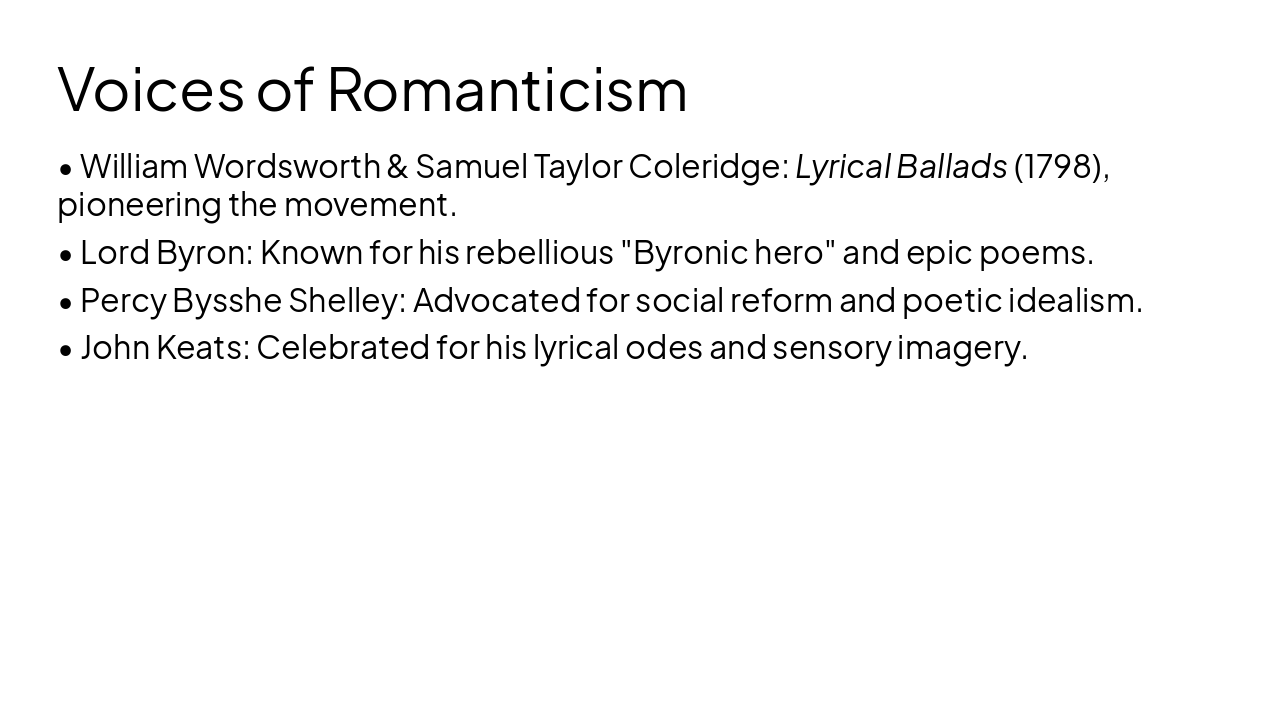
Slide 16 - Voices of Romanticism

  • William Wordsworth & Samuel Taylor Coleridge: Lyrical Ballads (1798), pioneering the movement.
  • Lord Byron: Known for his rebellious "Byronic hero" and epic poems.
  • Percy Bysshe Shelley: Advocated for social reform and poetic idealism.
  • John Keats: Celebrated for his lyrical odes and sensory imagery.
Slide 16 - Voices of Romanticism
Slide 17 of 20

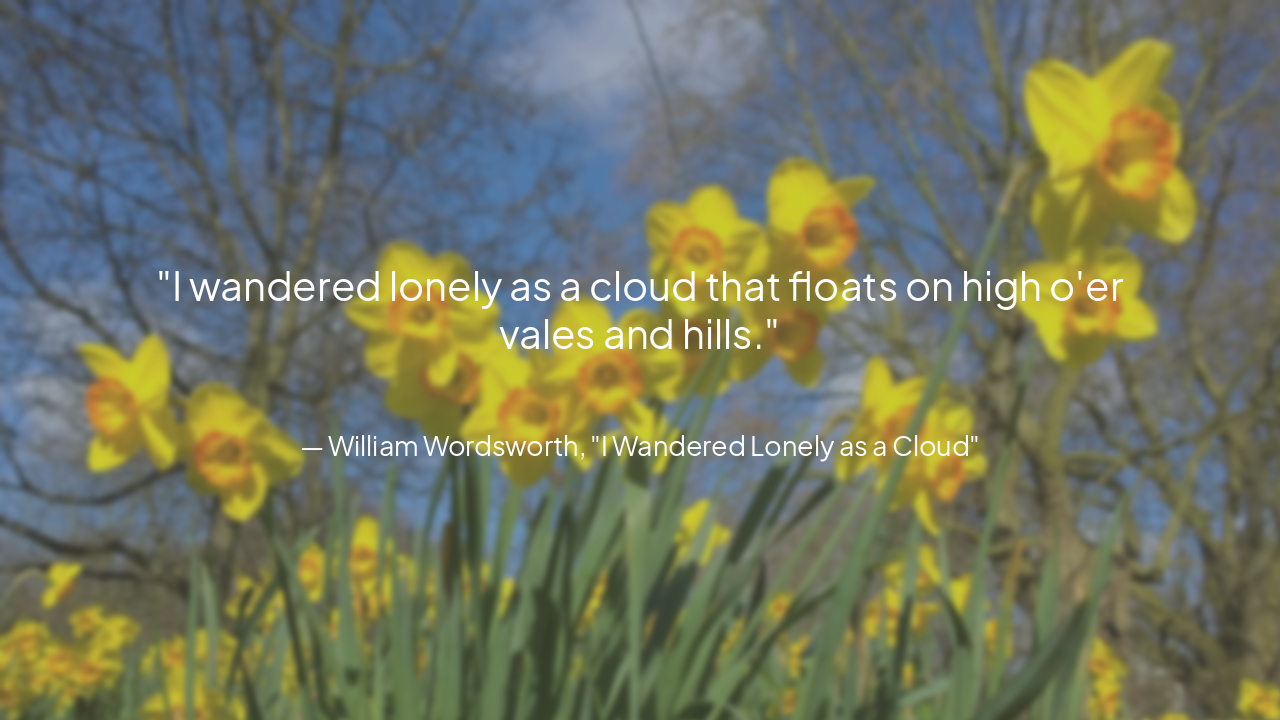
Slide 17 - A Romantic Sentiment

> I wandered lonely as a cloud that floats on high o'er vales and hills.

— William Wordsworth, "I Wandered Lonely as a Cloud"

---

Photo by Chris Linnett on Unsplash
Slide 17 - A Romantic Sentiment
Slide 18 of 20

Slide 18 - Victorian Literature

6

Victorian Literature

Industrial Age, Social Commentary, and Moral Dilemmas (1837-1901)

---

Photo by Dorin Seremet on Unsplash
Slide 18 - Victorian Literature
Slide 19 of 20

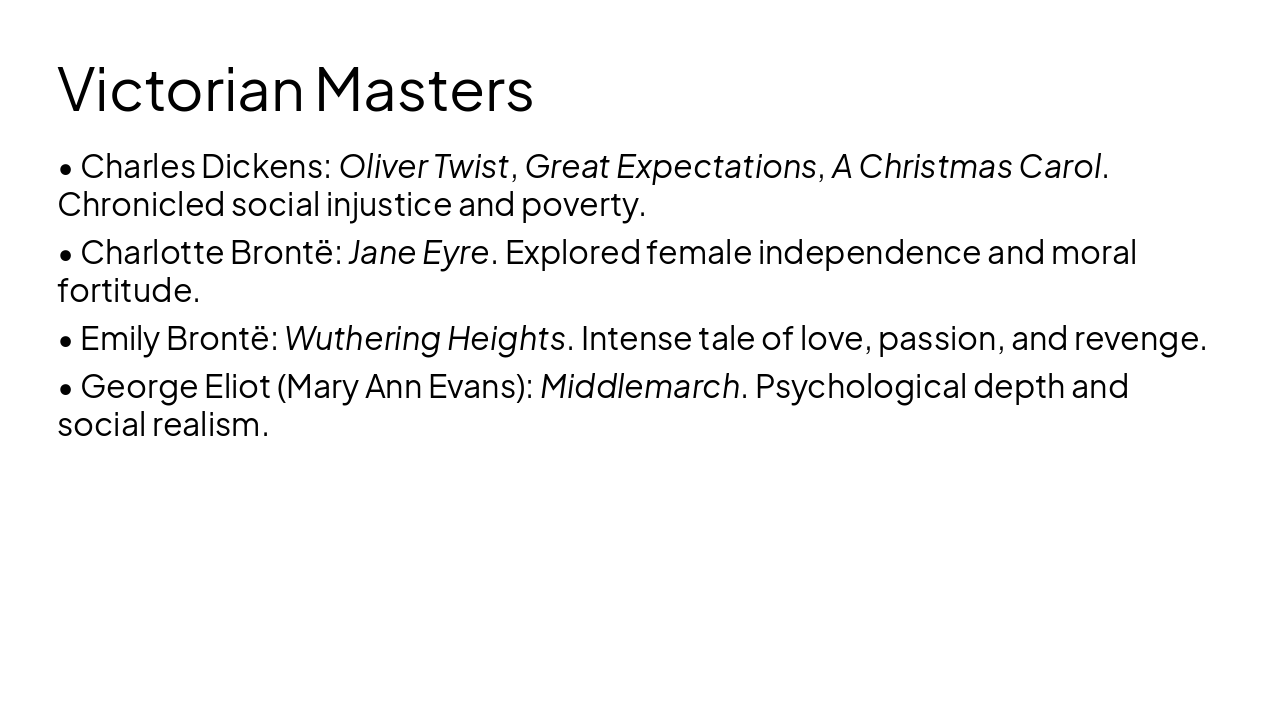
Slide 19 - Victorian Masters

  • Charles Dickens: Oliver Twist, Great Expectations, A Christmas Carol. Chronicled social injustice and poverty.
  • Charlotte Brontë: Jane Eyre. Explored female independence and moral fortitude.
  • Emily Brontë: Wuthering Heights. Intense tale of love, passion, and revenge.
  • George Eliot (Mary Ann Evans): Middlemarch. Psychological depth and social realism.
Slide 19 - Victorian Masters
Slide 20 of 20

Slide 20 - Conclusion

British Literature: A Legacy of Innovation and Influence

Continually Evolving, Forever Inspiring

---

Photo by Chandler Cruttenden on Unsplash
Slide 20 - Conclusion

Discover More Presentations

Explore thousands of AI-generated presentations for inspiration

Browse Presentations
Powered by AI

Create Your Own Presentation

Generate professional presentations in seconds with Karaf's AI. Customize this presentation or start from scratch.

Create New Presentation

Powered by Karaf.ai — AI-Powered Presentation Generator