Tumour Markers: Cancer Diagnosis Guide (35 chars)

Generated from prompt:

Create a PowerPoint presentation in English about Tumour Markers with a modern dark theme (dark navy or charcoal background and light text). Keep it elegant and professional with minimal icons and clean sans-serif fonts. Include 9 slides: 1. Title - Tumour Markers (Definition and Importance) 2. Introduction - Definition and role in cancer diagnosis and monitoring. 3. Determination Types - Qualitative (histopathologic) and Quantitative (serum/fluids). 4. Ideal Characteristics - High specificity, sensitivity, and organ specificity. 5. Specific Tumour Markers (Part 1) - CEA, AFP, HCG. 6. Specific Tumour Markers (Part 2) - CA 19-9, CA 15-3, CA 27-29. 7. Additional Markers - LDH, NSE. 8. Therapeutic Aspects - Strategy and treatment selection. 9. Main Treatment Modalities - Chemotherapy, Radiotherapy, Surgery; conclusion emphasizing importance of tumour markers.

Explores tumour markers' definition, role in diagnosis/monitoring, types (qualitative/quantitative), ideal characteristics, key examples (CEA, AFP, CA19-9, etc.), additional markers (LDH, NSE), therap

December 16, 20259 slides
Slide 1 of 9

Slide 1 - Tumour Markers: Definition and Importance

This title slide is named "Tumour Markers: Definition and Importance." It displays "Tumour Markers" as the main text and "Definition and Importance in Oncology" as the subtitle.

Tumour Markers

Definition and Importance in Oncology

Source: PowerPoint presentation on Tumour Markers

Slide 1 - Tumour Markers: Definition and Importance
Slide 2 of 9

Slide 2 - Introduction

Tumor markers are substances produced by cancer cells or the body in response to cancer. They enable early diagnosis of malignancies, monitor treatment effectiveness, and detect recurrence after therapy.

Introduction

  • Substances produced by cancer cells or body in response to cancer
  • Enable early diagnosis of malignancies
  • Monitor effectiveness of cancer treatments
  • Detect recurrence after therapy completion

Source: Tumour Markers Presentation

Speaker Notes
Introduce tumour markers: substances from cancer or host response. Highlight roles in diagnosis, monitoring, and recurrence detection.
Slide 2 - Introduction
Slide 3 of 9

Slide 3 - Determination Types

The slide "Determination Types" contrasts qualitative histopathologic analysis, which uses tissue biopsies to microscopically detect tumor marker presence for confirming tumor characteristics, with quantitative serum/fluid analysis, which measures marker concentrations via immunoassays to monitor disease progression and treatment response.

Determination Types

Qualitative (Histopathologic)Quantitative (Serum/Fluids)
Tissue-based analysis via biopsy. Examines cellular and tissue structures microscopically to detect tumor marker expression. Provides presence/absence information, essential for confirming tumor type and characteristics.Measures tumor marker levels in blood, urine, or other fluids using sensitive immunoassays. Yields numerical concentrations for monitoring disease progression, treatment response, and early detection.

Source: Tumour Markers Presentation

Speaker Notes
Highlight the complementary nature of qualitative tissue analysis and quantitative fluid measurements in tumor marker detection.
Slide 3 - Determination Types
Slide 4 of 9

Slide 4 - Ideal Characteristics

The slide "Ideal Characteristics" lists key traits for effective tumor markers. These include high specificity (cancer-specific) and sensitivity (detecting most cases), organ specificity, early tumor production, and alignment with disease stage.

Ideal Characteristics

  • High specificity (cancer-specific)
  • High sensitivity (detects most cases)
  • Organ specificity
  • Early production by tumour
  • Parallel disease stage
Slide 4 - Ideal Characteristics
Slide 5 of 9

Slide 5 - Specific Tumour Markers (Part 1)

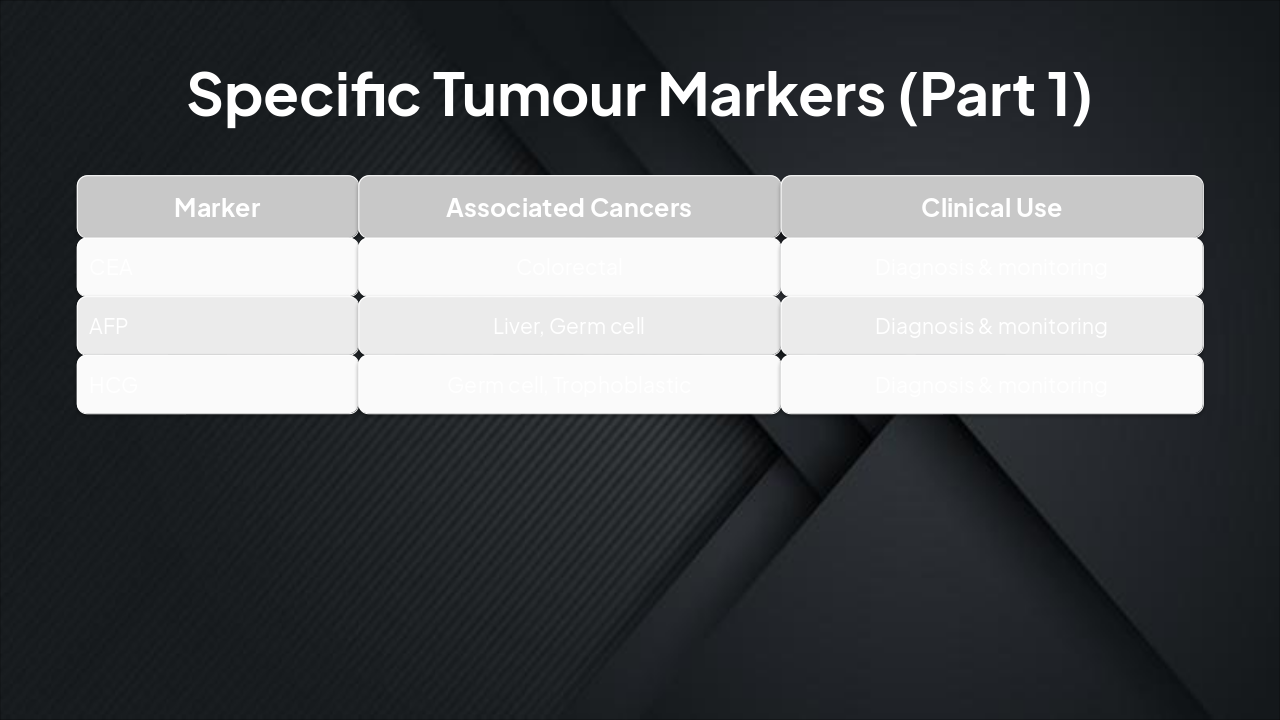
This slide, titled "Specific Tumour Markers (Part 1)," presents a table of three markers: CEA (colorectal cancer), AFP (liver and germ cell cancers), and HCG (germ cell and trophoblastic cancers). All are used for diagnosis and monitoring.

Specific Tumour Markers (Part 1)

{ "headers": [ "Marker", "Associated Cancers", "Clinical Use" ], "rows": [ [ "CEA", "Colorectal", "Diagnosis & monitoring" ], [ "AFP", "Liver, Germ cell", "Diagnosis & monitoring" ], [ "HCG", "Germ cell, Trophoblastic", "Diagnosis & monitoring" ] ] }

Slide 5 - Specific Tumour Markers (Part 1)
Slide 6 of 9

Slide 6 - Specific Tumour Markers (Part 2)

This slide table on "Specific Tumour Markers (Part 2)" lists CA 19-9 for pancreatic and GI cancers, used in diagnosis, monitoring, and prognosis. It also covers CA 15-3 and CA 27-29 for breast cancer, primarily to monitor therapy and recurrence.

Specific Tumour Markers (Part 2)

{ "headers": [ "Marker", "Associated Cancers", "Clinical Use" ], "rows": [ [ "CA 19-9", "Pancreatic, GI", "Diagnosis, monitoring, prognosis" ], [ "CA 15-3", "Breast", "Monitor therapy, recurrence" ], [ "CA 27-29", "Breast", "Monitor therapy, recurrence" ] ] }

Slide 6 - Specific Tumour Markers (Part 2)
Slide 7 of 9

Slide 7 - Additional Markers

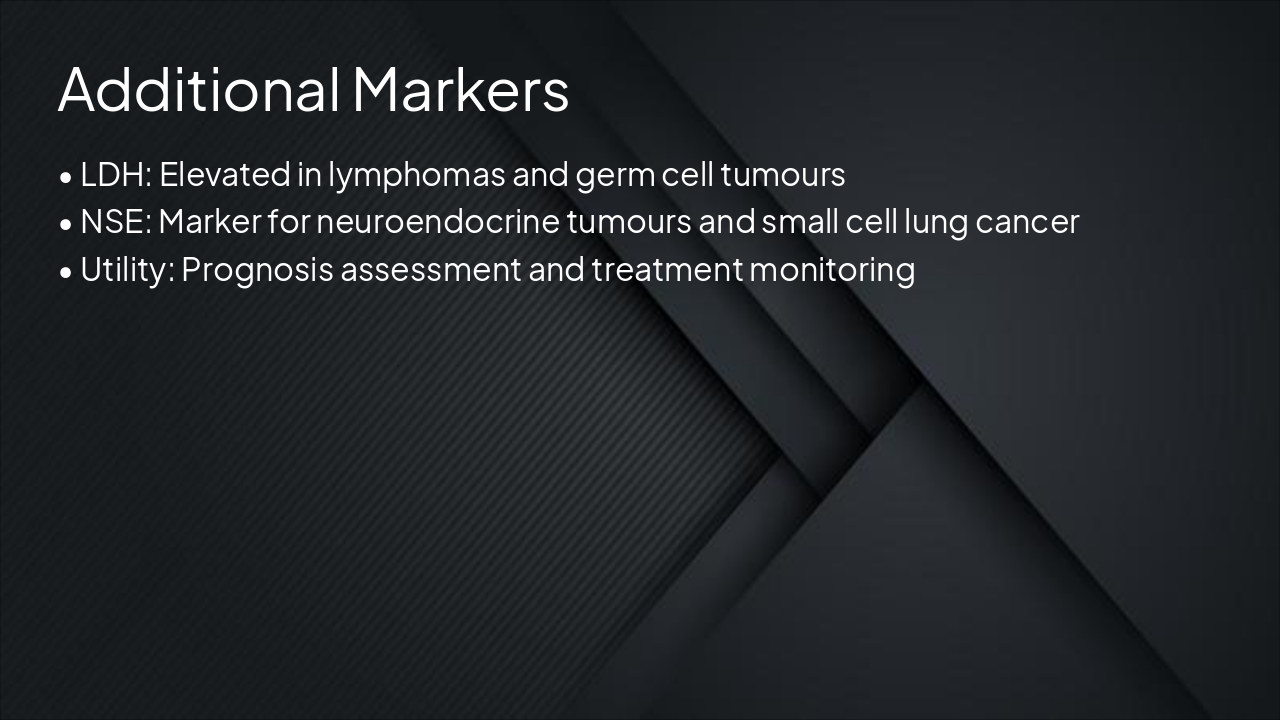
The slide lists additional markers: LDH, elevated in lymphomas and germ cell tumors, and NSE, for neuroendocrine tumors and small cell lung cancer. Their utility includes prognosis assessment and treatment monitoring.

Additional Markers

  • LDH: Elevated in lymphomas and germ cell tumours
  • NSE: Marker for neuroendocrine tumours and small cell lung cancer
  • Utility: Prognosis assessment and treatment monitoring
Slide 7 - Additional Markers
Slide 8 of 9

Slide 8 - Therapeutic Aspects

Therapeutic Aspects slide outlines how markers guide treatment strategy, target selection, and personalize therapy based on levels. It also assesses therapeutic response and efficacy while predicting outcomes and prognosis.

Therapeutic Aspects

  • Guides treatment strategy and target selection
  • Assesses therapeutic response and efficacy
  • Personalizes therapy based on marker levels
  • Predicts treatment outcomes and prognosis
Slide 8 - Therapeutic Aspects
Slide 9 of 9

Slide 9 - Main Treatment Modalities

The slide outlines main cancer treatment modalities: chemotherapy, radiotherapy, and surgery. It stresses that tumour markers are essential for precise diagnosis, monitoring progress, optimizing patient care, and improving survival rates.

Main Treatment Modalities

Chemotherapy Radiotherapy Surgery

Tumour markers essential for:

  • Precise diagnosis
  • Monitoring progress
  • Optimizing patient care

Key to improving survival rates.

Tumour Markers: Key to Survival

Source: Tumour Markers Presentation

Speaker Notes
Closing message: 'Tumour Markers: Key to Survival.' CTA: 'Integrate tumour markers for optimized cancer care and better outcomes.' Emphasize role in treatment selection.
Slide 9 - Main Treatment Modalities

Discover More Presentations

Explore thousands of AI-generated presentations for inspiration

Browse Presentations
Powered by AI

Create Your Own Presentation

Generate professional presentations in seconds with Karaf's AI. Customize this presentation or start from scratch.

Create New Presentation

Powered by Karaf.ai — AI-Powered Presentation Generator