Mastering Structured Documents

Generated from prompt:

Create a presentation about this document

This presentation explores structured documents, emphasizing markup for semantic meaning, hierarchy, and relationships. It covers basics, structural semantics, additional layers, context, intent, and

November 19, 202513 slides
Slide 1 of 13

Slide 1 - Understanding Structured Documents

The slide, titled "Understanding Structured Documents," introduces the concept of electronic files that employ markup languages to convey meaning and structure beyond mere visual formatting. It serves as a title slide to set the stage for exploring how such documents organize and interpret content meaningfully.

Understanding Structured Documents

Electronic files using markup to define meaning beyond formatting.
Slide 1
Slide 2 of 13

Slide 2 - Presentation Agenda

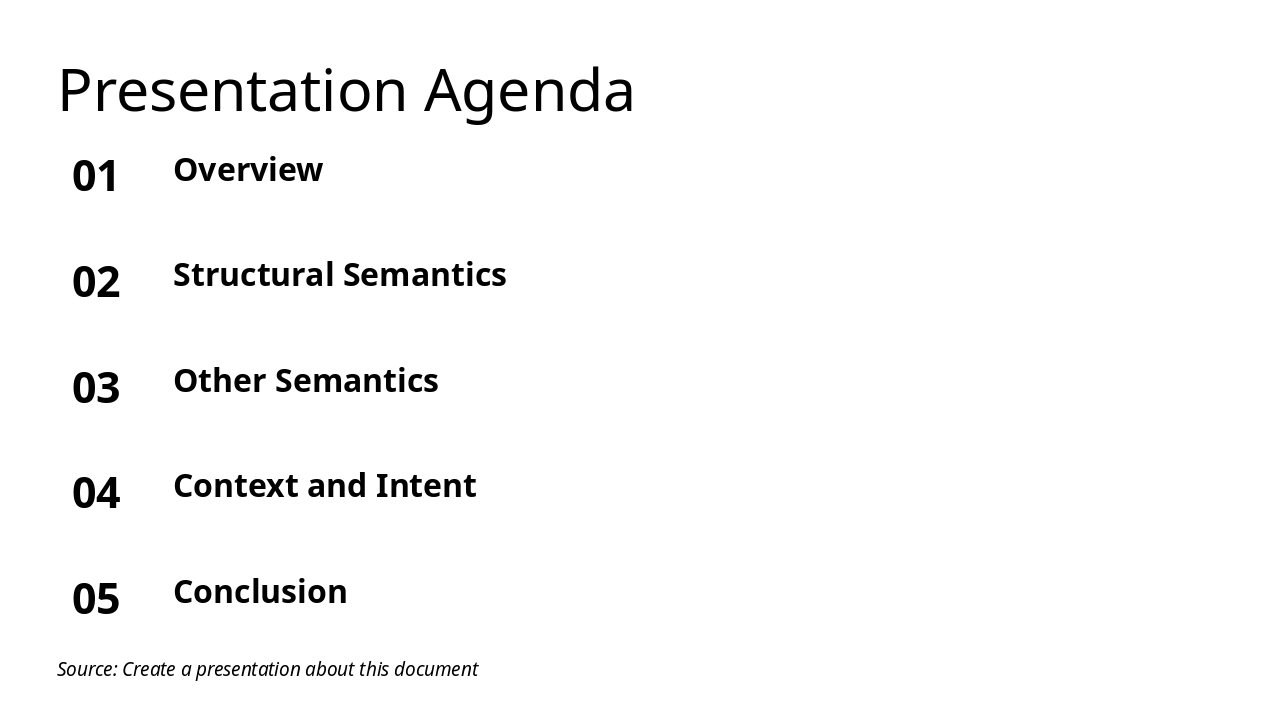
The slide titled "Presentation Agenda" outlines the structure of the presentation in a simple list format. It includes five key items: Overview, Structural Semantics, Other Semantics, Context and Intent, and Conclusion.

Presentation Agenda

  1. Overview
  1. Structural Semantics
  1. Other Semantics
  1. Context and Intent
  1. Conclusion

Source: Create a presentation about this document

Slide 2
Slide 3 of 13

Slide 3 - Overview

This slide serves as a section header titled "Overview" for the topic "Structured Documents Overview," marked as section 01. It features a subtitle that introduces exploring the definition of structured documents and their essential characteristics.

Overview

01

Structured Documents Overview

Exploring what structured documents are and their key characteristics

Source: Structured Documents Presentation

Slide 3
Slide 4 of 13

Slide 4 - Definition and Basics

Semantic HTML consists of electronic documents enhanced with markup that imparts semantic meaning to content. It goes beyond mere formatting like bold text by identifying roles such as 'chapter title' and using elements with defined structures to organize information clearly.

Definition and Basics

  • Electronic documents with markup for semantic meaning.
  • Identifies content roles like 'chapter title' beyond bold formatting.
  • Elements feature defined semantic roles for structure.
Slide 4
Slide 5 of 13

Slide 5 - Markup Example

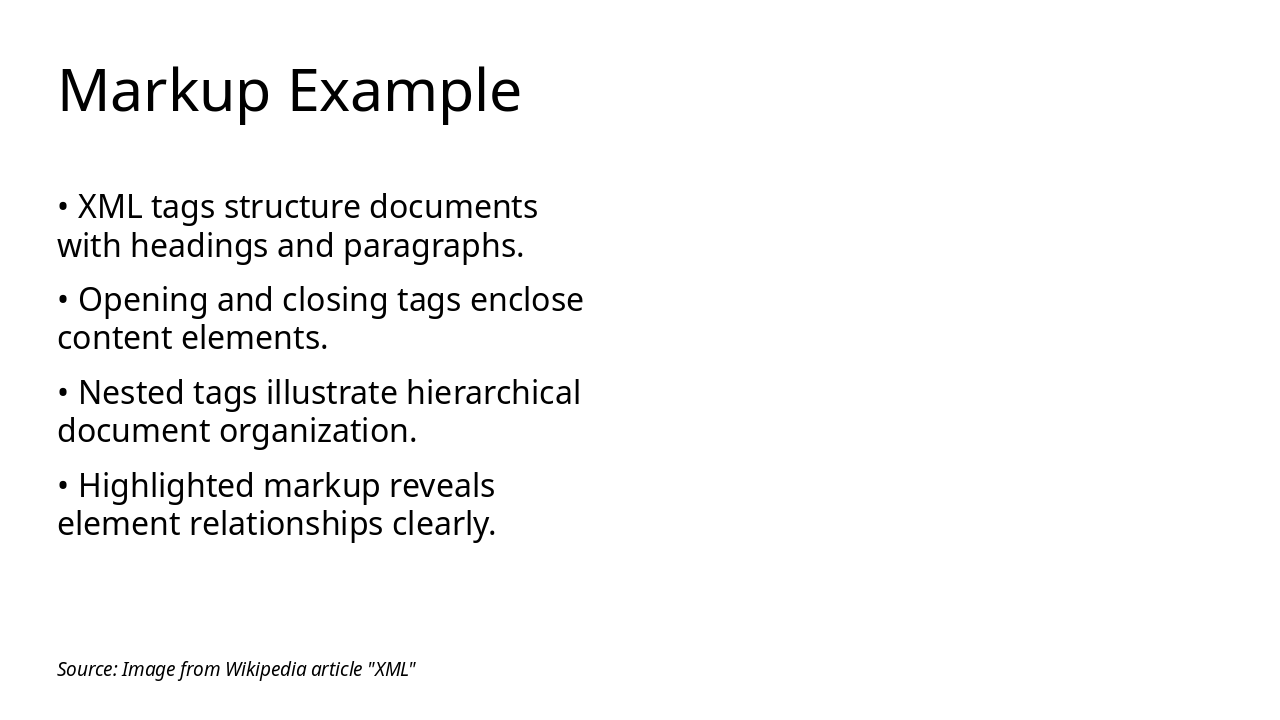
The slide titled "Markup Example" illustrates XML tags used to structure documents, including headings and paragraphs, with opening and closing tags enclosing content elements. It highlights nested tags to demonstrate hierarchical organization and clearly reveals relationships between markup elements.

Markup Example

!Image

  • XML tags structure documents with headings and paragraphs.
  • Opening and closing tags enclose content elements.
  • Nested tags illustrate hierarchical document organization.
  • Highlighted markup reveals element relationships clearly.

Source: Image from Wikipedia article "XML"

--- Speaker Notes: Visual of XML markup showing structure in a document, highlighting tags for elements like headings and paragraphs.

Slide 5
Slide 6 of 13

Slide 6 - Structural Semantics

This section header slide is titled "Structural Semantics." It features a subtitle explaining that the section will explore how a document's structure conveys its intended meaning.

Structural Semantics

Structural Semantics

This section explores how the structure of a document conveys its intended meaning.

Slide 6
Slide 7 of 13

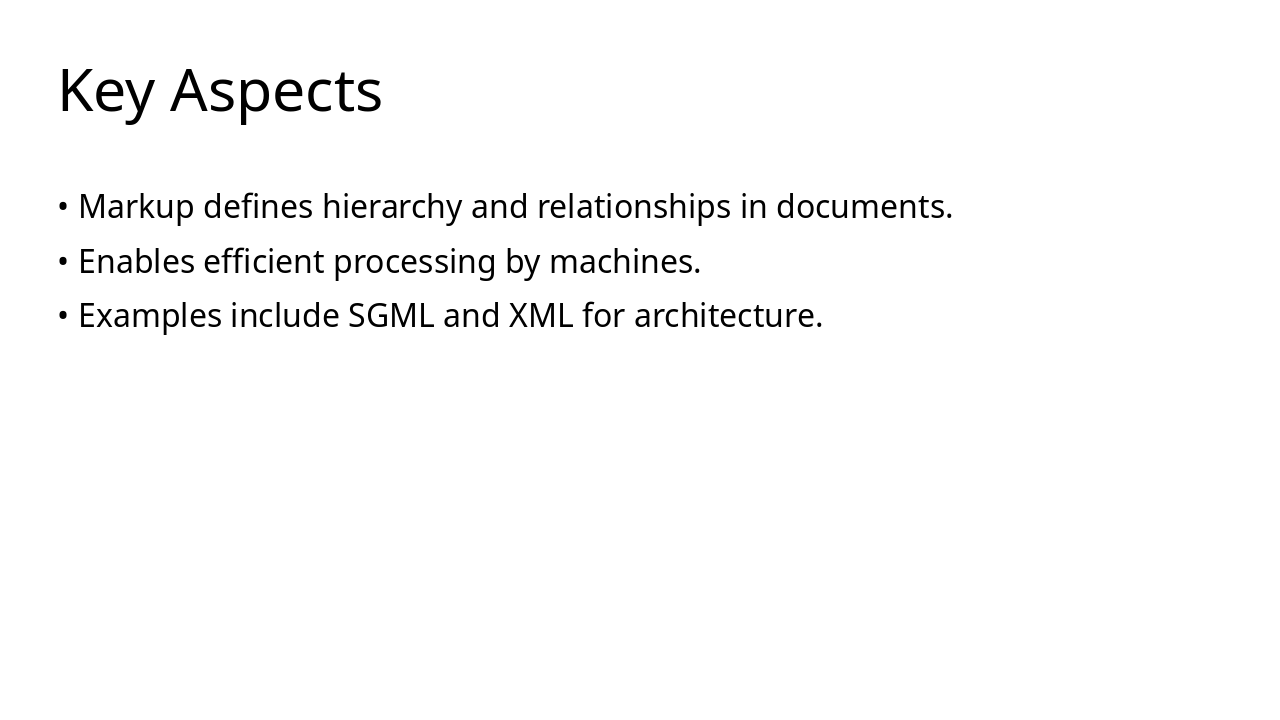
Slide 7 - Key Aspects

Markup defines the hierarchy and relationships within documents, enabling efficient processing by machines. Examples of this architecture include SGML and XML.

Key Aspects

  • Markup defines hierarchy and relationships in documents.
  • Enables efficient processing by machines.
  • Examples include SGML and XML for architecture.
Slide 7
Slide 8 of 13

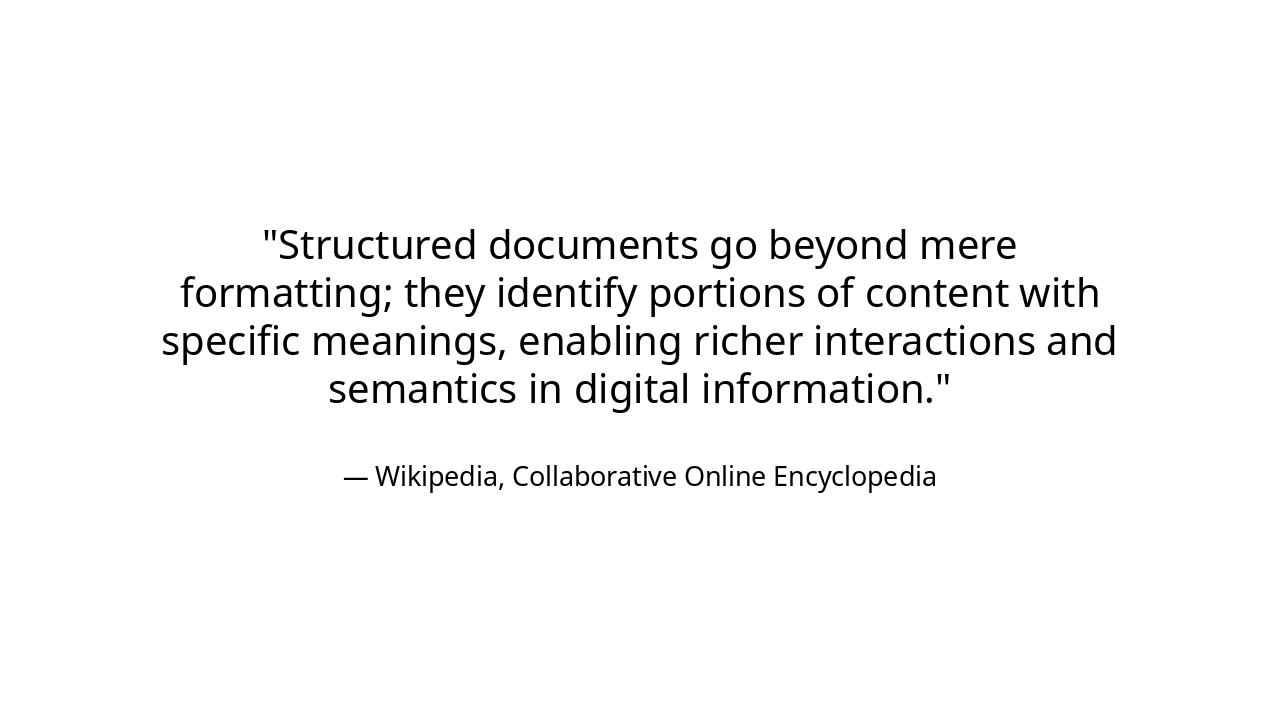
Slide 8 - On Structure

The slide, titled "On Structure," features a quote from Wikipedia defining structured documents as more than just formatted text, emphasizing their role in tagging content sections with distinct meanings. This approach enhances interactions and adds deeper semantics to digital information.

On Structure

> Structured documents go beyond mere formatting; they identify portions of content with specific meanings, enabling richer interactions and semantics in digital information.

— Wikipedia, Collaborative Online Encyclopedia

Slide 8
Slide 9 of 13

Slide 9 - Other Semantics

The slide titled "Other Semantics" serves as a section header in the presentation. It features a subtitle that introduces an exploration of semantics extending past the fundamental structural elements.

Other Semantics

Other Semantics

Delving into semantics beyond the basic structure

Slide 9
Slide 10 of 13

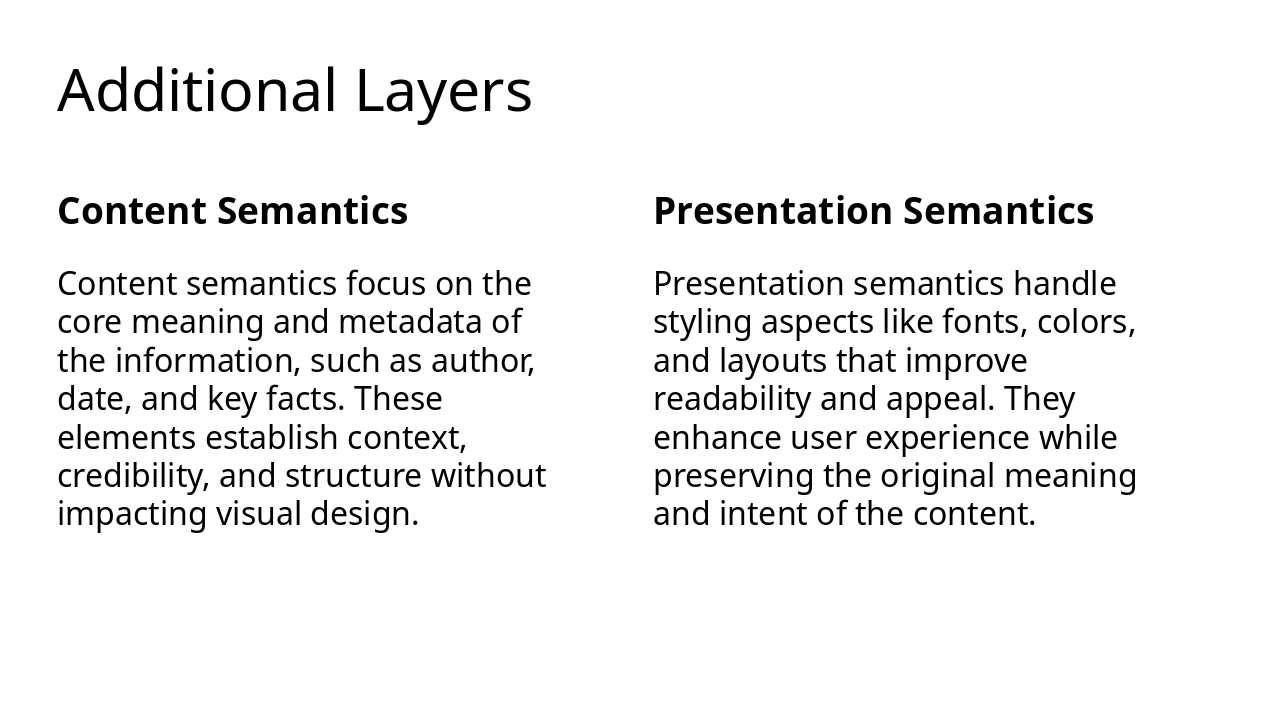
Slide 10 - Additional Layers

The slide "Additional Layers" divides its content into two columns: the left discusses content semantics, which emphasize the core meaning and metadata like author, date, and key facts to provide context, credibility, and structure without affecting visual design. The right column covers presentation semantics, focusing on styling elements such as fonts, colors, and layouts that boost readability and appeal while maintaining the content's original meaning and intent.

Additional Layers

Content SemanticsPresentation Semantics
Content semantics focus on the core meaning and metadata of the information, such as author, date, and key facts. These elements establish context, credibility, and structure without impacting visual design.Presentation semantics handle styling aspects like fonts, colors, and layouts that improve readability and appeal. They enhance user experience while preserving the original meaning and intent of the content.
Slide 10
Slide 11 of 13

Slide 11 - Context and Intent

This slide serves as a section header titled "Context and Intent," introducing the exploration of perspectives within the document. Its subtitle highlights a focus on user and system viewpoints to provide foundational understanding.

Context and Intent

Context and Intent

Exploring user and system perspectives in this document.

Source: Presentation about this document

Slide 11
Slide 12 of 13

Slide 12 - Importance

This slide emphasizes the importance of markup in documents by providing essential context for their usage and clearly conveying the author's intent. It also highlights how markup enhances interoperability and enables efficient content reuse across different systems.

Importance

  • Provides context for document usage
  • Conveys author's intent through markup
  • Enhances interoperability and content reuse
Slide 12
Slide 13 of 13

Slide 13 - Key Takeaways

Structured documents enhance usability and automation by adding semantic depth. The slide encourages exploring XML and SGML for practical applications while urging adoption of structured markup today.

Key Takeaways

Structured documents add semantic depth for better usability and automation. Explore XML and SGML for practical applications.

Embrace structured markup today.

Source: Presentation on Structured Documents

Slide 13
Powered by AI

Create Your Own Presentation

Generate professional presentations in seconds with Karaf's AI. Customize this presentation or start from scratch.

Create New Presentation

Powered by Karaf.ai — AI-Powered Presentation Generator