Theory of Computation: A Modern Perspective

Generated from prompt:

Improve and redesign the uploaded PPT on Theory of Computation (TOC). Make it visually engaging with modern design, concise bullet points, diagrams, and examples. Sections: Regular Expressions & FA problems, Closure Properties of Regular Languages (all types with examples), Closure Properties of CFL, CFG structure with example, Pushdown Automata (model + components + tuple), DPDA vs NPDA comparison, Types of Turing Machines (multi-tape, multi-head, 2D, etc.), Turing Machine examples (adder, palindrome, a^n b^n c^n, 1's complement). Add diagrams, icons, color theme, and summary slides.

This presentation offers a clear, engaging redesign of core Theoretical Computer Science concepts, covering regular languages and finite automata, closure properties of regular and context-free languages, context-free grammars and pushdown automata (

April 23, 202613 slides
Slide 1 of 13

Slide 1 - Theory of Computation: A Modern Perspective

Theory of Computation: A Modern Perspective

Redesigning Theoretical Computer Science Concepts for Clarity and Engagement

---

Photo by Egor Komarov on Unsplash
Slide 1 - Theory of Computation: A Modern Perspective
Slide 2 of 13

Slide 2 - Presentation Agenda

  • Regular Languages & Finite Automata
  • Closure Properties of Regular & Context-Free Languages
  • CFG & Pushdown Automata (PDA)
  • DPDA vs. NPDA Comparison
  • Turing Machines: Types & Advanced Examples
  • Summary & Key Takeaways

---

Photo by Ellephant on Unsplash

Slide 2 - Presentation Agenda
Slide 3 of 13

Slide 3 - Section 1: Regular Languages

1

Regular Languages & Finite Automata

Foundations of Computation: REs and FA Problems

---

Photo by Dave Meckler on Unsplash
Slide 3 - Section 1: Regular Languages
Slide 4 of 13

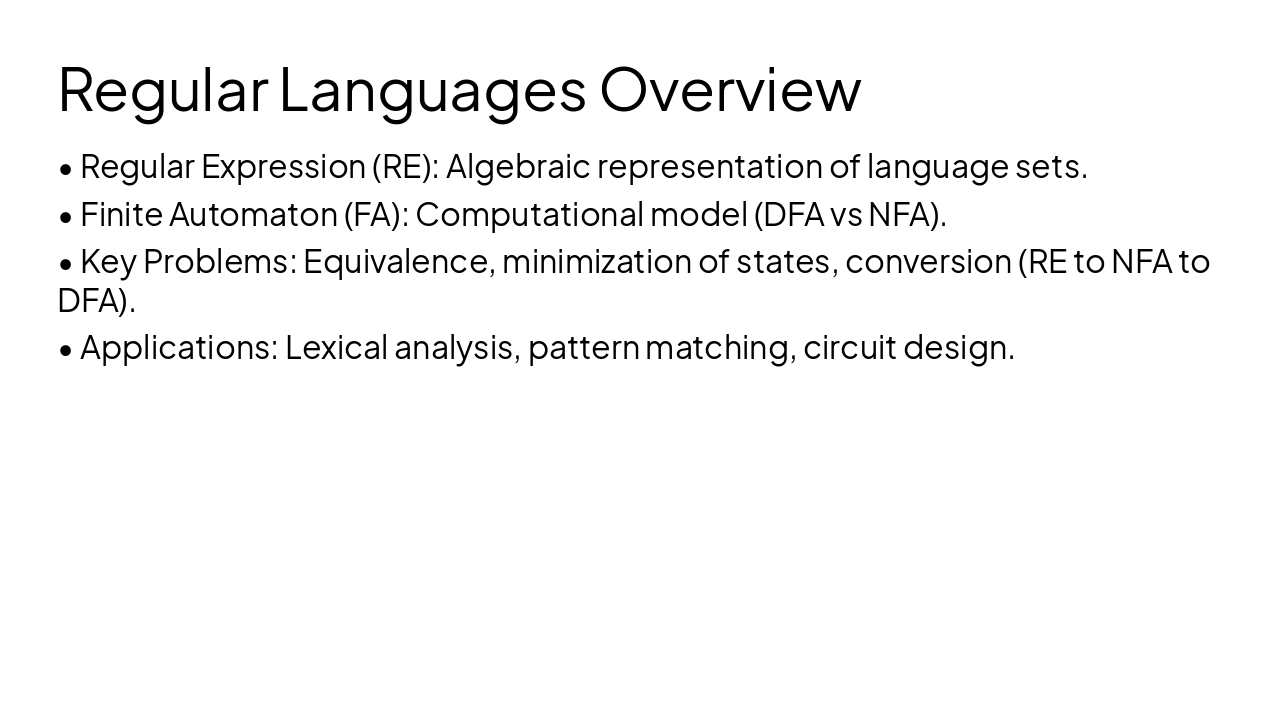
Slide 4 - Regular Languages Overview

  • Regular Expression (RE): Algebraic representation of language sets.
  • Finite Automaton (FA): Computational model (DFA vs NFA).
  • Key Problems: Equivalence, minimization of states, conversion (RE to NFA to DFA).
  • Applications: Lexical analysis, pattern matching, circuit design.
Slide 4 - Regular Languages Overview
Slide 5 of 13

Slide 5 - Section 2: Closure Properties

2

Closure Properties

Regular Languages and Context-Free Languages (CFL)

---

Photo by Shubham Dhage on Unsplash
Slide 5 - Section 2: Closure Properties
Slide 6 of 13

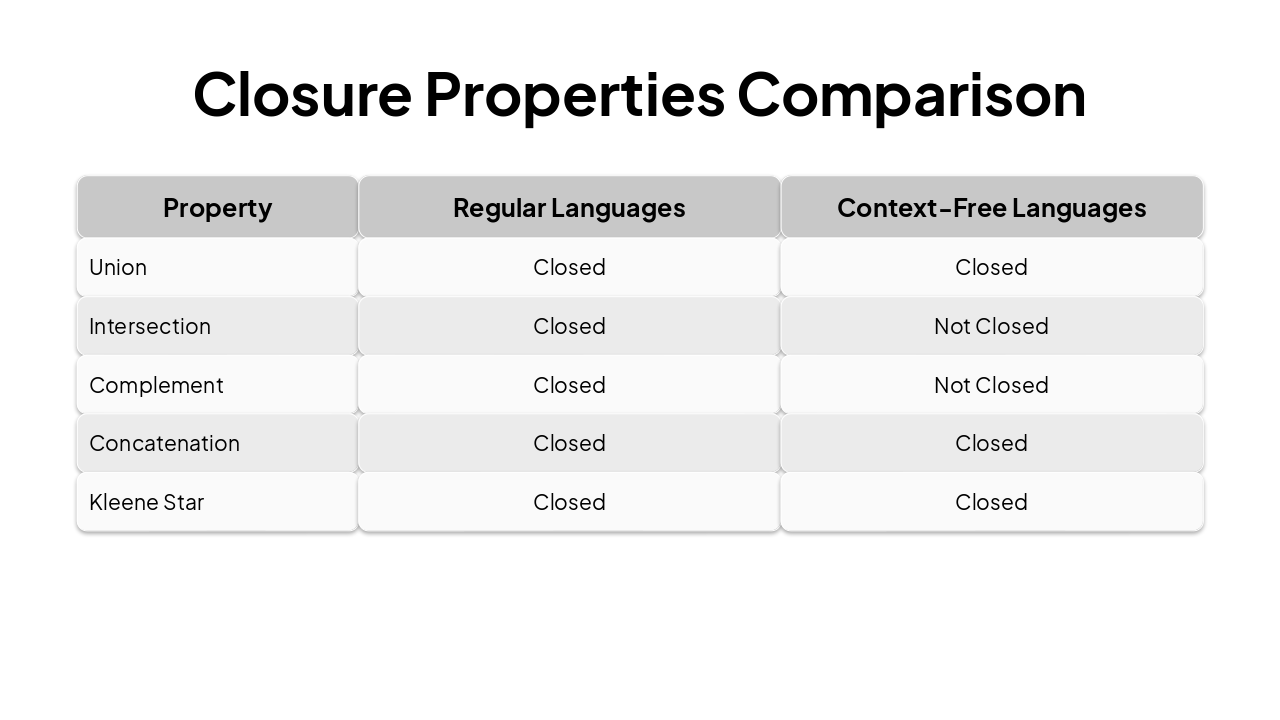
Slide 6 - Closure Properties Comparison

PropertyRegular LanguagesContext-Free Languages
UnionClosedClosed
IntersectionClosedNot Closed
ComplementClosedNot Closed
ConcatenationClosedClosed
Kleene StarClosedClosed
Slide 6 - Closure Properties Comparison
Slide 7 of 13

Slide 7 - Section 3: CFG and PDA

3

CFG & Pushdown Automata

Structure and Model for Context-Free Grammars

---

Photo by Marek Studzinski on Unsplash
Slide 7 - Section 3: CFG and PDA
Slide 8 of 13

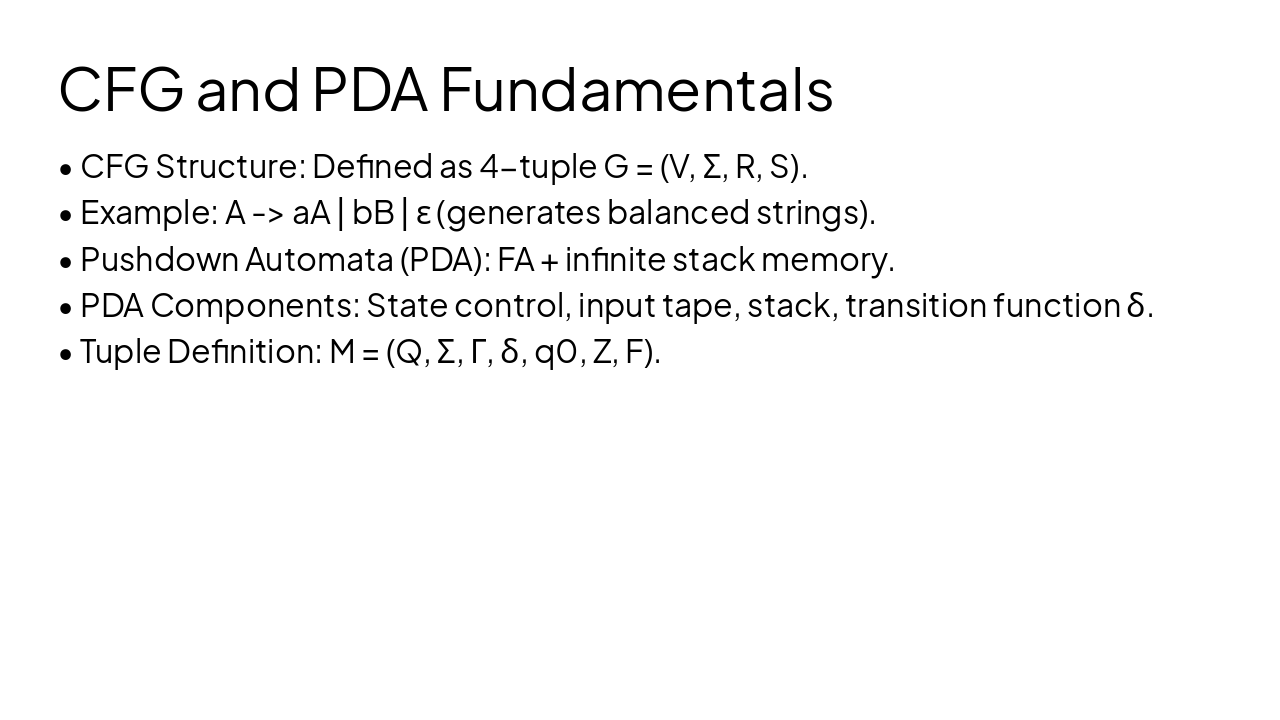
Slide 8 - CFG and PDA Fundamentals

  • CFG Structure: Defined as 4-tuple G = (V, Σ, R, S).
  • Example: A -> aA | bB | ε (generates balanced strings).
  • Pushdown Automata (PDA): FA + infinite stack memory.
  • PDA Components: State control, input tape, stack, transition function δ.
  • Tuple Definition: M = (Q, Σ, Γ, δ, q0, Z, F).
Slide 8 - CFG and PDA Fundamentals
Slide 9 of 13

Slide 9 - DPDA vs. NPDA Comparison

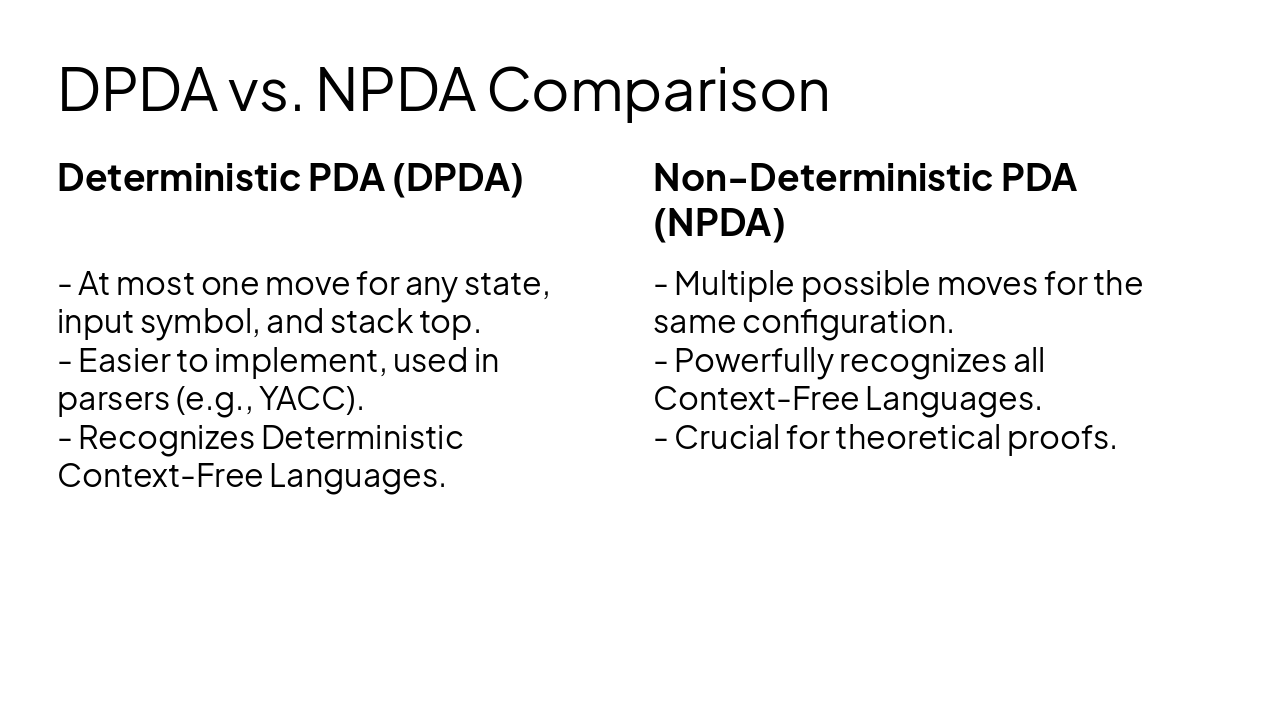
Deterministic PDA (DPDA)

  • At most one move for any state, input symbol, and stack top.
  • Easier to implement, used in parsers (e.g., YACC).
  • Recognizes Deterministic Context-Free Languages.

Non-Deterministic PDA (NPDA)

  • Multiple possible moves for the same configuration.
  • Powerfully recognizes all Context-Free Languages.
  • Crucial for theoretical proofs.
Slide 9 - DPDA vs. NPDA Comparison
Slide 10 of 13

Slide 10 - Section 4: Turing Machines

4

Turing Machines (TM)

Exploring Advanced Automata and Examples

---

Photo by Darko Trajkovic on Unsplash
Slide 10 - Section 4: Turing Machines
Slide 11 of 13

Slide 11 - Types of Turing Machines

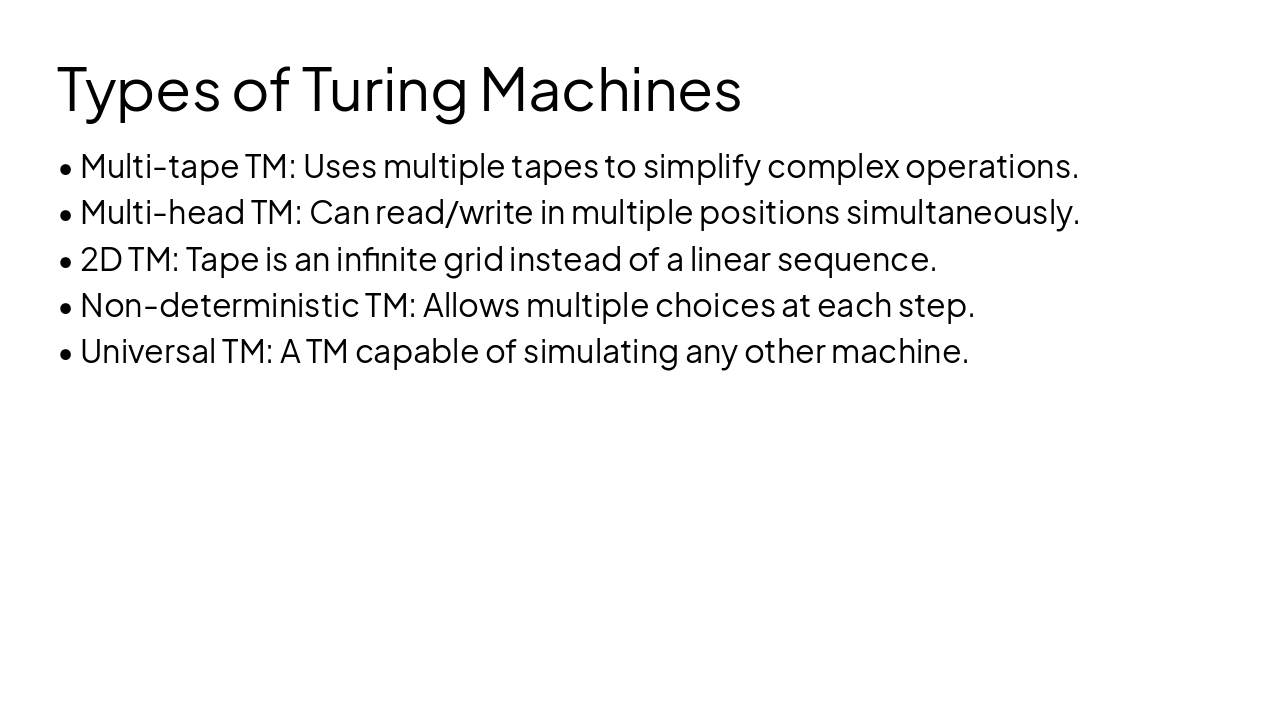
  • Multi-tape TM: Uses multiple tapes to simplify complex operations.
  • Multi-head TM: Can read/write in multiple positions simultaneously.
  • 2D TM: Tape is an infinite grid instead of a linear sequence.
  • Non-deterministic TM: Allows multiple choices at each step.
  • Universal TM: A TM capable of simulating any other machine.
Slide 11 - Types of Turing Machines
Slide 12 of 13

Slide 12 - Common Turing Machine Examples

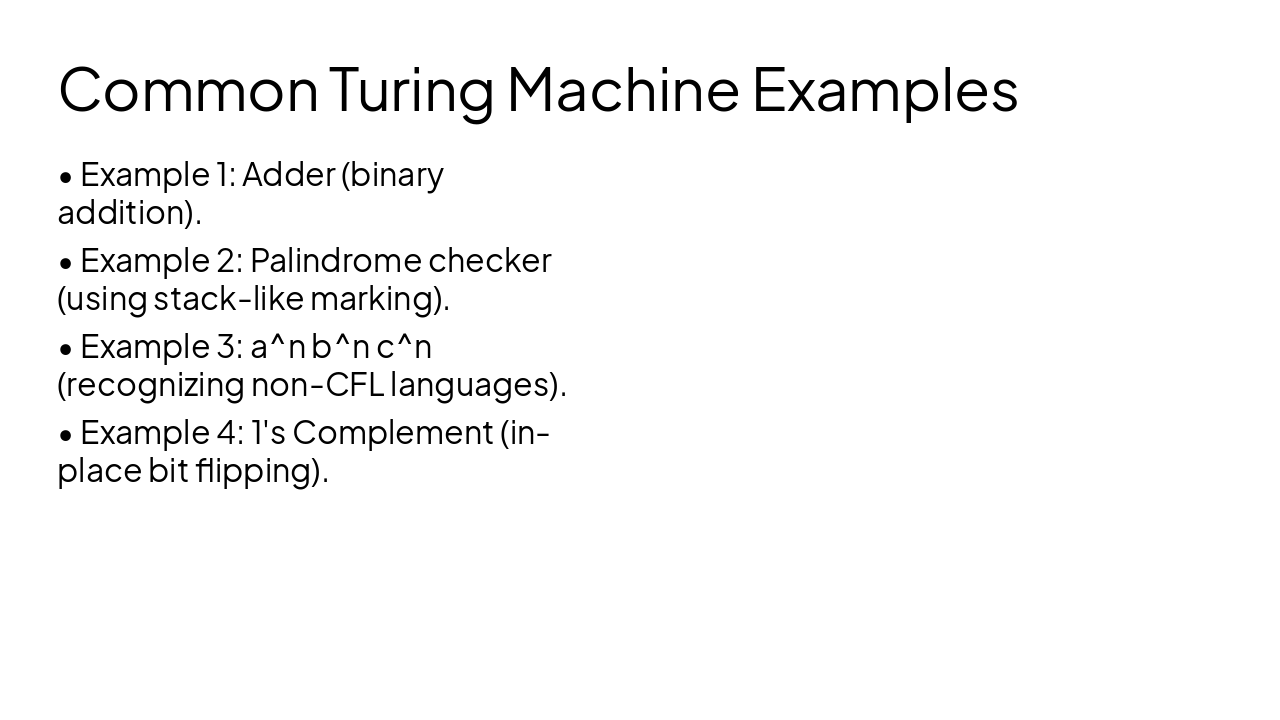
  • Example 1: Adder (binary addition).
  • Example 2: Palindrome checker (using stack-like marking).
  • Example 3: a^n b^n c^n (recognizing non-CFL languages).
  • Example 4: 1's Complement (in-place bit flipping).
Slide 12 - Common Turing Machine Examples
Slide 13 of 13

Slide 13 - Summary & Key Takeaways

Understanding computation models from FAs to Turing Machines unlocks the core of Computer Science.

Final Thoughts on Automata Theory
Slide 13 - Summary & Key Takeaways

Discover More Presentations

Explore thousands of AI-generated presentations for inspiration

Browse Presentations
Powered by AI

Create Your Own Presentation

Generate professional presentations in seconds with Karaf's AI. Customize this presentation or start from scratch.

Create New Presentation

Powered by Karaf.ai — AI-Powered Presentation Generator