Class B Cement Spill Investigation - OXAGON

Generated from prompt:

Create a detailed PowerPoint presentation titled 'Environmental Incident Investigation – Chemical Spill (Class B) | OXAGON Coast Guard Facilities'. Use the NEOM corporate color scheme (blue, grey, white) and a clean, professional layout. Include descriptive explanations and structured text for each slide. Add relevant visuals such as icons and placeholders for photos. **Slide 1: Title Slide** - Title: NEOM Environmental Incident Investigation Report - Subtitle: Class B – Chemical (Cement) Spill - Project: OXAGON Coast Guard Facilities | Contractor: Al Fahad Company Trading Industries & Contracting - Date: December 2025 - Prepared by: Environmental Department **Slide 2: Project and Incident Overview** - Project Name: Construction of OXAGON Coast Guard Facilities - Contractor: Al Fahad Company Trading Industries & Contracting - Environment Manager: Gupta Prasad | Project Manager: Ayham El Ghol - Incident Date: 09 December 2025 | Time: 12:01 AM - Location: Laydown Area near Cement Storage (GPS: N 27°34'10.4", E 35°32'23.6") - Notification: Submitted to NEOM Environment on 10-Dec-2025 at 2:40 PM **Slide 3: Incident Summary** - During a routine PMT inspection, a chemical spill (cement) was discovered in the laydown area near the site office. - The incident involved torn cement bags leading to spillage on soil, raising potential contamination concerns. - Immediate containment was executed by the Environmental Engineer and Emergency Response Team (ERT). - The area was cordoned off and covered to prevent dust and further spread. - No injuries, fauna, or flora impact reported. **Slide 4: Visual Evidence of Incident** - Include images showing: (1) spilled cement bags, (2) cleanup in progress, (3) containment area post-action. - Add captions under each image describing what it shows. **Slide 5: Classification of Incident** - Category: Chemical Spill on Land (EI3) - Risk Level: Class B (Moderate impact, controllable, no permanent damage) - Reporting Compliance: In line with NEOM-EV-PRC-013 **Slide 6: Root Cause Analysis (RCAT Findings)** - **Root Cause 1:** Inadequate Storage Controls – Cement bags stored without proper containment or weather protection. - **Root Cause 2:** Insufficient Inspection and Monitoring – Lack of routine supervision to identify early deterioration of packaging. - **Root Cause 3:** Lack of Job Knowledge – Workers unaware of proper handling and response procedures. **Slide 7: Contributory Factors** - Lack of Secondary Containment or Engineering Controls. - Inadequate Preventive Monitoring and Inspection. - Improper Storage and Housekeeping practices. - No structured spill prevention awareness before the incident. **Slide 8: Immediate Corrective Actions** - Environmental Engineer and ERT secured and contained the spill area. - Damaged and spilled material removed; contaminated soil collected for safe disposal. - Affected area cleaned and re-covered with plastic sheeting. - Toolbox talks conducted for all laydown workers and supervisors. - Spill pallets and secondary containment provided for storage materials. **Slide 9: Preventive and Long-Term Actions** - Daily inspections and supervision of laydown and storage areas. - Limit on-site material storage to immediate requirements. - Regular employee training on chemical handling and spill response (scheduled for 22-Dec-2025). - Introduce routine environmental monitoring and housekeeping audits. - Strengthen site-specific environmental emergency response planning. **Slide 10: Supporting Documentation & Evidence** - Photos of the incident and cleanup. - Root Cause Analysis Form (RCAT). - Toolbox Talk photos and attendance sheet. - Witness statements and training schedule. **Slide 11: Conclusion & Lessons Learned** - The Class B chemical spill was effectively contained and mitigated without environmental or safety escalation. - Corrective and preventive measures were implemented promptly. - Continuous supervision, improved containment infrastructure, and employee awareness will significantly reduce recurrence risk. - Reinforces NEOM’s commitment to environmental compliance and sustainability excellence.

Report on NEOM's Class B cement spill at OXAGON Coast Guard site: details incident discovery, root causes (poor storage/inspection), containment actions, preventive measures, and lessons for environme

December 13, 202511 slides
Slide 1 of 11

Slide 1 - NEOM Environmental Incident Investigation Report

This title slide introduces the "NEOM Environmental Incident Investigation Report" for a Class B Chemical (Cement) Spill. It details the OXAGON Coast Guard Facilities project by contractor Al Fahad Company Trading Industries & Contracting, dated December 2025, and prepared by the Environmental Department.

NEOM Environmental Incident Investigation Report

Class B – Chemical (Cement) Spill Project: OXAGON Coast Guard Facilities | Contractor: Al Fahad Company Trading Industries & Contracting Date: December 2025 Prepared by: Environmental Department
Slide 1 - NEOM Environmental Incident Investigation Report
Slide 2 of 11

Slide 2 - Project and Incident Overview

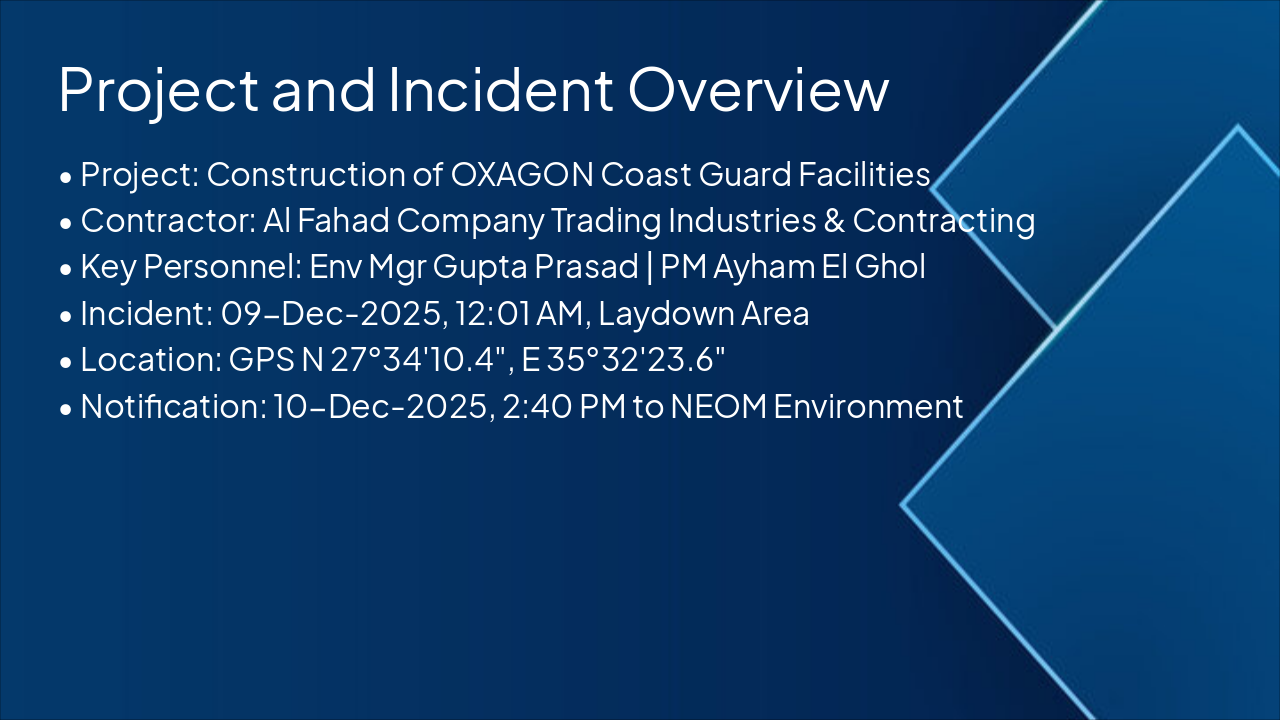
The slide provides an overview of the OXAGON Coast Guard Facilities construction project by Al Fahad Company, highlighting key personnel Env Mgr Gupta Prasad and PM Ayham El Ghol. It details an incident on 09-Dec-2025 at 12:01 AM in the Laydown Area (GPS N 27°34'10.4", E 35°32'23.6"), notified to NEOM Environment on 10-Dec-2025 at 2:40 PM.

Project and Incident Overview

  • Project: Construction of OXAGON Coast Guard Facilities
  • Contractor: Al Fahad Company Trading Industries & Contracting
  • Key Personnel: Env Mgr Gupta Prasad | PM Ayham El Ghol
  • Incident: 09-Dec-2025, 12:01 AM, Laydown Area
  • Location: GPS N 27°34'10.4", E 35°32'23.6"
  • Notification: 10-Dec-2025, 2:40 PM to NEOM Environment
Slide 2 - Project and Incident Overview
Slide 3 of 11

Slide 3 - Incident Summary

A routine PMT inspection discovered torn cement bags spilling onto the soil. The Environmental Engineer and ERT immediately contained the area by cordoning it off and covering it, with no injuries or ecological impacts reported.

Incident Summary

  • Routine PMT inspection found torn cement bags spilling on soil.
  • Immediate containment executed by Env Engineer & ERT.
  • Area cordoned off and covered to prevent spread.
  • No injuries or ecological impacts reported.
Slide 3 - Incident Summary
Slide 4 of 11

Slide 4 - Visual Evidence of Incident

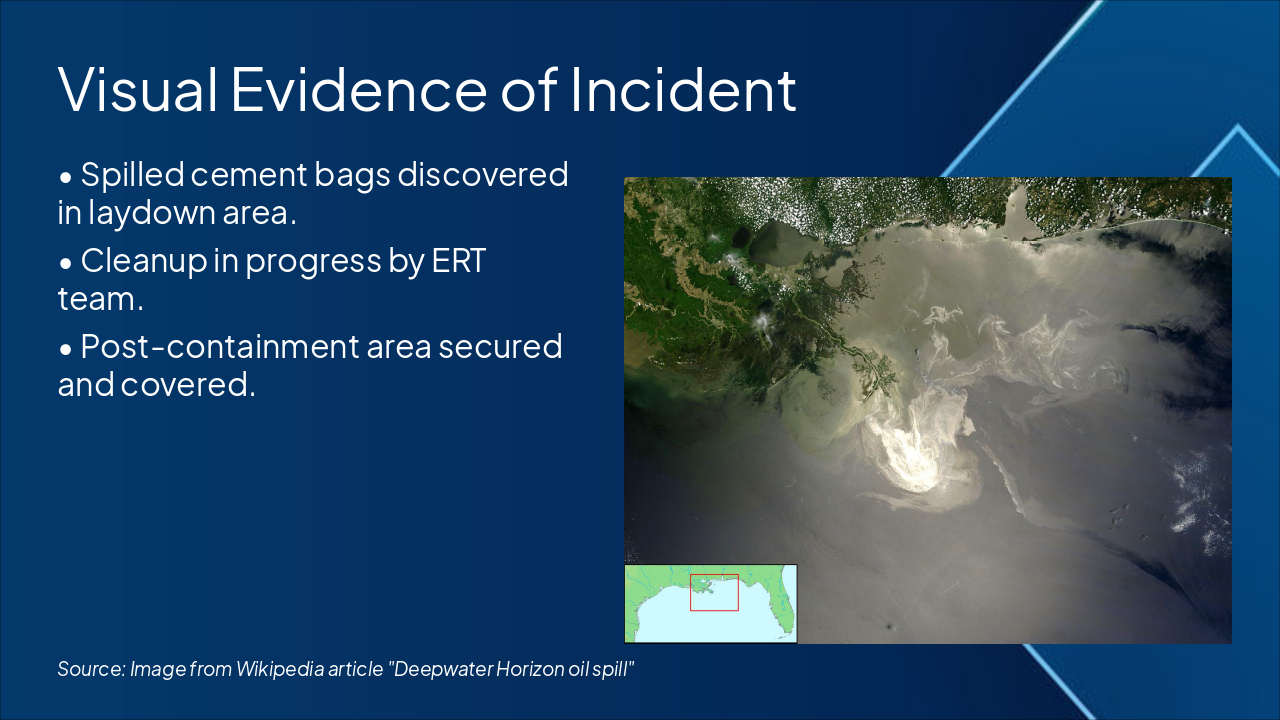
The slide provides visual evidence of spilled cement bags discovered in the laydown area. It shows cleanup in progress by the ERT team, with the post-containment area secured and covered.

Visual Evidence of Incident

!Image

  • Spilled cement bags discovered in laydown area.
  • Cleanup in progress by ERT team.
  • Post-containment area secured and covered.

Source: Image from Wikipedia article "Deepwater Horizon oil spill"

Slide 4 - Visual Evidence of Incident
Slide 5 of 11

Slide 5 - Classification of Incident

The slide classifies the incident as a Chemical Spill on Land (EI3) with a Class B risk level, meaning moderate, controllable impact with no permanent damage. It confirms full compliance with NEOM-EV-PRC-013 guidelines.

Classification of Incident

  • Category: Chemical Spill on Land (EI3)
  • Risk Level: Class B (moderate, controllable, no permanent damage)
  • Fully compliant with NEOM-EV-PRC-013 guidelines
Slide 5 - Classification of Incident
Slide 6 of 11

Slide 6 - Root Cause Analysis (RCAT Findings)

The Root Cause Analysis (RCAT Findings) slide outlines three key issues. It cites inadequate storage controls without containment or weather protection, insufficient inspection of packaging deterioration, and lack of job knowledge on handling procedures.

Root Cause Analysis (RCAT Findings)

  • Inadequate storage controls: no containment or weather protection.
  • Insufficient inspection and monitoring of packaging deterioration.
  • Lack of job knowledge on handling and response procedures.
Slide 6 - Root Cause Analysis (RCAT Findings)
Slide 7 of 11

Slide 7 - Contributory Factors

The "Contributory Factors" slide outlines key issues leading to an incident. It lists lack of secondary containment or engineering controls, inadequate monitoring and inspections, improper storage and housekeeping, and no prior spill prevention training.

Contributory Factors

  • Lack of secondary containment or engineering controls.
  • Inadequate preventive monitoring and inspections.
  • Improper storage and housekeeping practices.
  • No prior spill prevention awareness training.

Source: Environmental Incident Investigation Report

Speaker Notes
Highlight how these factors exacerbated the root causes; emphasize preventive measures.
Slide 7 - Contributory Factors
Slide 8 of 11

Slide 8 - Immediate Corrective Actions

The ERT and Environmental Engineer secured the spill area, removed damaged materials and contaminated soil for disposal, and cleaned and covered the affected site. Toolbox talks were held for workers and supervisors, and spill pallets with secondary containment were provided for storage materials.

Immediate Corrective Actions

  • ERT and Environmental Engineer secured and contained the spill area.
  • Removed damaged material and contaminated soil for safe disposal.
  • Cleaned affected area and covered with plastic sheeting.
  • Conducted toolbox talks for laydown workers and supervisors.
  • Provided spill pallets and secondary containment for storage materials.

Source: Environmental Incident Investigation – Chemical Spill (Class B)

Speaker Notes
Emphasize the rapid response by ERT and Environmental Engineer to contain and mitigate the spill effectively.
Slide 8 - Immediate Corrective Actions
Slide 9 of 11

Slide 9 - Preventive and Long-Term Actions

The slide lists preventive actions like daily inspections of laydown and storage areas and limiting on-site storage to immediate needs. It also covers long-term measures, including chemical handling training on 22-Dec-2025, routine environmental audits, and enhanced site-specific emergency response planning.

Preventive and Long-Term Actions

  • Conduct daily inspections of laydown and storage areas.
  • Limit on-site storage to immediate requirements only.
  • Deliver training on chemical handling (22-Dec-2025).
  • Implement routine environmental audits and monitoring.
  • Enhance site-specific emergency response planning.
Slide 9 - Preventive and Long-Term Actions
Slide 10 of 11

Slide 10 - Supporting Documentation & Evidence

The "Supporting Documentation & Evidence" slide features a grid of five key items: incident photos capturing spills and cleanup, RCAT forms with root cause findings, toolbox talks records, witness statements, and training schedules. Each is represented by an icon and brief description to highlight visual and procedural evidence for incident management.

Supporting Documentation & Evidence

{ "features": [ { "icon": "📸", "heading": "Incident Photos", "description": "Visual evidence capturing spill discovery and cleanup process." }, { "icon": "📋", "heading": "RCAT Form", "description": "Root Cause Analysis Tool form with detailed findings." }, { "icon": "👥", "heading": "Toolbox Talks", "description": "Photos and attendance records from safety awareness sessions." }, { "icon": "✍️", "heading": "Witness Statements", "description": "Signed declarations from personnel involved in the incident." }, { "icon": "📅", "heading": "Training Schedule", "description": "Upcoming sessions on chemical handling and spill response." } ] }

Slide 10 - Supporting Documentation & Evidence
Slide 11 of 11

Slide 11 - Conclusion & Lessons Learned

The spill was contained without escalation via prompt corrective actions. Ongoing supervision, infrastructure, and training reduce risks, upholding NEOM's environmental commitment through proactive sustainability excellence.

Conclusion & Lessons Learned

• Spill contained without escalation.

  • Prompt corrective actions implemented.
  • Ongoing supervision, infrastructure, & training reduce risks.
  • Upholds NEOM's environmental commitment.

Lessons Learned: Proactive Excellence in Sustainability

Source: Environmental Incident Investigation – Chemical Spill (Class B) | OXAGON Coast Guard Facilities

Speaker Notes
Closing message: 'Spill contained successfully.' (3 words) Call-to-action: 'Commit to supervision, training, and infrastructure improvements.' (6 words) Key points: Emphasize swift response prevented escalation. Highlight ongoing measures reduce risks. Reinforce NEOM's environmental leadership. Use blue/grey/white scheme with icons for checkmarks or eco symbols.
Slide 11 - Conclusion & Lessons Learned

Discover More Presentations

Explore thousands of AI-generated presentations for inspiration

Browse Presentations
Powered by AI

Create Your Own Presentation

Generate professional presentations in seconds with Karaf's AI. Customize this presentation or start from scratch.

Create New Presentation

Powered by Karaf.ai — AI-Powered Presentation Generator