Why LC-MS? Intro for Liquid Analysts

Generated from prompt:

Lecture 1 – Why LC–MS? Basic MS concepts for liquid people. 24-slide academic lecture covering introductory LC–MS concepts. Style: clean white background, dark text, 16:9 widescreen. Include speaker notes where specified in outline. Slide list: 1. Introduction to LC–Mass Spectrometry 2. Learning Outcomes 3. Where LC–MS Fits in the Analytical World 4. Real-World Motivation 5. What Does a Mass Spectrometer Measure? 6. From Molecule to Ion 7. Notation for Ions in LC–MS 8. What is a Mass Spectrum? 9. Basic Instrument Block Diagram 10. A Timeline of Events Inside the Instrument 11. Mass vs m/z vs Charge 12. Isotopes: Why We Don’t Get a Single Perfect Peak 13. Resolution and Mass Accuracy (Concept Only) 14. Why Do We Need Chromatography Before MS? 15. Chromatogram vs Spectrum 16. TIC and EIC Explained 17. LC–MS vs LC–UV 18. LC–MS vs GC–MS vs MALDI–MS 19. Typical LC–MS Workflows 20. LC–MS Strengths 21. LC–MS Limitations and Pain Points 22. Minimal Background You Need for Rest of the Course 23. Quick Concept Check / Discussion 24. Looking Ahead.

This 24-slide lecture introduces LC-MS fundamentals for beginners, covering ion basics, spectra, chromatography integration, workflows, strengths, limitations, and real-world applications like drug di

November 30, 202524 slides
Slide 1 of 24

Slide 1 - Introduction to LC–Mass Spectrometry

The slide titled "Introduction to LC–Mass Spectrometry" serves as an introductory overview of this analytical technique. It highlights LC–Mass Spectrometry as a powerful method that integrates liquid chromatography for separation with mass spectrometry for detection, ideal for analyzing complex samples.

Introduction to LC–Mass Spectrometry

Powerful Technique Combining Separation and Detection for Complex Samples

Source: Lecture 1: Why LC-MS? Basic MS Concepts

Speaker Notes
Greet the audience and outline the goals of the lecture: introducing LC-MS as a powerful technique and covering basic concepts.
Slide 1 - Introduction to LC–Mass Spectrometry
Slide 2 of 24

Slide 2 - Learning Outcomes

The slide outlines key learning outcomes for mass spectrometry and LC-MS, focusing on understanding its basic principles and explaining the role of LC-MS in analytical processes. It also covers identifying major components of LC-MS systems and describing typical workflows involved.

Learning Outcomes

  • Understand basic principles of mass spectrometry
  • Explain the role of LC-MS in analysis
  • Identify key components of LC-MS systems
  • Describe typical LC-MS workflows

Source: Lecture 1 – Why LC–MS? Basic MS concepts for liquid people.

Slide 2 - Learning Outcomes
Slide 3 of 24

Slide 3 - Where LC–MS Fits in the Analytical World

LC–MS bridges liquid chromatography and mass spectrometry to enable the separation and identification of complex mixtures, making it ideal for trace-level analyte detection. It plays a critical role in pharmaceutical quality and impurity analysis, environmental pollutant monitoring, and food safety contaminant screening.

Where LC–MS Fits in the Analytical World

  • Bridges liquid chromatography and mass spectrometry techniques
  • Enables separation and identification of complex mixtures
  • Ideal for trace-level analyte detection in samples
  • Essential in pharmaceutical quality and impurity analysis
  • Critical for environmental pollutant monitoring
  • Key tool in food safety and contaminant screening
Slide 3 - Where LC–MS Fits in the Analytical World
Slide 4 of 24

Slide 4 - Real-World Motivation

The slide, titled "Real-World Motivation," features an image alongside three key applications of the topic. These include drug discovery in pharmaceuticals, pesticide detection in water samples, and protein analysis in biotechnology.

Real-World Motivation

!Image

  • Drug discovery in pharmaceuticals
  • Pesticide detection in water samples
  • Protein analysis in biotechnology

Source: Mass spectrometry applications

Speaker Notes
Share a quick case study to hook interest.
Slide 4 - Real-World Motivation
Slide 5 of 24

Slide 5 - What Does a Mass Spectrometer Measure?

A mass spectrometer measures the mass-to-charge ratio (m/z) of ions, allowing it to determine the molecular weight of intact ions. It also reveals molecular structure through ion fragmentation, enabling the identification and quantification of compounds.

What Does a Mass Spectrometer Measure?

  • Measures mass-to-charge ratio (m/z) of ions
  • Provides molecular weight from intact ions
  • Reveals molecular structure via ion fragmentation
  • Enables compound identification and quantification
Slide 5 - What Does a Mass Spectrometer Measure?
Slide 6 of 24

Slide 6 - From Molecule to Ion

Neutral molecules from the LC eluent enter the ion source and are ionized through methods like ESI or APCI, forming gas-phase ions without destroying the analytes. These ions are then prepared for mass-to-charge separation and detection in the mass spectrometer.

From Molecule to Ion

  • Neutral molecules in LC eluent enter ion source
  • Ionized via ESI or APCI to form gas-phase ions
  • Process transfers analytes without molecular destruction
  • Ions ready for mass-to-charge separation and detection
Slide 6 - From Molecule to Ion
Slide 7 of 24

Slide 7 - Notation for Ions in LC–MS

In LC-MS, protonated molecules are denoted as [M+H]⁺ in positive ionization mode, while deprotonated ones appear as [M-H]⁻ in negative mode, with common adducts like [M+Na]⁺ or [M+NH₄]⁺ forming during electrospray. For large biomolecules, multiple charge states such as [M+nH]ⁿ⁺ are used, and all notations reflect the mass-to-charge ratio (m/z) rather than the actual molecular mass.

Notation for Ions in LC–MS

  • Protonated molecules denoted as [M+H]⁺ in positive mode
  • Deprotonated molecules as [M-H]⁻ in negative ionization
  • Adducts form, e.g., [M+Na]⁺ or [M+NH₄]⁺ during electrospray
  • Multiple charge states: [M+nH]ⁿ⁺ for large biomolecules
  • m/z notation reflects mass-to-charge ratio, not molecular mass
Slide 7 - Notation for Ions in LC–MS
Slide 8 of 24

Slide 8 - What is a Mass Spectrum?

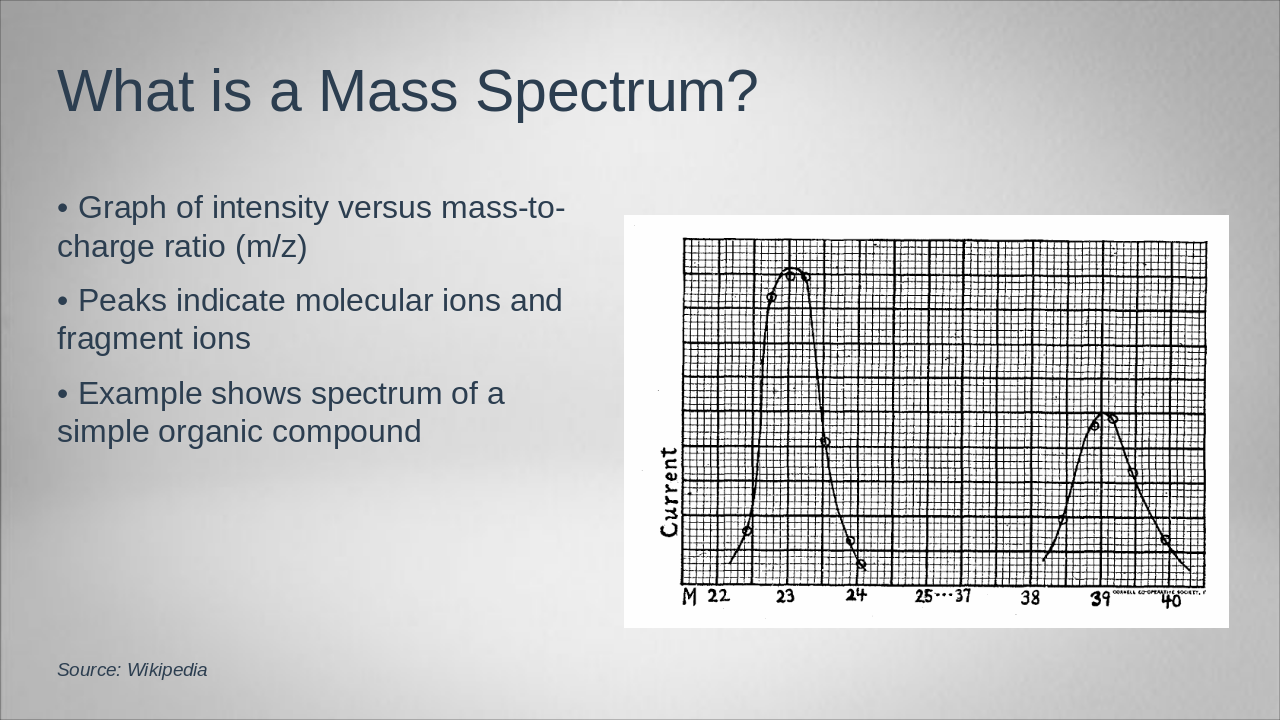
A mass spectrum is a graph plotting intensity against mass-to-charge ratio (m/z), where peaks represent molecular ions and their fragments. The slide features an example spectrum from a simple organic compound to illustrate this concept.

What is a Mass Spectrum?

!Image

  • Graph of intensity versus mass-to-charge ratio (m/z)
  • Peaks indicate molecular ions and fragment ions
  • Example shows spectrum of a simple organic compound

Source: Wikipedia

Slide 8 - What is a Mass Spectrum?
Slide 9 of 24

Slide 9 - Basic Instrument Block Diagram

The slide presents a basic block diagram of a liquid chromatography-mass spectrometry (LC-MS) instrument, illustrating the flow from sample delivery to data detection. Key components include the LC pump that delivers the sample in mobile phase, a column for separating analytes by retention, an ESI source for ionizing molecules into the gas phase, a quadrupole analyzer that filters ions by mass-to-charge ratio, and a detector that records ion signals as data.

Basic Instrument Block Diagram

!Image

  • LC Pump: Delivers sample in mobile phase
  • Column: Separates analytes by retention
  • ESI Source: Ionizes molecules into gas phase
  • Quadrupole Analyzer: Filters ions by m/z
  • Detector: Records ion signals as data

Source: Wikipedia: Liquid chromatography–mass spectrometry

Slide 9 - Basic Instrument Block Diagram
Slide 10 of 24

Slide 10 - A Timeline of Events Inside the Instrument

The timeline slide outlines the key events in a liquid chromatography-mass spectrometry (LC-MS) instrument, starting with sample injection at 0 minutes, followed by analyte separation in the LC column from 1-5 minutes. It then covers the ionization of eluting molecules around 5 minutes, mass analysis of ions by their mass-to-charge ratio at the same time, and finally detection to generate signals from 5-10 minutes.

A Timeline of Events Inside the Instrument

0 min: Sample Injection Sample mixture is injected into the liquid chromatography system to begin analysis. 1-5 min: Separation in LC Column Analytes separate based on chemical properties as they travel through the column. ~5 min: Ionization Process Eluting molecules are ionized, often by electrospray, creating gas-phase ions. ~5 min: Mass Analysis Ions are filtered by mass-to-charge ratio in the mass analyzer. ~5-10 min: Detection and Signal Ions strike detector, producing electrical signal for data acquisition.

Slide 10 - A Timeline of Events Inside the Instrument
Slide 11 of 24

Slide 11 - Mass vs m/z vs Charge

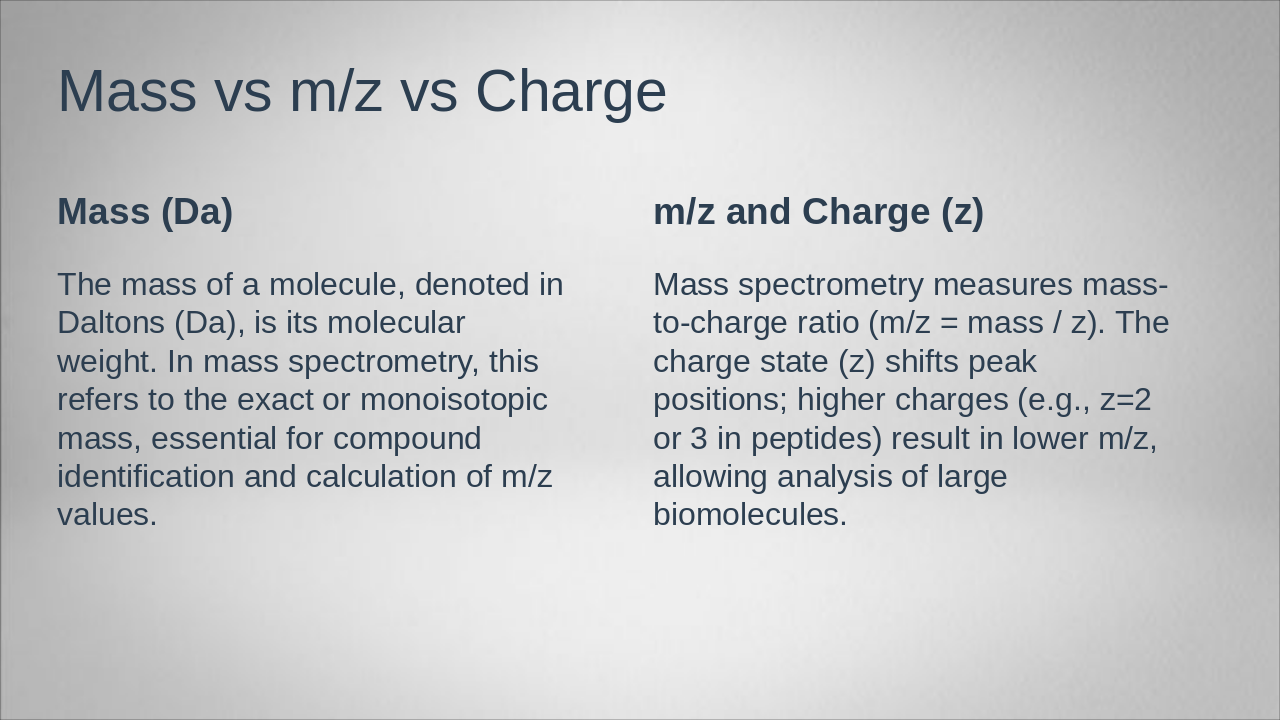
The slide explains mass in Daltons (Da) as the molecular weight of a molecule, specifically the exact or monoisotopic mass used in mass spectrometry for compound identification and m/z calculations. It also covers the mass-to-charge ratio (m/z = mass / z), where the charge state (z) affects peak positions, with higher charges like z=2 or 3 in peptides lowering m/z values to enable analysis of large biomolecules.

Mass vs m/z vs Charge

Mass (Da)m/z and Charge (z)
The mass of a molecule, denoted in Daltons (Da), is its molecular weight. In mass spectrometry, this refers to the exact or monoisotopic mass, essential for compound identification and calculation of m/z values.Mass spectrometry measures mass-to-charge ratio (m/z = mass / z). The charge state (z) shifts peak positions; higher charges (e.g., z=2 or 3 in peptides) result in lower m/z, allowing analysis of large biomolecules.
Speaker Notes
Left: Mass (Da) is molecular weight. Right: m/z = mass/charge; Charge (z) affects peak position, e.g., multiply charged peptides.
Slide 11 - Mass vs m/z vs Charge
Slide 12 of 24

Slide 12 - Isotopes: Why We Don’t Get a Single Perfect Peak

Natural elements consist of isotopes, such as C-12 and C-13, which result in clusters of peaks rather than a single perfect peak in mass spectra. These isotopic distributions broaden the signals, and the resulting peak patterns provide insights into elemental composition and molecular formulas.

Isotopes: Why We Don’t Get a Single Perfect Peak

  • Natural elements contain isotopes like C-12 and C-13
  • Isotopes produce clusters of peaks instead of single peaks
  • Isotopic distributions broaden mass spectral signals
  • Peak patterns reveal elemental composition and molecular formulas
Slide 12 - Isotopes: Why We Don’t Get a Single Perfect Peak
Slide 13 of 24

Slide 13 - Resolution and Mass Accuracy (Concept Only)

Resolution refers to a mass spectrometer's ability to distinguish closely spaced m/z peaks, such as a 10,000 FWHM resolution separating peaks about 0.2 Da apart at m/z 2000. Mass accuracy measures how closely the detected m/z value matches the true value, typically expressed in ppm, like a 5 ppm error equating to 0.01 Da at m/z 2000.

Resolution and Mass Accuracy (Concept Only)

  • Resolution: Ability to separate closely spaced m/z peaks
  • Example: 10,000 FWHM distinguishes peaks ~0.2 Da apart at m/z 2000
  • Mass Accuracy: How closely measured m/z matches true value
  • Expressed in ppm, e.g., 5 ppm error is 0.01 Da at m/z 2000
Slide 13 - Resolution and Mass Accuracy (Concept Only)
Slide 14 of 24

Slide 14 - Why Do We Need Chromatography Before MS?

Chromatography, such as LC, is essential before mass spectrometry (MS) because it separates complex mixtures into individual components, preventing MS from struggling with co-eluting compounds. This separation reduces ion suppression, enabling accurate detection and precise quantification of analytes.

Why Do We Need Chromatography Before MS?

  • LC separates complex mixtures into individual components
  • Reduces ion suppression for accurate detection
  • Enables precise quantification of analytes
  • MS alone cannot handle co-eluting compounds
Slide 14 - Why Do We Need Chromatography Before MS?
Slide 15 of 24

Slide 15 - Chromatogram vs Spectrum

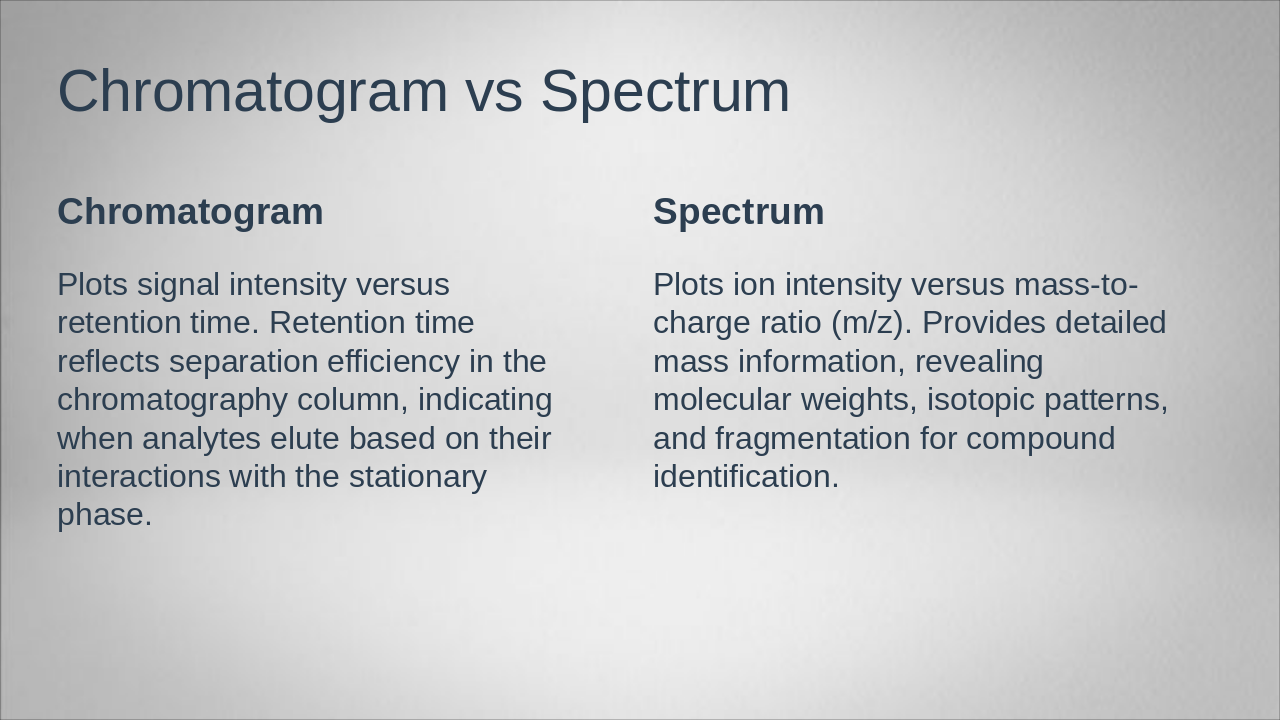
The slide contrasts chromatograms and spectra in analytical chemistry. A chromatogram plots signal intensity against retention time to show analyte separation efficiency in the chromatography column, while a spectrum plots ion intensity against mass-to-charge ratio (m/z) to reveal molecular details like weights, isotopic patterns, and fragmentation for identification.

Chromatogram vs Spectrum

ChromatogramSpectrum
Plots signal intensity versus retention time. Retention time reflects separation efficiency in the chromatography column, indicating when analytes elute based on their interactions with the stationary phase.Plots ion intensity versus mass-to-charge ratio (m/z). Provides detailed mass information, revealing molecular weights, isotopic patterns, and fragmentation for compound identification.
Slide 15 - Chromatogram vs Spectrum
Slide 16 of 24

Slide 16 - TIC and EIC Explained

The Total Ion Chromatogram (TIC) represents the sum of all ions detected over time, illustrating the overall chromatographic separation profile. In contrast, the Extracted Ion Chromatogram (EIC) focuses on specific mass-to-charge (m/z) values, allowing for targeted analysis of particular compounds.

TIC and EIC Explained

  • TIC: Total Ion Chromatogram sums all ions over time
  • TIC shows overall chromatographic separation profile
  • EIC: Extracted Ion Chromatogram for specific m/z values
  • EIC enables targeted analysis of particular compounds
Slide 16 - TIC and EIC Explained
Slide 17 of 24

Slide 17 - LC–MS vs LC–UV

LC-MS offers highly specific detection down to femtogram levels, providing detailed structural information via mass-to-charge ratios for identifying and quantifying compounds in complex mixtures. In contrast, LC-UV depends on non-specific UV absorbance with nanogram sensitivity, features more affordable equipment, but lacks mass data for structural analysis.

LC–MS vs LC–UV

LC-MSLC-UV
Highly specific detection with sensitivity down to femtogram (fg) levels. Provides detailed structural information through mass-to-charge ratios, enabling compound identification and quantification in complex mixtures.Relies on UV absorbance, which is non-specific and limited to nanogram (ng) detection levels. More affordable instrumentation, but lacks mass data for structural elucidation.
Slide 17 - LC–MS vs LC–UV
Slide 18 of 24

Slide 18 - LC–MS vs GC–MS vs MALDI–MS

LC-MS excels in analyzing polar, non-volatile liquids like pharmaceuticals and metabolites using soft ionization techniques such as ESI, offering a broader polarity range, while GC-MS is ideal for volatile, non-polar gases in environmental and petrochemical applications with high-resolution separation via hard EI ionization. In contrast to MALDI-MS, LC-MS enables online quantitative analysis of liquid mixtures in proteomics and drug studies, whereas MALDI-MS suits direct analysis of solid biomolecules like peptides and proteins, providing spatial information in tissue imaging.

LC–MS vs GC–MS vs MALDI–MS

LC-MS vs GC-MSLC-MS vs MALDI-MS
LC-MS handles polar, non-volatile liquids via soft ionization (e.g., ESI), ideal for pharmaceuticals and metabolites. GC-MS suits volatile, non-polar gases with hard EI ionization, common for environmental volatiles and petrochemicals. LC-MS offers broader polarity range; GC-MS excels in high-resolution separation of gases.LC-MS analyzes liquid samples online with chromatography, using ESI/APCI for intact ions in proteomics/drug analysis. MALDI-MS targets solid biomolecules (e.g., peptides, proteins) via matrix-assisted laser desorption, providing spatial info in imaging. LC-MS better for quantitative mixtures; MALDI for direct tissue analysis.
Slide 18 - LC–MS vs GC–MS vs MALDI–MS
Slide 19 of 24

Slide 19 - Typical LC–MS Workflows

Typical LC-MS workflows begin with sample preparation to extract and purify analytes from complex matrices, followed by LC separation to resolve compounds based on their chemical properties. The process continues with MS detection to ionize molecules and measure mass-to-charge ratios, data analysis for qualitative identification and quantitative assays, and method development to optimize the workflow for specific analytical goals.

Typical LC–MS Workflows

  • Sample preparation: Extract and purify analytes from complex matrices
  • LC separation: Resolve compounds based on chemical properties
  • MS detection: Ionize molecules and measure mass-to-charge ratios
  • Data analysis: Perform qualitative identification and quantitative assays
  • Method development: Optimize workflow for specific analytical goals
Speaker Notes
Steps: Sample prep → LC separation → MS detection → Data analysis (qual/quant); Examples in method development.
Slide 19 - Typical LC–MS Workflows
Slide 20 of 24

Slide 20 - LC–MS Strengths

LC–MS offers high sensitivity for detecting trace-level analytes and excellent selectivity in complex sample matrices, making it versatile for analyzing diverse chemical compounds and identifying unknowns. It also supports efficient high-throughput screening workflows.

LC–MS Strengths

  • High sensitivity for trace-level analyte detection
  • Excellent selectivity in complex sample matrices
  • Versatility across diverse chemical analytes
  • Enables identification of unknown compounds
  • Supports high-throughput screening workflows
Slide 20 - LC–MS Strengths
Slide 21 of 24

Slide 21 - LC–MS Limitations and Pain Points

LC-MS faces significant limitations, including its susceptibility to matrix effects in complex samples and challenges with ion suppression during quantitative analysis. Additionally, it involves high instrument and operational costs, requires specialized expertise for use and interpretation, and demands ongoing maintenance and troubleshooting.

LC–MS Limitations and Pain Points

  • Susceptibility to matrix effects in complex samples
  • High instrument and operational costs
  • Requires specialized expertise for operation and interpretation
  • Ion suppression challenges in quantitative analysis
  • Ongoing maintenance and troubleshooting demands
Slide 21 - LC–MS Limitations and Pain Points
Slide 22 of 24

Slide 22 - Minimal Background You Need for Rest of the Course

This slide outlines the essential background knowledge required for the rest of the course in mass spectrometry. It covers key topics including ionization modes like ESI and APCI, basic mass analyzers such as quadrupole and TOF, interpreting mass spectra and chromatograms, and recognizing isotopes, adducts, and resolution concepts.

Minimal Background You Need for Rest of the Course

  • Understand ionization modes like ESI and APCI
  • Know basic mass analyzers: quadrupole and TOF
  • Interpret mass spectra and chromatograms
  • Recognize isotopes, adducts, and resolution concepts

Source: Lecture 1: Introductory LC–MS Concepts

Speaker Notes
Emphasize these as foundational; upcoming topics build on them. Key: Ionization modes, basic analyzers, data interpretation.
Slide 22 - Minimal Background You Need for Rest of the Course
Slide 23 of 24

Slide 23 - Quick Concept Check / Discussion

This slide, titled "Quick Concept Check / Discussion," presents a bullet-point list of key questions to prompt discussion on mass spectrometry fundamentals. The points cover the definition of m/z, the importance of isotopes in mass spectra, the impact of charge on ion detection, and the role of resolution in MS.

Quick Concept Check / Discussion

  • What is m/z?
  • Why do isotopes matter in mass spectra?
  • How does charge affect ion detection?
  • What role does resolution play in MS?
Speaker Notes
Pause for Q&A or poll audience.
Slide 23 - Quick Concept Check / Discussion
Slide 24 of 24

Slide 24 - Looking Ahead

The conclusion slide, titled "Looking Ahead," previews upcoming lectures on advanced mass spectrometry techniques and data analysis tools. It concludes with a thank you for attention, followed by an invitation for Q&A.

Looking Ahead

• Next Lectures:

  • Advanced MS Techniques
  • Data Analysis Tools

Thank You!

Q&A

Thank you for your attention!

Source: Lecture 1 – Why LC–MS? Basic MS concepts

Speaker Notes
Next lectures: Advanced MS techniques, data analysis tools. Thank you! Q&A. Encourage questions on introductory concepts.
Slide 24 - Looking Ahead

Discover More Presentations

Explore thousands of AI-generated presentations for inspiration

Browse Presentations
Powered by AI

Create Your Own Presentation

Generate professional presentations in seconds with Karaf's AI. Customize this presentation or start from scratch.

Create New Presentation

Powered by Karaf.ai — AI-Powered Presentation Generator