Thrifts vs. Banks: Regulation & Structure

Generated from prompt:

Make a presentation about Part B- Powerpoint Presentations ): Describe the regulation and structure of the thrift industry and compare it to that of the commercial banking industry. Note Complete the assignment in word file followed by references Paste the PPT slides below as follows (remove the template and paste the one that you prepared) Number of slides should not exceed 8.

This presentation explores the thrift industry's focus on savings, loans, and housing finance under OCC/FDIC oversight, contrasting it with commercial banking's broader services and dual federal/state

November 21, 20258 slides
Slide 1 of 8

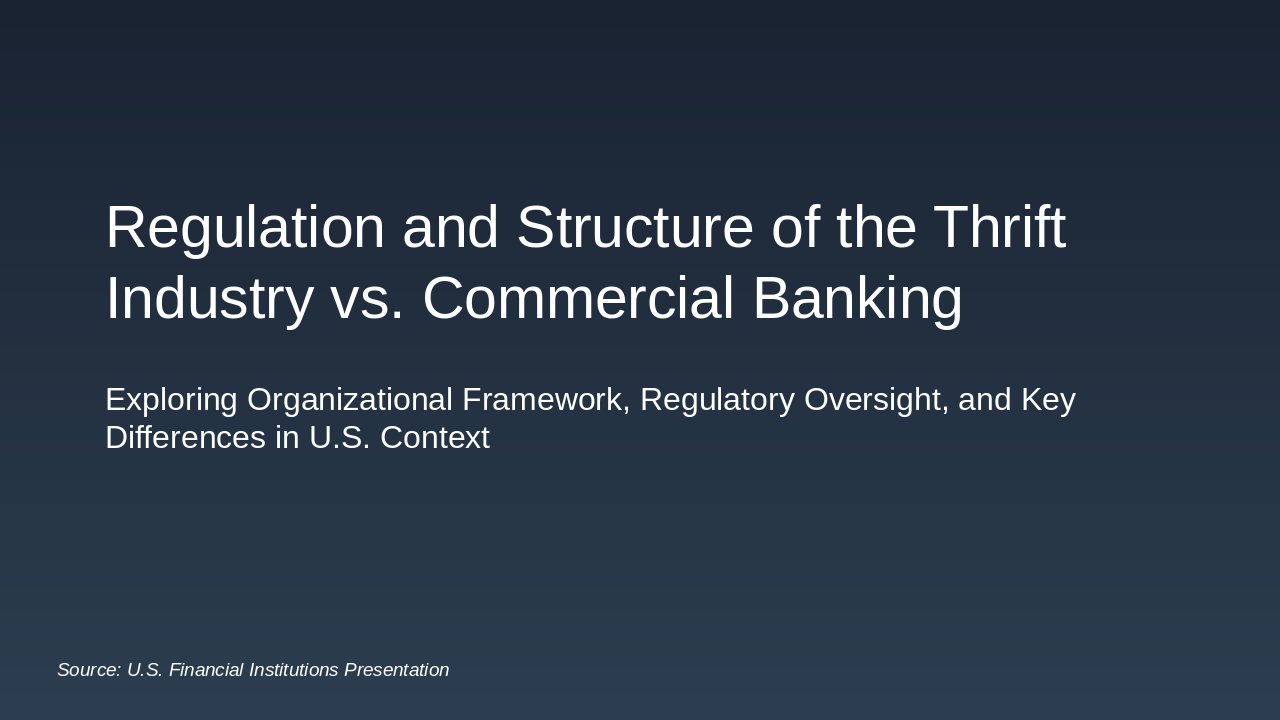
Slide 1 - Regulation and Structure of the Thrift Industry vs. Commercial Banking

This title slide introduces the topic of comparing the regulation and structure of the thrift industry to that of commercial banking. It features a subtitle that highlights an exploration of organizational frameworks, regulatory oversight, and key differences within the U.S. context.

Regulation and Structure of the Thrift Industry vs. Commercial Banking

Exploring Organizational Framework, Regulatory Oversight, and Key Differences in U.S. Context

Source: U.S. Financial Institutions Presentation
Slide 1
Slide 2 of 8

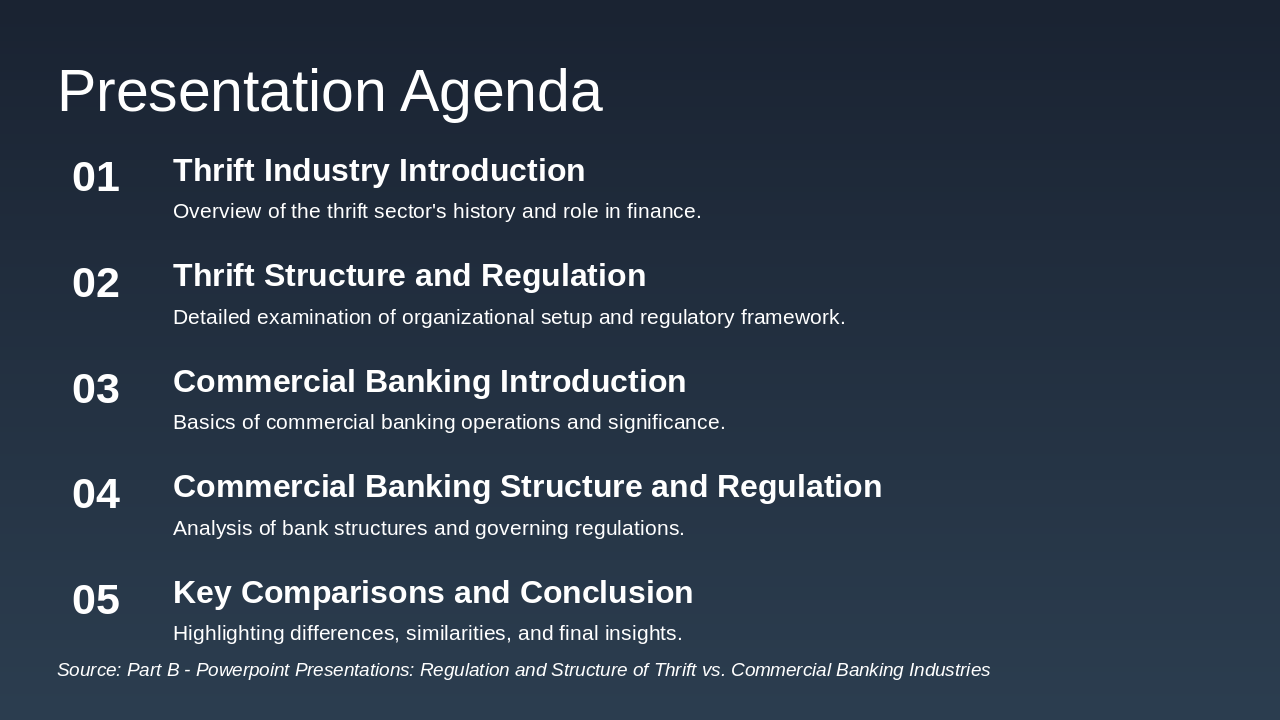
Slide 2 - Presentation Agenda

The presentation agenda outlines an introduction to the thrift industry, covering its history and role in finance, followed by a detailed look at its structure and regulatory framework. It then shifts to commercial banking basics and operations, its structure and regulations, before concluding with key comparisons and insights between the two sectors.

Presentation Agenda

  1. Thrift Industry Introduction

Overview of the thrift sector's history and role in finance.

  1. Thrift Structure and Regulation

Detailed examination of organizational setup and regulatory framework.

  1. Commercial Banking Introduction

Basics of commercial banking operations and significance.

  1. Commercial Banking Structure and Regulation

Analysis of bank structures and governing regulations.

  1. Key Comparisons and Conclusion

Highlighting differences, similarities, and final insights.

Source: Part B - Powerpoint Presentations: Regulation and Structure of Thrift vs. Commercial Banking Industries

--- Speaker Notes: This agenda outlines the key sections of the presentation, limited to 8 slides total.

Slide 2
Slide 3 of 8

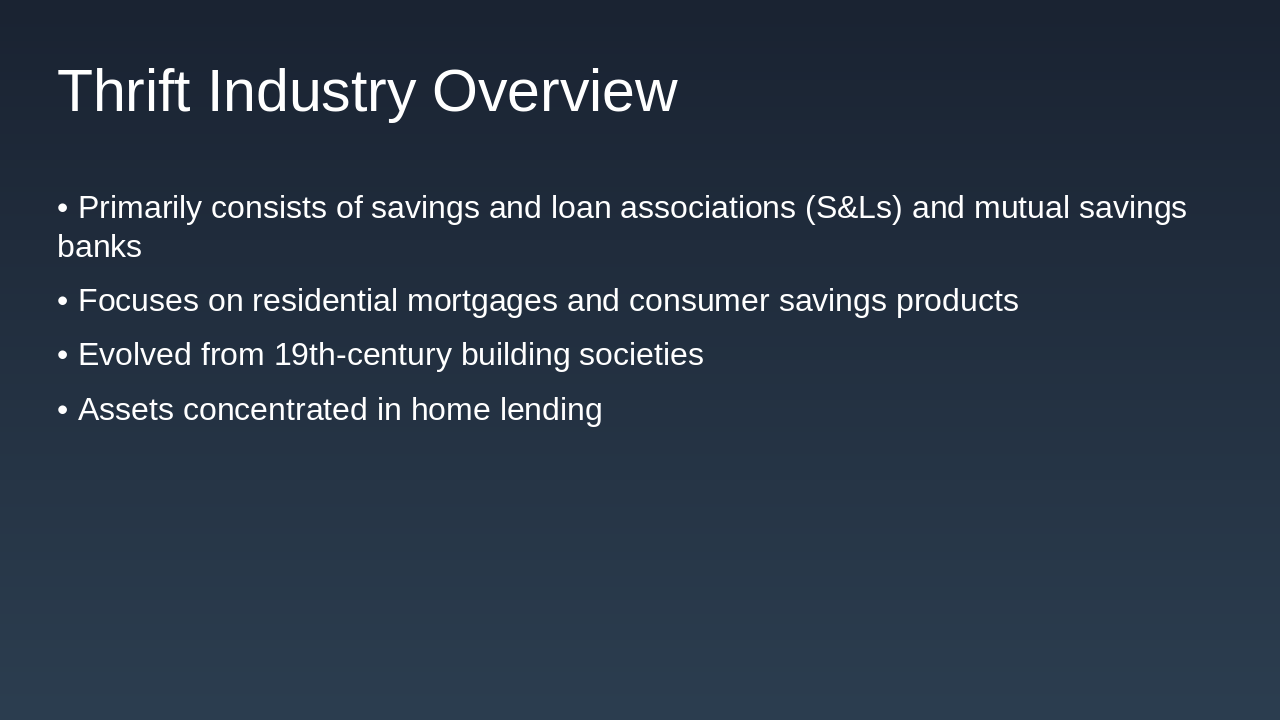
Slide 3 - Thrift Industry Overview

The thrift industry primarily comprises savings and loan associations (S&Ls) and mutual savings banks, which focus on residential mortgages and consumer savings products. Originating from 19th-century building societies, these institutions have assets heavily concentrated in home lending.

Thrift Industry Overview

  • Primarily consists of savings and loan associations (S&Ls) and mutual savings banks
  • Focuses on residential mortgages and consumer savings products
  • Evolved from 19th-century building societies
  • Assets concentrated in home lending
Slide 3
Slide 4 of 8

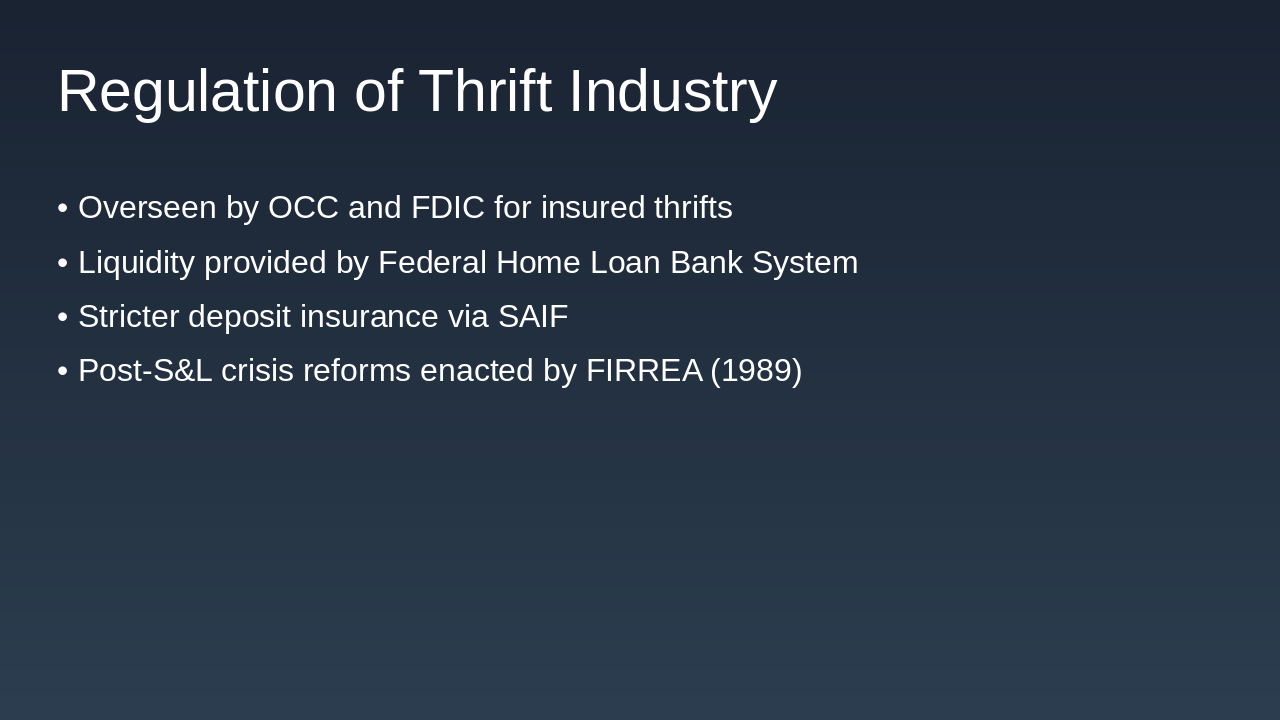
Slide 4 - Regulation of Thrift Industry

The U.S. thrift industry is regulated by the OCC and FDIC for insured institutions, with liquidity support from the Federal Home Loan Bank System and stricter deposit insurance through SAIF. Following the S&L crisis, FIRREA in 1989 introduced key reforms to strengthen oversight and stability.

Regulation of Thrift Industry

  • Overseen by OCC and FDIC for insured thrifts
  • Liquidity provided by Federal Home Loan Bank System
  • Stricter deposit insurance via SAIF
  • Post-S&L crisis reforms enacted by FIRREA (1989)

--- Speaker Notes: Overseen by Office of the Comptroller of the Currency (OCC) and FDIC for insured thrifts Federal Home Loan Bank System provides liquidity Stricter deposit insurance via Savings Association Insurance Fund (SAIF) Post-S&L crisis reforms via FIRREA (1989)

Slide 4
Slide 5 of 8

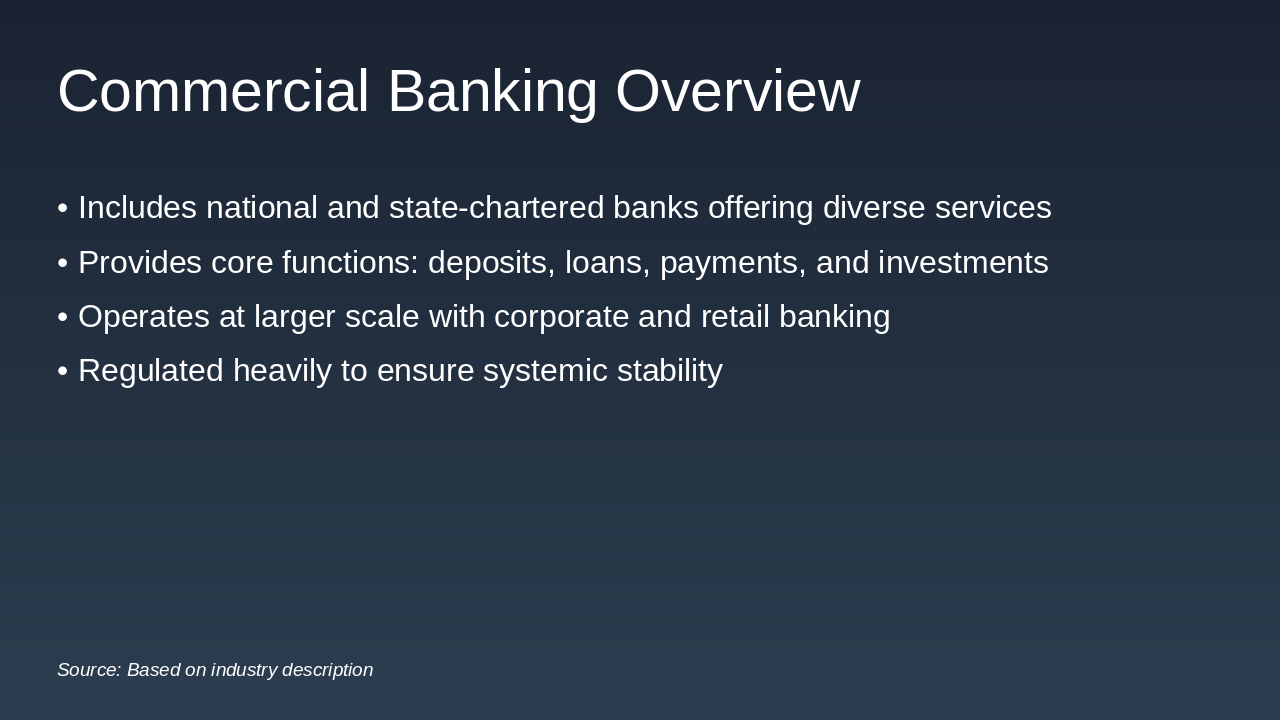
Slide 5 - Commercial Banking Overview

Commercial banking encompasses national and state-chartered banks that deliver a wide array of services, including core functions like deposits, loans, payments, and investments, while operating on a large scale across corporate and retail sectors. These institutions face heavy regulation to maintain systemic stability in the financial system.

Commercial Banking Overview

  • Includes national and state-chartered banks offering diverse services
  • Provides core functions: deposits, loans, payments, and investments
  • Operates at larger scale with corporate and retail banking
  • Regulated heavily to ensure systemic stability

Source: Based on industry description

--- Speaker Notes: Highlight key aspects of commercial banking structure and functions for comparison with thrift industry.

Slide 5
Slide 6 of 8

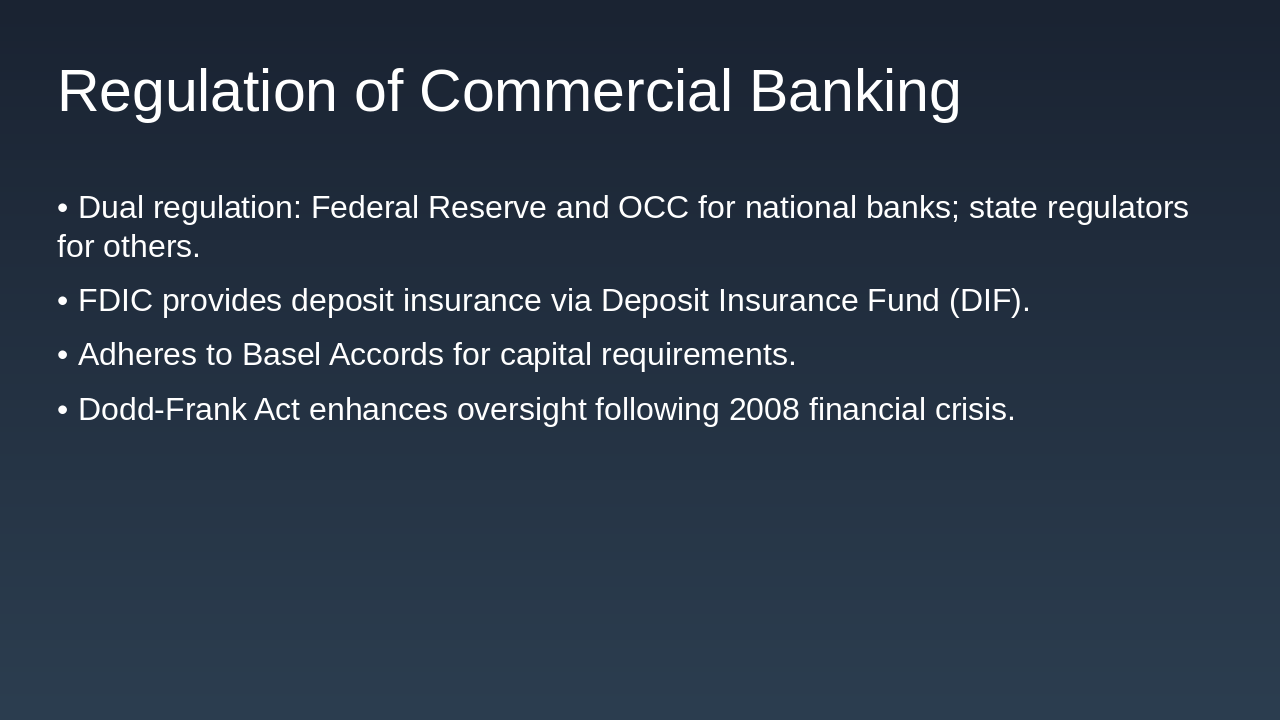
Slide 6 - Regulation of Commercial Banking

Commercial banking is regulated through a dual system, where national banks fall under the Federal Reserve and OCC, while others are overseen by state regulators, with the FDIC providing deposit insurance through the Deposit Insurance Fund. Banks must adhere to Basel Accords for capital requirements, and the Dodd-Frank Act has strengthened oversight in the wake of the 2008 financial crisis.

Regulation of Commercial Banking

  • Dual regulation: Federal Reserve and OCC for national banks; state regulators for others.
  • FDIC provides deposit insurance via Deposit Insurance Fund (DIF).
  • Adheres to Basel Accords for capital requirements.
  • Dodd-Frank Act enhances oversight following 2008 financial crisis.

--- Speaker Notes: This slide outlines key regulatory aspects of commercial banking, highlighting dual oversight, insurance, international standards, and post-crisis reforms. Compare to thrift industry in subsequent slides.

Slide 6
Slide 7 of 8

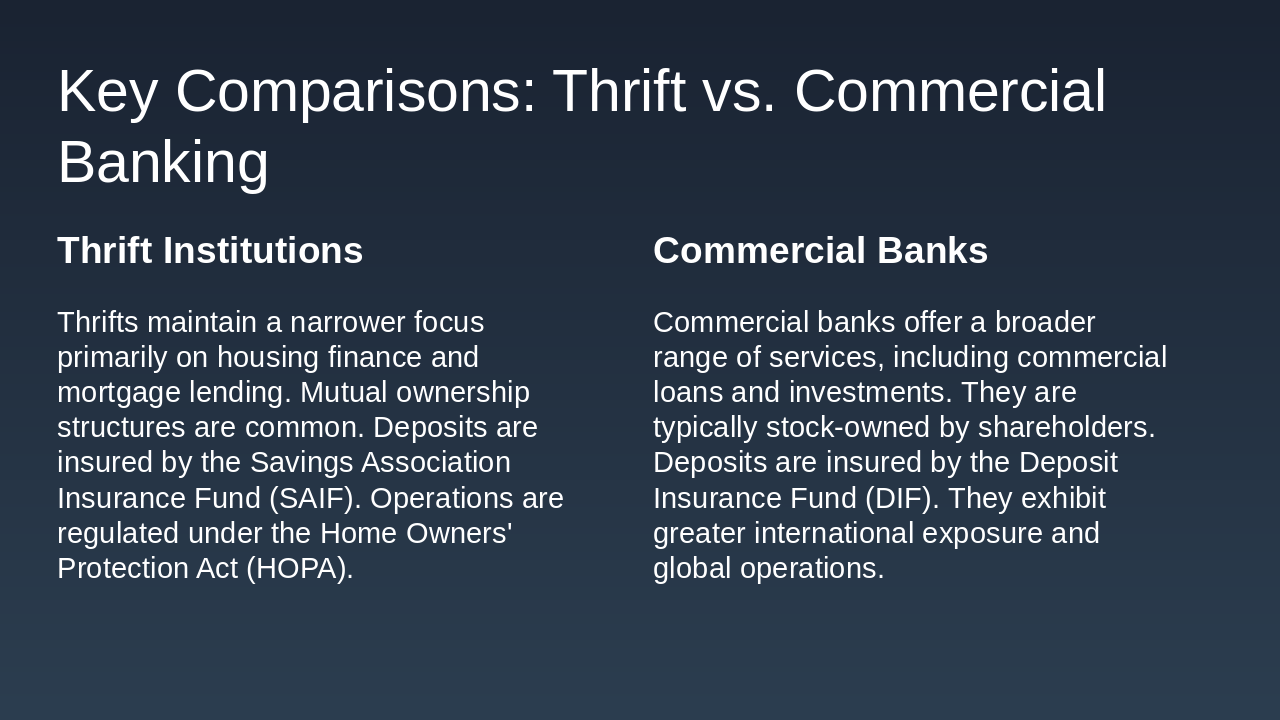
Slide 7 - Key Comparisons: Thrift vs. Commercial Banking

Thrift institutions primarily focus on housing finance and mortgage lending, often operate under mutual ownership, have deposits insured by the SAIF, and are regulated by the Home Owners' Protection Act. In contrast, commercial banks provide a wider array of services like commercial loans and investments, are typically stock-owned by shareholders, insure deposits through the DIF, and maintain significant international operations.

Key Comparisons: Thrift vs. Commercial Banking

Thrift InstitutionsCommercial Banks
Thrifts maintain a narrower focus primarily on housing finance and mortgage lending. Mutual ownership structures are common. Deposits are insured by the Savings Association Insurance Fund (SAIF). Operations are regulated under the Home Owners' Protection Act (HOPA).Commercial banks offer a broader range of services, including commercial loans and investments. They are typically stock-owned by shareholders. Deposits are insured by the Deposit Insurance Fund (DIF). They exhibit greater international exposure and global operations.

--- Speaker Notes: This slide highlights structural and regulatory differences between thrift institutions and commercial banks, emphasizing focus areas, ownership, insurance, and operational scopes.

Slide 7
Slide 8 of 8

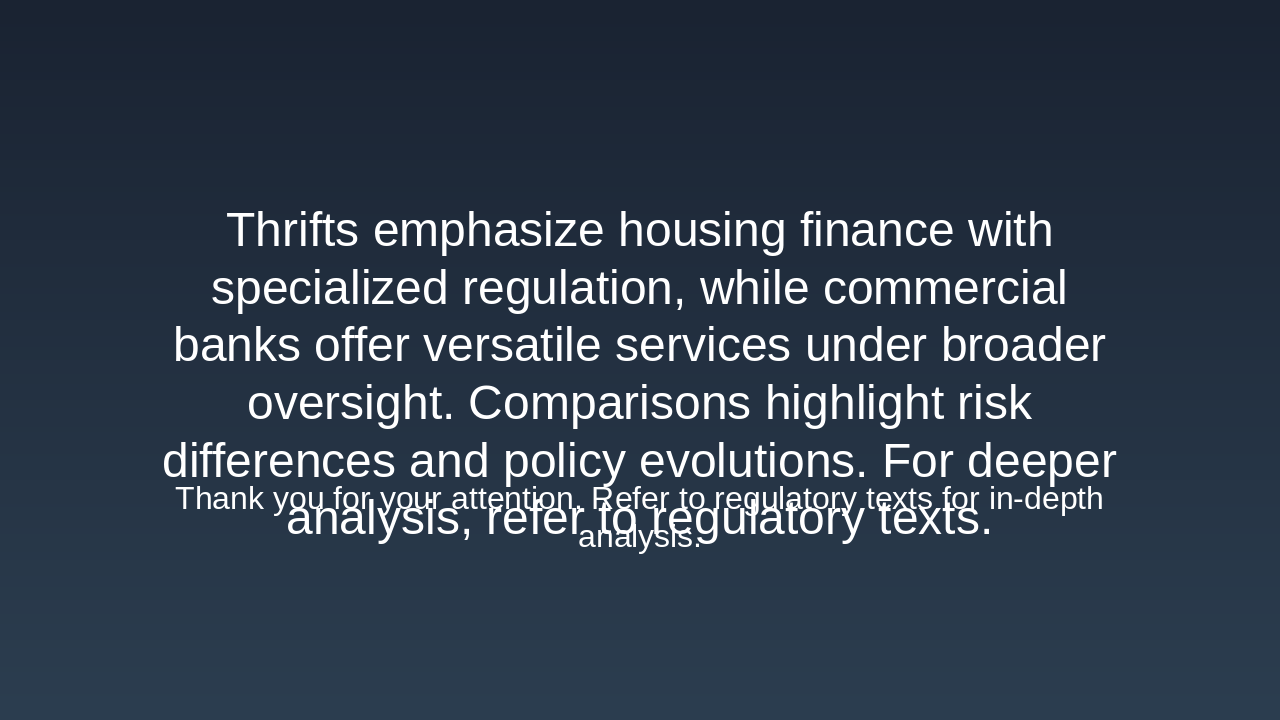
Slide 8 - Conclusion and Insights

Thrifts prioritize housing finance under specialized regulations, whereas commercial banks provide diverse services with more general oversight, underscoring key risk variations and regulatory shifts. For further details, consult regulatory texts, and thank you for your attention.

Conclusion and Insights

Thrifts emphasize housing finance with specialized regulation, while commercial banks offer versatile services under broader oversight. Comparisons highlight risk differences and policy evolutions. For deeper analysis, refer to regulatory texts.

Thank you for your attention. Refer to regulatory texts for in-depth analysis.

--- Speaker Notes: Summarize key differences in regulation and structure between thrifts and commercial banks. Emphasize housing focus for thrifts vs. versatility for banks, risk profiles, and policy changes. Direct audience to regulatory texts for further reading. Closing message: 'Thank you for your attention.' Call-to-action: 'Refer to regulatory texts for in-depth analysis.'

Slide 8
Powered by AI

Create Your Own Presentation

Generate professional presentations in seconds with Karaf's AI. Customize this presentation or start from scratch.

Create New Presentation

Powered by Karaf.ai — AI-Powered Presentation Generator