AI History: Milestones and Ethical Focus

Generated from prompt:

make a presentation about the history of artificial intelligence

This presentation traces AI's evolution from the 1956 Dartmouth Conference and Turing's vision, through AI winters and machine learning advances, to modern growth and challenges. It emphasizes ethical

November 10, 202511 slides
Slide 1 of 11

Slide 1 - The History of Artificial Intelligence

The slide's title is "The History of Artificial Intelligence," introducing a presentation on the subject. Its subtitle, "Exploring the Evolution of AI Over Time," indicates a focus on tracing AI's development through history.

The History of Artificial Intelligence

Exploring the Evolution of AI Over Time

--- Speaker Notes: Welcome slide introducing the topic of AI's evolution over time.

Slide 1
Slide 2 of 11

Slide 2 - Presentation Agenda

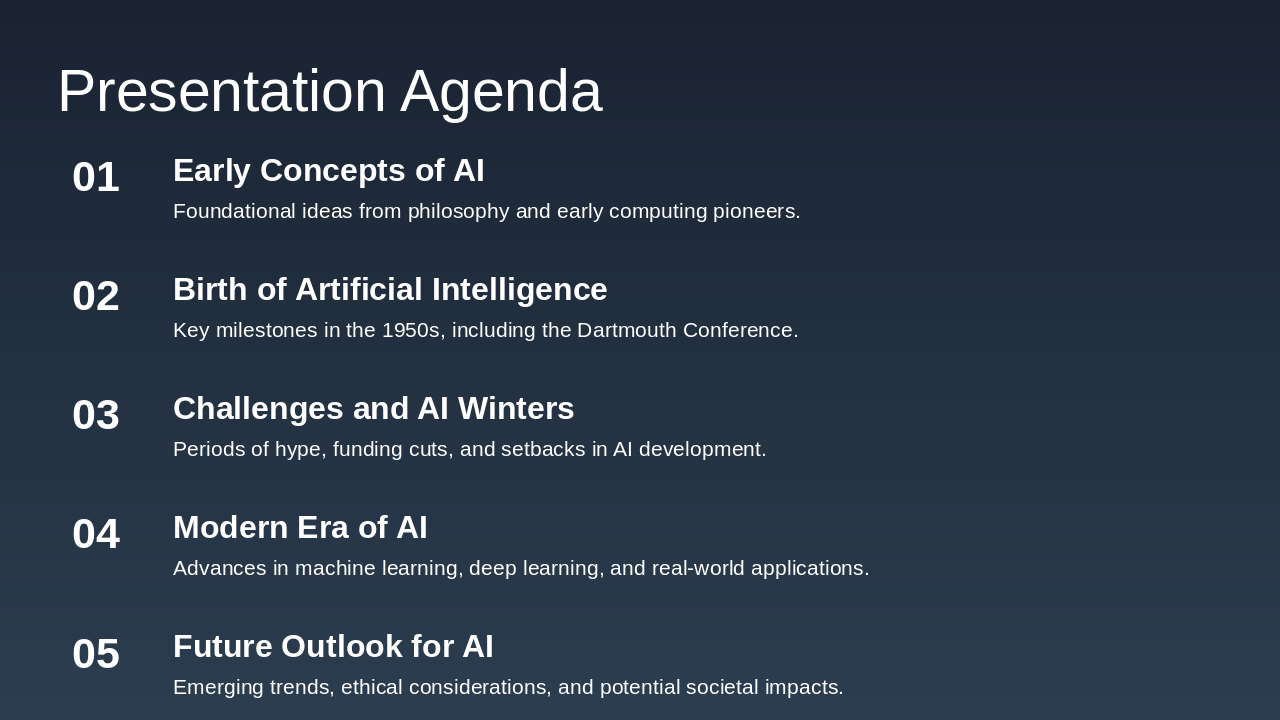
The presentation agenda outlines the historical evolution of AI, starting with early philosophical and computing concepts, followed by its birth in the 1950s via milestones like the Dartmouth Conference. It then covers challenges including AI winters, the modern era's advances in machine learning and applications, and a future outlook on trends, ethics, and societal impacts.

Presentation Agenda

  1. Early Concepts of AI

Foundational ideas from philosophy and early computing pioneers.

  1. Birth of Artificial Intelligence

Key milestones in the 1950s, including the Dartmouth Conference.

  1. Challenges and AI Winters

Periods of hype, funding cuts, and setbacks in AI development.

  1. Modern Era of AI

Advances in machine learning, deep learning, and real-world applications.

  1. Future Outlook for AI

Emerging trends, ethical considerations, and potential societal impacts.

Slide 2
Slide 3 of 11

Slide 3 - Early Concepts of AI

This section header slide introduces "Early Concepts of AI" as the second topic in the presentation. It covers pre-1950s ideas, ranging from ancient myths to Alan Turing's influential 1950 paper on machine intelligence.

Early Concepts of AI

02

Early Concepts of AI

Pre-1950s ideas from ancient myths to Alan Turing's 1950 paper on machine intelligence.

Slide 3
Slide 4 of 11

Slide 4 - Key Milestones Timeline

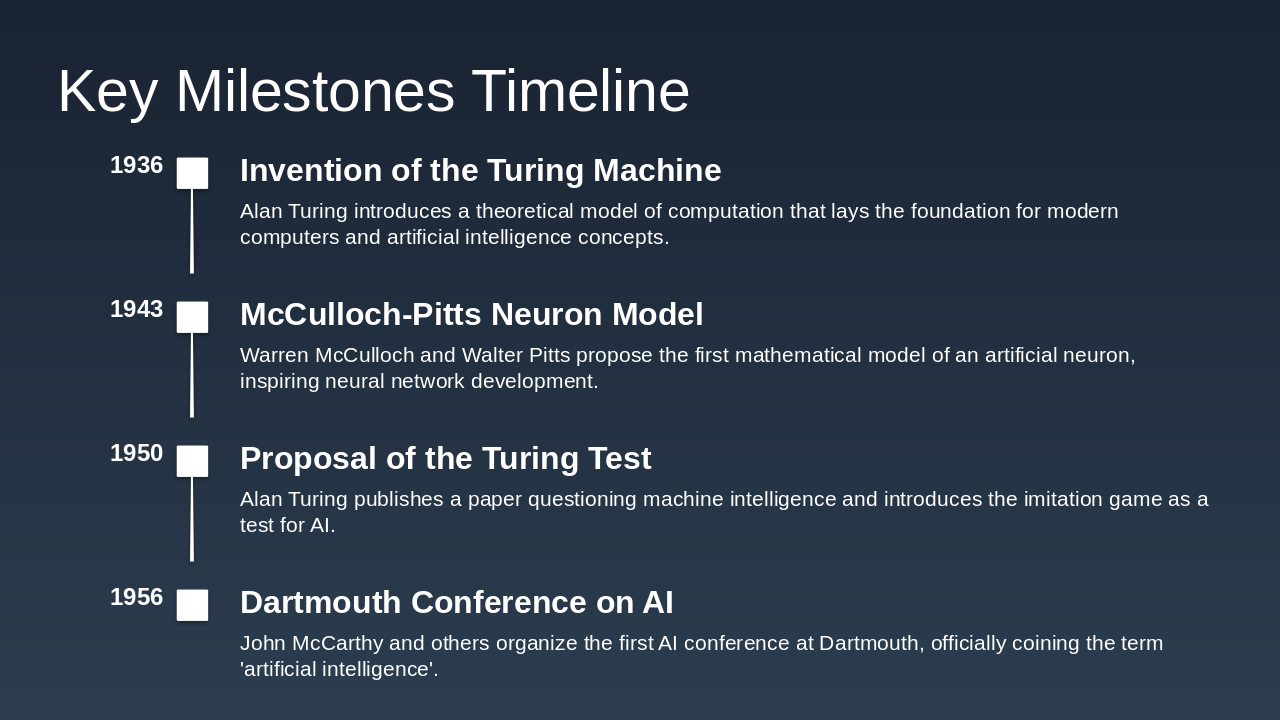
The timeline slide outlines key early milestones in the history of computing and artificial intelligence, starting with Alan Turing's 1936 invention of the Turing Machine, which provided a foundational theoretical model for computation and AI concepts. It continues through the 1943 McCulloch-Pitts artificial neuron model, Turing's 1950 proposal of the Turing Test for machine intelligence, and culminates in the 1956 Dartmouth Conference, where the term "artificial intelligence" was officially coined.

Key Milestones Timeline

1936: Invention of the Turing Machine Alan Turing introduces a theoretical model of computation that lays the foundation for modern computers and artificial intelligence concepts. 1943: McCulloch-Pitts Neuron Model Warren McCulloch and Walter Pitts propose the first mathematical model of an artificial neuron, inspiring neural network development. 1950: Proposal of the Turing Test Alan Turing publishes a paper questioning machine intelligence and introduces the imitation game as a test for AI. 1956: Dartmouth Conference on AI John McCarthy and others organize the first AI conference at Dartmouth, officially coining the term 'artificial intelligence'.

Slide 4
Slide 5 of 11

Slide 5 - Birth of AI: 1956 Dartmouth Conference

The 1956 Dartmouth Conference marked the founding event of the artificial intelligence field, where John McCarthy, Marvin Minsky, and others coined the term "Artificial Intelligence." The gathering showcased early programs like the Logic Theorist and expressed strong optimism about achieving human-level AI in the near future.

Birth of AI: 1956 Dartmouth Conference

  • 1956 Dartmouth Conference: Founding event of AI field
  • Coined term 'Artificial Intelligence' by McCarthy, Minsky et al.
  • Showcased early programs like the Logic Theorist
  • Expressed optimism for achieving human-level AI soon
Slide 5
Slide 6 of 11

Slide 6 - Alan Turing's Vision

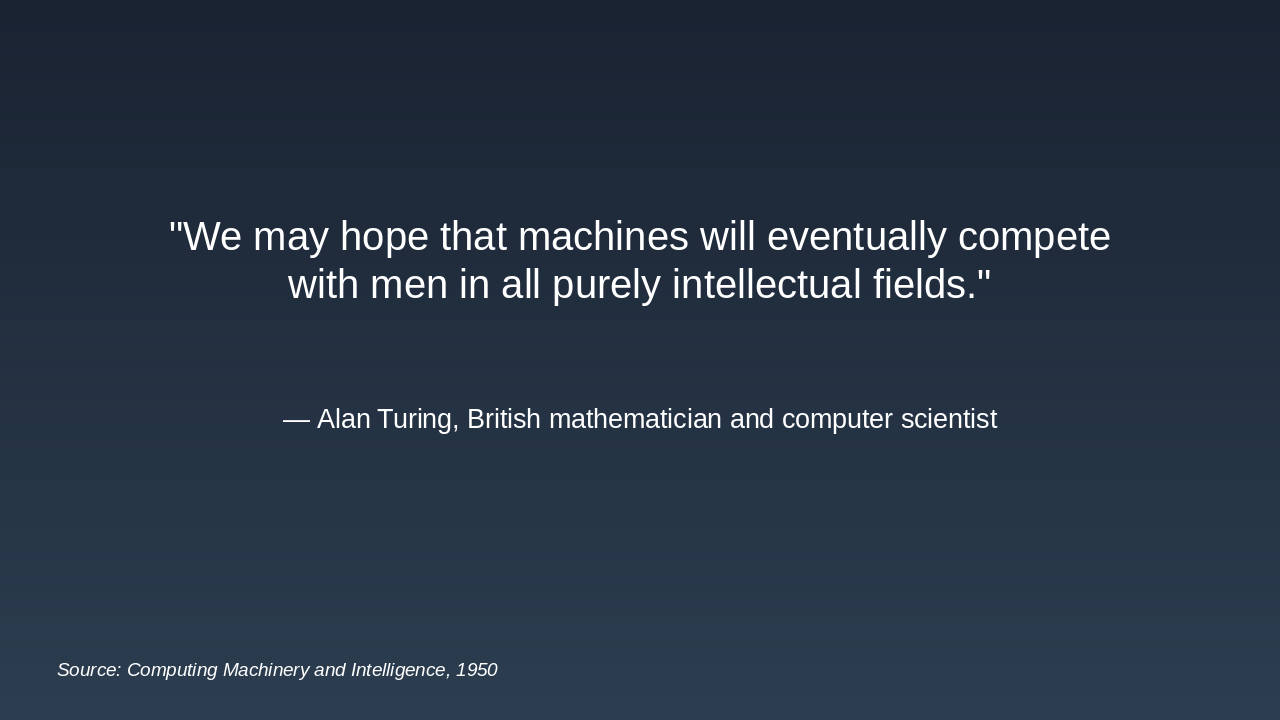
The slide, titled "Alan Turing's Vision," features a quote from the renowned British mathematician and computer scientist Alan Turing. In it, he expresses optimism that machines will one day rival humans in all purely intellectual pursuits.

Alan Turing's Vision

> We may hope that machines will eventually compete with men in all purely intellectual fields.

— Alan Turing, British mathematician and computer scientist

Source: Computing Machinery and Intelligence, 1950

--- Speaker Notes: In the context of a presentation on the history of artificial intelligence, this quote underscores Turing's pioneering vision for machine intelligence.

Slide 6
Slide 7 of 11

Slide 7 - The AI Winters

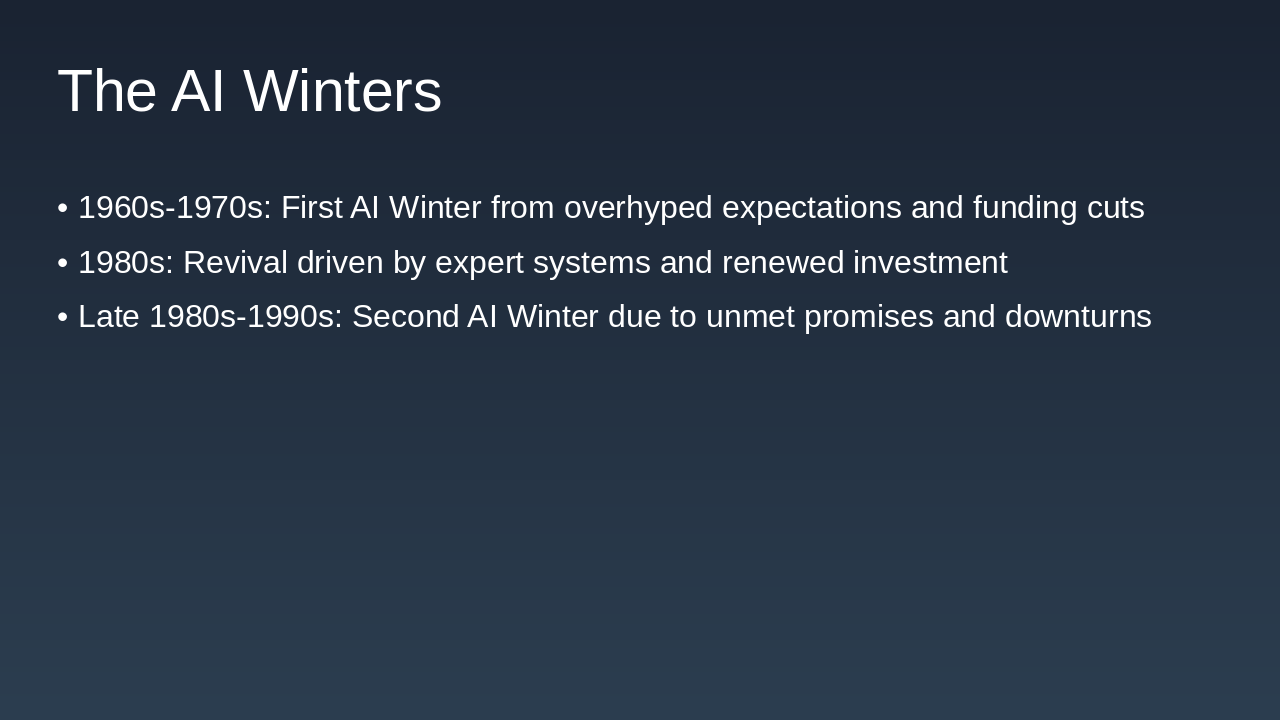
The AI Winters slide outlines two major periods of stagnation in artificial intelligence development. The first occurred in the 1960s-1970s due to overhyped expectations and funding cuts, followed by a revival in the 1980s through expert systems and renewed investment, only for a second winter to hit in the late 1980s-1990s from unmet promises and economic downturns.

The AI Winters

  • 1960s-1970s: First AI Winter from overhyped expectations and funding cuts
  • 1980s: Revival driven by expert systems and renewed investment
  • Late 1980s-1990s: Second AI Winter due to unmet promises and downturns
Slide 7
Slide 8 of 11

Slide 8 - Rise of Machine Learning

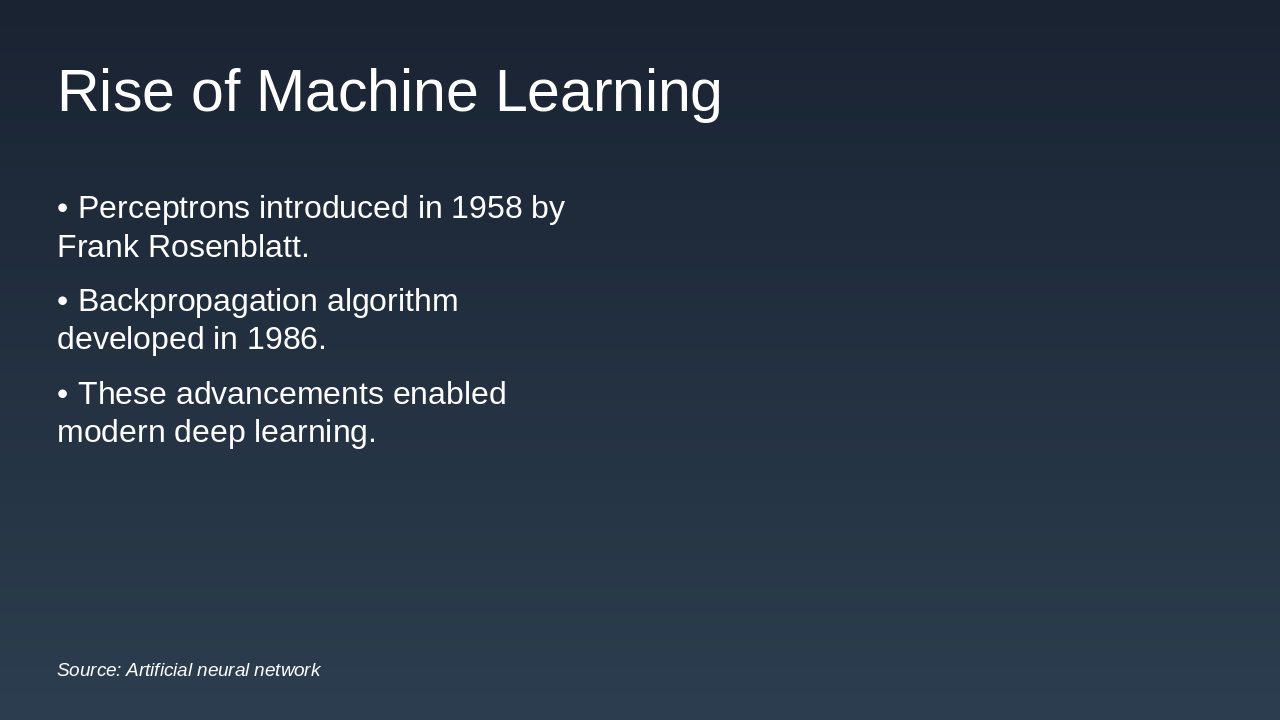
The slide titled "Rise of Machine Learning" highlights key historical milestones in the field. It notes the introduction of perceptrons in 1958 by Frank Rosenblatt, the development of the backpropagation algorithm in 1986, and how these advancements paved the way for modern deep learning.

Rise of Machine Learning

!Image

  • Perceptrons introduced in 1958 by Frank Rosenblatt.
  • Backpropagation algorithm developed in 1986.
  • These advancements enabled modern deep learning.

Source: Artificial neural network

--- Speaker Notes: Visual: Neural networks evolution. From perceptrons (1958) to backpropagation (1986) enabling deep learning. Context: presentation about the history of artificial intelligence.

Slide 8
Slide 9 of 11

Slide 9 - AI Growth Statistics

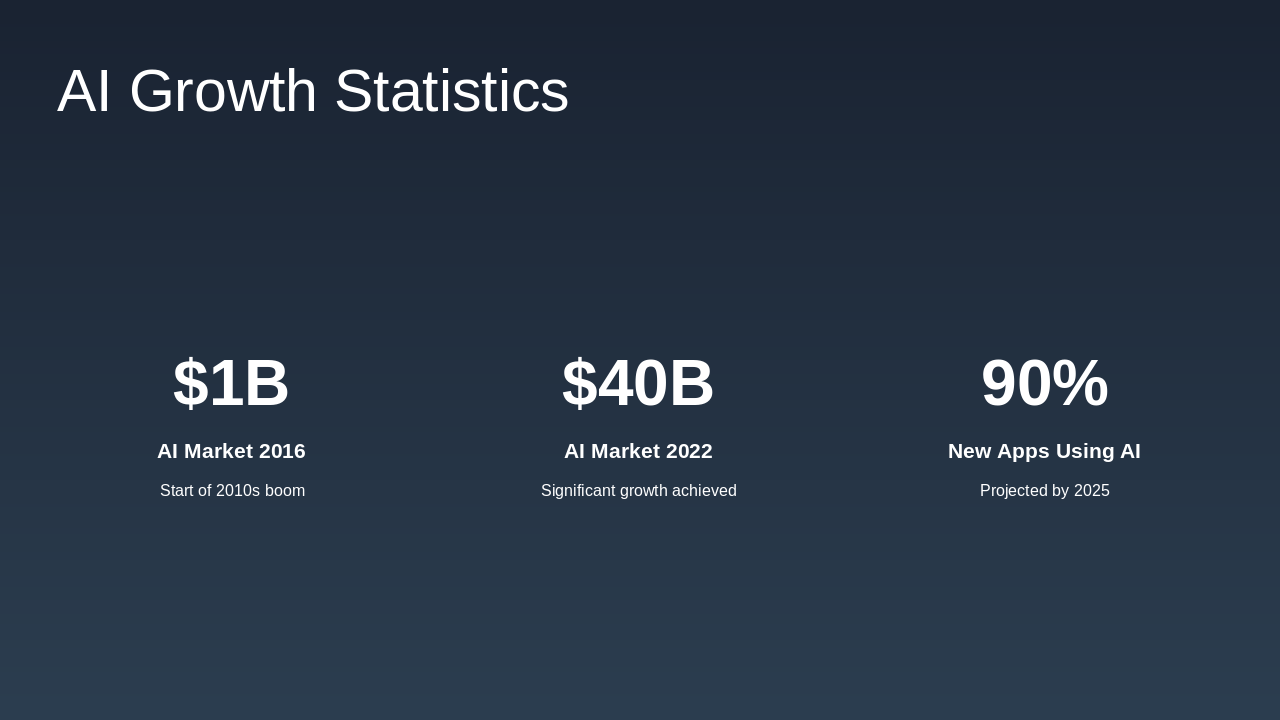
The AI market has experienced explosive growth, expanding from $1 billion in 2016—marking the start of the 2010s boom—to $40 billion by 2022. Projections indicate that 90% of new applications will incorporate AI by 2025.

AI Growth Statistics

  • $1B: AI Market 2016

Start of 2010s boom

  • $40B: AI Market 2022

Significant growth achieved

  • 90%: New Apps Using AI

Projected by 2025

Slide 9
Slide 10 of 11

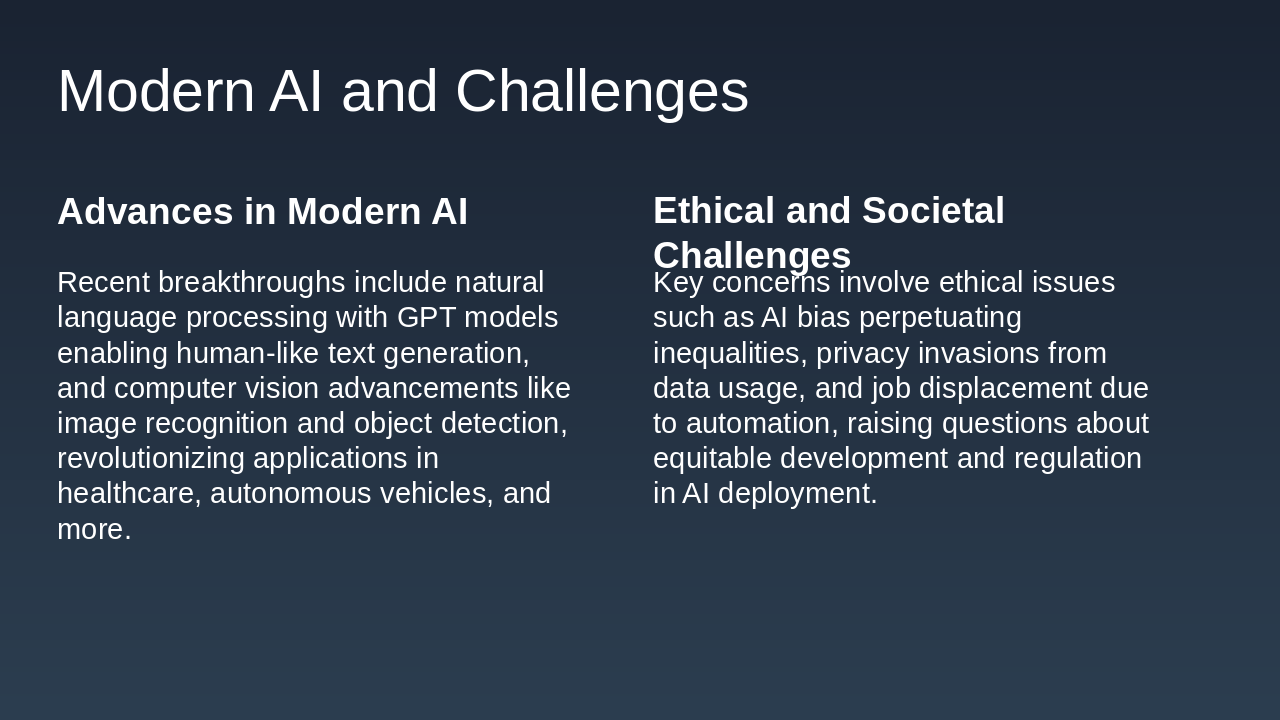
Slide 10 - Modern AI and Challenges

Modern AI advances feature breakthroughs in natural language processing, such as GPT models for human-like text generation, and computer vision for image recognition and object detection, transforming fields like healthcare and autonomous vehicles. However, these developments raise ethical and societal challenges, including AI bias that perpetuates inequalities, privacy risks from data usage, and job displacement through automation, prompting needs for equitable regulation.

Modern AI and Challenges

Advances in Modern AIEthical and Societal Challenges
Recent breakthroughs include natural language processing with GPT models enabling human-like text generation, and computer vision advancements like image recognition and object detection, revolutionizing applications in healthcare, autonomous vehicles, and more.Key concerns involve ethical issues such as AI bias perpetuating inequalities, privacy invasions from data usage, and job displacement due to automation, raising questions about equitable development and regulation in AI deployment.
Slide 10
Slide 11 of 11

Slide 11 - The Future of AI

The slide titled "The Future of AI" concludes that artificial intelligence is continually transforming society, emphasizing the need to focus on ethical development to achieve beneficial outcomes. Its subtitle, "Shaping a Responsible AI Future," underscores this call to action, ending with a simple "Thank you!"

The Future of AI

AI continues to transform society. Focus on ethical development for beneficial outcomes. Thank you!

Shaping a Responsible AI Future

Source: History of Artificial Intelligence Presentation

--- Speaker Notes: Closing message: Embrace ethical AI for a better tomorrow. (6 words) Call-to-action: Commit to responsible innovation in AI development today. (7 words)

Slide 11
Powered by AI

Create Your Own Presentation

Generate professional presentations in seconds with Karaf's AI. Customize this presentation or start from scratch.

Create New Presentation

Powered by Karaf.ai — AI-Powered Presentation Generator