Modern Metadata Platform: Arch, Gov & AI (39 chars)

Generated from prompt:

Create a professional, enterprise-grade 31-slide presentation titled 'The Modern Metadata Management Platform: Architecture, Governance & Agentic AI'. The presentation should be designed for financial services audiences, focusing on metadata governance, AI, compliance (BCBS 239, KYC/AML), and data architecture. Use clean visuals, diagrams, and icons to represent architectures and processes. Include the following sections: 1. Title Slide 2. Executive Summary (2 slides) 3. Industry Context (2 slides) 4. What is a Modern Metadata Platform? (2 slides) 5. Platform Principles (3 slides) 6. Reference Architecture (5 slides) 7. Governance Operating Model (3 slides) 8. Agentic AI for Metadata (4 slides) 9. Banking-Specific Requirements (3 slides) 10. Maturity Model (2 slides) 11. Business Value (2 slides) 12. Implementation Roadmap (2 slides) 13. Closing (1 slide) Tone: Executive, strategic, and visually engaging. Use subtle animations and a modern data/AI design theme (navy, silver, and teal palette).

Enterprise-grade presentation for financial services on a modern metadata platform. Covers architecture, governance, agentic AI for compliance (BCBS 239, KYC/AML), reference designs, maturity model, b

December 5, 202543 slides
Slide 1 of 43

Slide 1 - The Modern Metadata Management Platform: Architecture, Governance & Agentic AI

This title slide features the main title "The Modern Metadata Management Platform: Architecture, Governance & Agentic AI." Its subtitle emphasizes empowering compliance, governance, and AI innovation in financial services.

The Modern Metadata Management Platform: Architecture, Governance & Agentic AI

Empowering Compliance, Governance, and AI Innovation in Financial Services

Source: Financial Services Presentation

Speaker Notes
Navy/teal background with subtle data flow icons and presenter/company logo.
Slide 1 - The Modern Metadata Management Platform: Architecture, Governance & Agentic AI
Slide 2 of 43

Slide 2 - Executive Summary

This section header slide is titled "Executive Summary" for section 02. It overviews the benefits of a modern metadata platform for banking, emphasizing governance, AI, and compliance.

Executive Summary

02

Executive Summary

Overview of modern metadata platform benefits for banking: governance, AI, compliance.

Slide 2 - Executive Summary
Slide 3 of 43

Slide 3 - Executive Summary (1/2)

This executive summary slide addresses exploding data volumes requiring scalable metadata management and BCBS 239 regulations demanding robust risk data aggregation. It highlights AI-driven insights for strategic decision-making and a modern platform delivering enterprise-wide data agility.

Executive Summary (1/2)

  • Exploding data volumes demand scalable metadata management
  • BCBS 239 regulations require robust risk data aggregation
  • AI-driven insights unlock strategic decision-making potential
  • Modern platform delivers agility across enterprise data
Slide 3 - Executive Summary (1/2)
Slide 4 of 43

Slide 4 - Executive Summary (2/2)

This slide outlines a unified metadata foundation across enterprise data assets, enabled by agentic AI for automated governance and compliance. It drives risk reduction for BCBS 239 and KYC/AML while delivering rapid ROI via 40% efficiency gains and innovation acceleration.

Executive Summary (2/2)

  • Unified metadata foundation across enterprise data assets
  • Agentic AI enables automated governance and compliance
  • Drives risk reduction for BCBS 239, KYC/AML
  • Delivers rapid ROI: 40% efficiency gains, innovation acceleration

Source: Modern Metadata Management Platform Presentation

Speaker Notes
Emphasize unified metadata as foundation, agentic AI for automation, risk reduction for compliance, and preview ROI metrics.
Slide 4 - Executive Summary (2/2)
Slide 5 of 43

Slide 5 - The Modern Metadata Management Platform: Architecture, Governance & Agentic AI

This section header slide introduces Section 03: Industry Context within the presentation on modern metadata management platforms. The subtitle highlights financial services challenges, including data silos, compliance burdens, and AI opportunities.

The Modern Metadata Management Platform: Architecture, Governance & Agentic AI

03

Industry Context

Financial services challenges: Data silos, compliance burdens, AI opportunities.

Source: Financial services presentation

Speaker Notes
Introduce the industry challenges facing financial services, setting the stage for why a modern metadata platform is essential.
Slide 5 - The Modern Metadata Management Platform: Architecture, Governance & Agentic AI
Slide 6 of 43

Slide 6 - Industry Context (1/2)

This slide, titled "Industry Context (1/2)", outlines key banking challenges. It highlights fragmented data silos, strict KYC/AML compliance demands, and exploding data volumes from digital channels.

Industry Context (1/2)

!Image

  • Fragmented data silos across banking systems
  • KYC/AML regulations demand strict compliance
  • Exploding data volumes from digital channels

Source: Image from Wikipedia article "Information silo"

Speaker Notes
Diagram of banking data landscape: Silos, regulations (KYC/AML icons), exploding volumes.
Slide 6 - Industry Context (1/2)
Slide 7 of 43

Slide 7 - Industry Context (2/2)

Digital transformation and real-time compliance needs (e.g., BCBS 239, KYC/AML) drive demand for agile metadata management and instant lineage. Generative AI growth and enterprise AI adoption require strong governance, elevating metadata as a strategic asset.

Industry Context (2/2)

  • Digital transformation accelerates need for agile metadata management
  • Real-time compliance (BCBS 239, KYC/AML) demands instant lineage
  • Generative AI proliferation requires robust governance frameworks
  • Enterprise AI adoption elevates metadata as strategic asset
Slide 7 - Industry Context (2/2)
Slide 8 of 43

Slide 8 - The Modern Metadata Management Platform: Architecture, Governance & Agentic AI

This section header slide (04) introduces "What is a Modern Metadata Platform?" within the presentation on architecture, governance, and agentic AI. Its subtitle covers the definition and evolution from legacy to AI-powered systems.

The Modern Metadata Management Platform: Architecture, Governance & Agentic AI

04

What is a Modern Metadata Platform?

Definition and evolution from legacy to AI-powered.

Source: Financial Services Presentation

Speaker Notes
Introduce the definition of a modern metadata platform and its evolution from legacy systems to AI-powered solutions, setting the stage for subsequent architecture and governance discussions.
Slide 8 - The Modern Metadata Management Platform: Architecture, Governance & Agentic AI
Slide 9 of 43

Slide 9 - Modern Metadata Platform (1/2)

The slide introduces core components of a Modern Metadata Platform, including a unified metadata catalog for data asset discovery, end-to-end lineage for pipeline traceability, and a quality framework with automated checks for BCBS 239 compliance. It also details AI integration benefits like automated tagging, intelligent lineage inference, predictive quality analytics for KYC/AML and risk, and agentic AI for strategic operations.

Modern Metadata Platform (1/2)

Core ComponentsAI Integration Benefits

| Unified Metadata Catalog: Centralized discovery and management of data assets. End-to-End Data Lineage: Full traceability across pipelines. Quality Framework: Automated checks for accuracy, completeness, and compliance (BCBS 239). | Automated Tagging & Classification: Accelerates governance. Intelligent Lineage Inference: Reduces manual effort. Predictive Quality Analytics: Proactive issue detection for KYC/AML and risk. Enables Agentic AI for strategic metadata operations. |

Slide 9 - Modern Metadata Platform (1/2)
Slide 10 of 43

Slide 10 - Modern Metadata Platform (2/2)

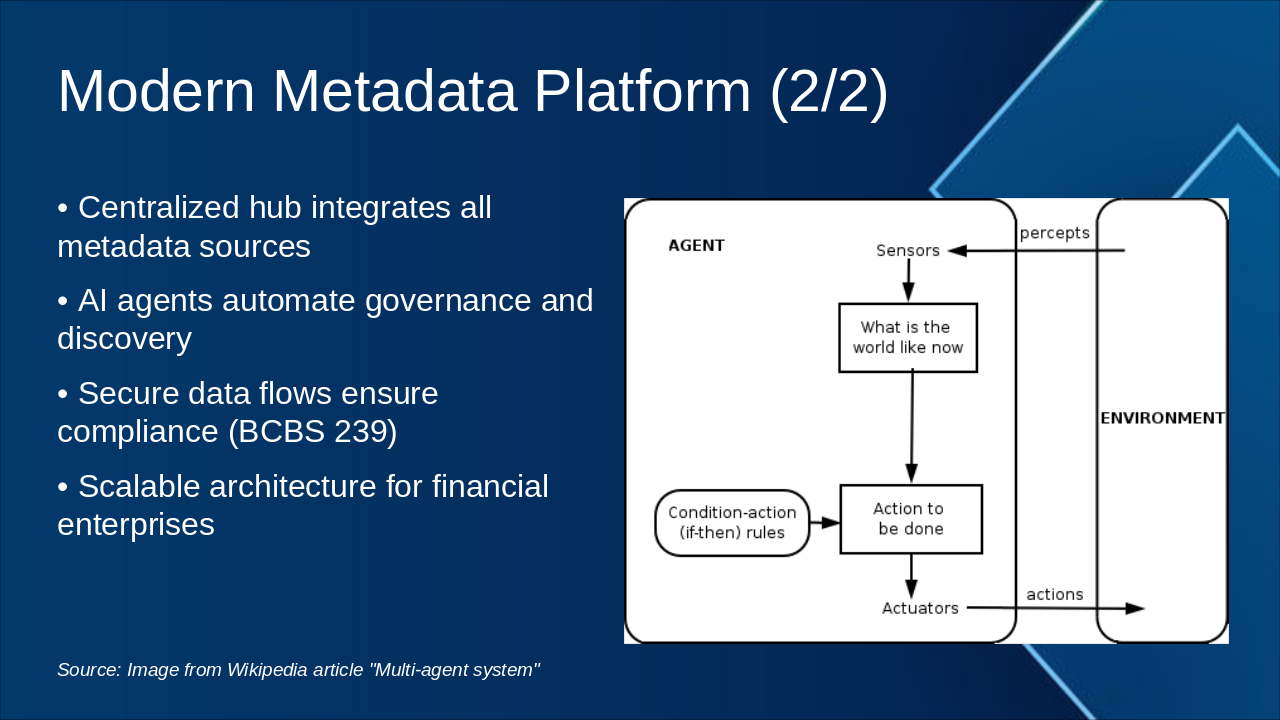
The "Modern Metadata Platform (2/2)" slide showcases a centralized hub that integrates all metadata sources. It features AI agents for automating governance and discovery, secure data flows ensuring BCBS 239 compliance, and scalable architecture for financial enterprises.

Modern Metadata Platform (2/2)

!Image

  • Centralized hub integrates all metadata sources
  • AI agents automate governance and discovery
  • Secure data flows ensure compliance (BCBS 239)
  • Scalable architecture for financial enterprises

Source: Image from Wikipedia article "Multi-agent system"

Slide 10 - Modern Metadata Platform (2/2)
Slide 11 of 43

Slide 11 - Platform Principles

This slide serves as the section header for "Platform Principles" (section 05). Its subtitle highlights guiding principles for enterprise adoption.

Platform Principles

05

Platform Principles

Guiding principles for enterprise adoption.

Slide 11 - Platform Principles
Slide 12 of 43

Slide 12 - Platform Principles (1/3)

This slide introduces Platform Principles (1/3), highlighting scalability through horizontal scaling for petabyte-scale metadata growth and interoperability via seamless integration across hybrid data ecosystems. It emphasizes a governance-first design with embedded BCBS 239 compliance, centralized policy enforcement, and decentralized execution.

Platform Principles (1/3)

  • Scalability: Horizontal scaling for petabyte-scale metadata growth
  • Interoperability: Seamless integration across hybrid data ecosystems
  • Governance-first: BCBS 239 compliance embedded by design
  • Governance-first: Centralized policy enforcement, decentralized execution
Slide 12 - Platform Principles (1/3)
Slide 13 of 43

Slide 13 - Platform Principles (2/3)

This slide outlines the platform's AI-native core for seamless agentic workflows and autonomous governance that accelerates metadata insights. It also features a zero-trust model for securing financial metadata, BCBS 239-compliant risk reporting, and KYC/AML readiness with immutable audit trails.

Platform Principles (2/3)

  • AI-native core enables seamless agentic workflows
  • Autonomous AI governance accelerates metadata insights
  • Zero-trust model secures sensitive financial metadata
  • BCBS 239-compliant risk aggregation and reporting
  • KYC/AML-ready with immutable audit trails

Source: Platform Principles

Speaker Notes
Highlight AI-native differentiation from legacy platforms; stress security for financial compliance (BCBS 239, KYC/AML). Use AI icon for pts 1-2, lock/shield for 3-5.
Slide 13 - Platform Principles (2/3)
Slide 14 of 43

Slide 14 - Platform Principles (3/3)

This slide, "Platform Principles (3/3)", outlines Principle 5 (User-Centric: intuitive self-service drives broad adoption) and Principle 6 (Observability: real-time monitoring ensures compliance transparency). It includes a summary diagram illustrating the holistic integration of all six principles.

Platform Principles (3/3)

  • Principle 5: User-Centric – Intuitive self-service drives broad adoption
  • Principle 6: Observability – Real-time monitoring ensures compliance transparency
  • Summary Diagram: Holistic integration of all six principles

Source: Modern Metadata Management Platform

Speaker Notes
Emphasize user-centric design for adoption in financial services and observability for BCBS 239 compliance. Walk through summary diagram showing all 6 principles integrated.
Slide 14 - Platform Principles (3/3)
Slide 15 of 43

Slide 15 - The Modern Metadata Management Platform: Architecture, Governance & Agentic AI

This section header slide introduces Section 06: Reference Architecture. It highlights a detailed layered architecture for enterprise metadata management and governance in financial services.

The Modern Metadata Management Platform: Architecture, Governance & Agentic AI

06

Reference Architecture

Detailed layered architecture for enterprise metadata management and governance in financial services.

Source: Financial Services Presentation

Speaker Notes
Detailed layered architecture.
Slide 15 - The Modern Metadata Management Platform: Architecture, Governance & Agentic AI
Slide 16 of 43

Slide 16 - Reference Architecture (1/5)

This slide, "Reference Architecture (1/5)", depicts the Ingestion, Storage, and Processing Layers of a data system. It describes Ingestion capturing metadata from diverse sources, Storage offering scalable secure repositories, and Processing transforming data via pipelines.

Reference Architecture (1/5)

!Image

  • Ingestion Layer: Captures metadata from diverse enterprise sources.
  • Storage Layer: Scalable repositories with compliance-grade security.
  • Processing Layer: Transforms and enriches data via pipelines.

Source: Photo by Ronak Naik on Unsplash

Slide 16 - Reference Architecture (1/5)
Slide 17 of 43

Slide 17 - Reference Architecture (2/5)

The slide's left column details "Metadata Sources," featuring automated ingestion from relational/NoSQL databases, ETL pipelines, BI tools, applications, and regulatory feeds like BCBS 239 and KYC/AML for real-time capture across hybrid environments. The right column describes the "Core Engine with AI Modules," a central ML-driven hub for classification, lineage, quality scoring, semantic enrichment, and governance to manage metadata lifecycles at enterprise scale.

Reference Architecture (2/5)

Metadata SourcesCore Engine with AI Modules
Automated ingestion from relational/NoSQL databases, ETL pipelines, BI tools, applications, and regulatory feeds (BCBS 239, KYC/AML). Ensures comprehensive, real-time metadata capture across hybrid environments.Central hub featuring ML-driven classification, automated lineage, quality scoring, semantic enrichment, and governance enforcement. Powers intelligent metadata lifecycle management for enterprise-scale compliance.

Source: Enterprise Metadata Platform

Speaker Notes
Emphasize seamless ingestion from diverse sources into the AI-powered core engine, ensuring compliance with BCBS 239 and KYC/AML standards.
Slide 17 - Reference Architecture (2/5)
Slide 18 of 43

Slide 18 - Reference Architecture (3/5)

This Reference Architecture slide (3/5) features an image of interactive flow diagrams with icons illustrating end-to-end data provenance and tracking. It emphasizes metadata-driven lineage visualization and support for BCBS 239 compliance audits.

Reference Architecture (3/5)

!Image

  • End-to-end data provenance and tracking
  • Interactive flow diagrams with icons
  • Metadata-driven lineage visualization
  • Supports BCBS 239 compliance audits

Source: Wikipedia: Data lineage

Speaker Notes
Emphasize interactive icons for exploring data flows, transformations, and compliance traceability in financial metadata platforms.
Slide 18 - Reference Architecture (3/5)
Slide 19 of 43

Slide 19 - Reference Architecture (4/5)

This slide details the reference architecture's API layer, featuring seamless RESTful APIs for core banking, an open ecosystem with regtech/compliance tools, standardized KYC/AML connectors, and a plugin architecture for custom integrations. It also emphasizes real-time event streaming via Kafka/WebSockets and secure OAuth2 authentication across endpoints.

Reference Architecture (4/5)

  • Seamless RESTful APIs for core banking systems
  • Open ecosystem with regtech and compliance tools
  • Standardized connectors for KYC/AML platforms
  • Real-time event streaming via Kafka/WebSockets
  • Plugin architecture for custom financial integrations
  • Secure OAuth2 authentication across all endpoints
Slide 19 - Reference Architecture (4/5)
Slide 20 of 43

Slide 20 - Reference Architecture (5/5)

This slide, titled "Reference Architecture (5/5)", outlines cloud-native deployment options on Kubernetes, AWS, and Azure. It emphasizes hybrid on-premises/public cloud integration, multi-cloud support for compliance, and automated scaling with resilience and zero-downtime updates.

Reference Architecture (5/5)

!Image

  • Cloud-native deployments on Kubernetes, AWS, Azure
  • Hybrid options: on-premises + public cloud integration
  • Multi-cloud support for regulatory compliance
  • Automated scaling, resilience, zero-downtime updates

Source: Image from Wikipedia article "Cloud computing"

Slide 20 - Reference Architecture (5/5)
Slide 21 of 43

Slide 21 - The Modern Metadata Management Platform: Architecture, Governance & Agentic AI

This section header slide introduces Section 07 titled "Governance Operating Model" in the presentation on The Modern Metadata Management Platform: Architecture, Governance & Agentic AI. The subtitle emphasizes "Defining roles, processes, and controls for metadata governance excellence."

The Modern Metadata Management Platform: Architecture, Governance & Agentic AI

07

Governance Operating Model

Defining roles, processes, and controls for metadata governance excellence

Source: Governance Operating Model

Speaker Notes
Transition to the Governance Operating Model section, emphasizing roles, processes, and controls tailored for financial services compliance (BCBS 239, KYC/AML).
Slide 21 - The Modern Metadata Management Platform: Architecture, Governance & Agentic AI
Slide 22 of 43

Slide 22 - Governance Model (1/3)

This slide, "Governance Model (1/3)", introduces the RACI framework outlining Responsible, Accountable, Consulted, and Informed roles. It specifies Metadata Stewards as Responsible for curation and validation, and Data Owners as Accountable for quality and compliance.

Governance Model (1/3)

!Image

  • RACI framework: Responsible, Accountable, Consulted, Informed roles
  • Metadata Stewards: Responsible for curation and validation
  • Data Owners: Accountable for quality and compliance

Source: Photo by Markus Spiske on Unsplash

Slide 22 - Governance Model (1/3)
Slide 23 of 43

Slide 23 - Governance Model (2/3)

The Governance Model (2/3) slide outlines automated real-time enforcement of metadata policies and immutable audit trails for all actions. It also covers seamless compliance with BCBS 239 and KYC/AML via centralized policy management with role-based controls.

Governance Model (2/3)

  • Automated enforcement of metadata policies in real-time
  • Immutable audit trails for all governance actions
  • Seamless compliance with BCBS 239 and KYC/AML
  • Centralized policy management with role-based controls

Source: Policies: Automated enforcement, audit trails.

Slide 23 - Governance Model (2/3)
Slide 24 of 43

Slide 24 - Governance Model (3/3)

The "Governance Model (3/3)" slide outlines key governance features including multi-stage approval workflows for metadata changes and automated continuous monitoring with real-time alerts. It also highlights quarterly review cycles, compliance audits, and escalation paths for exceptions and risks.

Governance Model (3/3)

!Image

  • Multi-stage approval workflows for metadata changes
  • Automated continuous monitoring with real-time alerts
  • Quarterly review cycles and compliance audits
  • Escalation paths for exceptions and risks

Source: Wikipedia

Speaker Notes
Illustrates workflow for approval processes and ongoing monitoring cycles in metadata governance.
Slide 24 - Governance Model (3/3)
Slide 25 of 43

Slide 25 - The Modern Metadata Management Platform: Architecture, Governance & Agentic AI

This slide serves as the section header for Section 08, titled "Agentic AI for Metadata." The subtitle emphasizes autonomous AI capabilities revolutionizing metadata governance in financial services.

The Modern Metadata Management Platform: Architecture, Governance & Agentic AI

08

Agentic AI for Metadata

Autonomous AI Capabilities Revolutionizing Metadata Governance in Financial Services

Speaker Notes
Introduce the Agentic AI section: Highlight autonomous AI capabilities for metadata management, governance, and compliance in financial services (BCBS 239, KYC/AML). Transition from governance model.
Slide 25 - The Modern Metadata Management Platform: Architecture, Governance & Agentic AI
Slide 26 of 43

Slide 26 - Agentic AI (1/4)

This slide, titled "Agentic AI (1/4)", outlines three key phases of agentic AI for data handling. It covers automatic discovery of metadata sources and assets, intelligent classification using AI models, and enrichment with contextual, compliance, and business tags.

Agentic AI (1/4)

!Image

  • Discovery: Automatically identifies metadata sources and assets
  • Classification: Intelligently categorizes data with AI models
  • Enrichment: Adds contextual, compliance, and business tags

Source: Wikipedia: intelligent agent architecture

Speaker Notes
AI agent architecture focusing on discovery, classification, and enrichment phases for metadata management.
Slide 26 - Agentic AI (1/4)
Slide 27 of 43

Slide 27 - Agentic AI (2/4)

Agentic AI features Auto-Lineage for automating end-to-end data flow mapping to ensure BCBS 239 compliance, real-time Anomaly Detection for metadata inconsistencies, and Natural Language Queries for intuitive metadata access. It also accelerates audits and KYC/AML processes with precise agentic capabilities.

Agentic AI (2/4)

  • Auto-Lineage: Automates end-to-end data flow mapping for BCBS 239 compliance
  • Anomaly Detection: Identifies metadata inconsistencies in real-time for proactive governance
  • Natural Language Queries: Enables intuitive, conversational access to metadata insights
  • Accelerates audits and KYC/AML processes with agentic precision
Slide 27 - Agentic AI (2/4)
Slide 28 of 43

Slide 28 - Agentic AI (3/4)

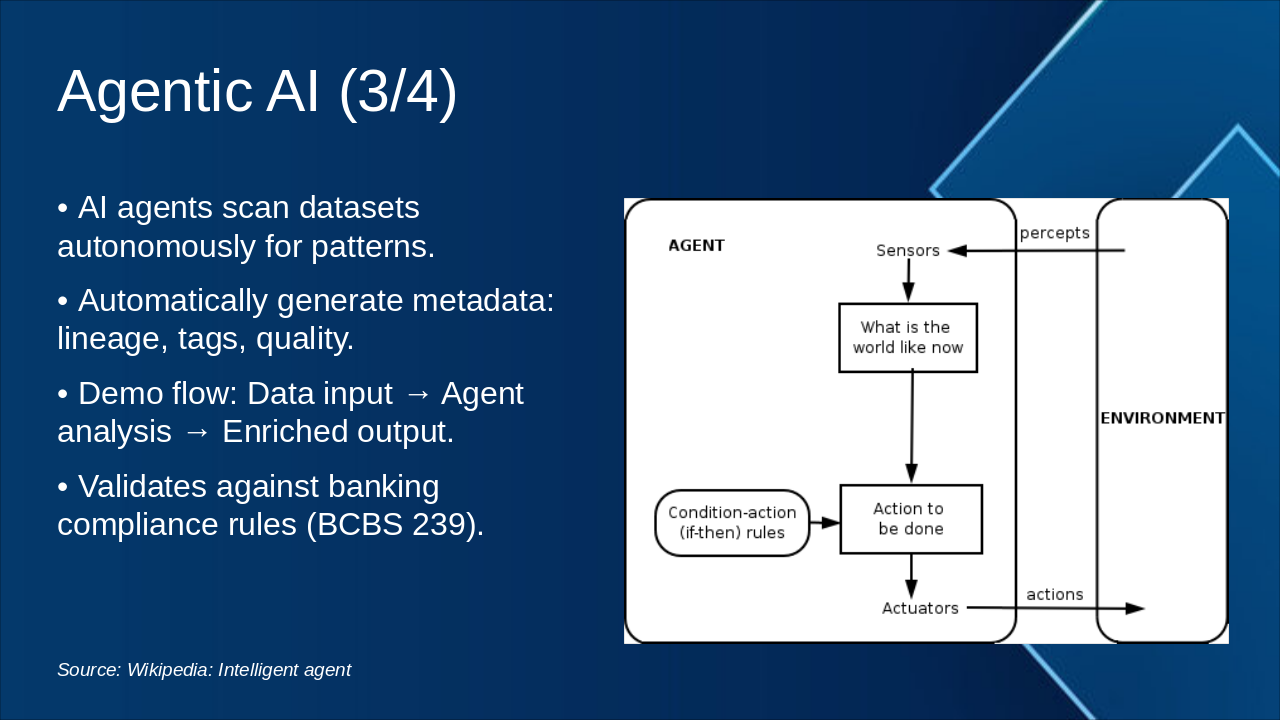
AI agents autonomously scan datasets for patterns and automatically generate metadata like lineage, tags, and quality. The demo flow shows data input → agent analysis → enriched output, validated against banking compliance rules (BCBS 239).

Agentic AI (3/4)

!Image

  • AI agents scan datasets autonomously for patterns.
  • Automatically generate metadata: lineage, tags, quality.
  • Demo flow: Data input → Agent analysis → Enriched output.
  • Validates against banking compliance rules (BCBS 239).

Source: Wikipedia: Intelligent agent

Speaker Notes
Demonstrate the AI-driven metadata generation flow live, highlighting autonomous agent processing.
Slide 28 - Agentic AI (3/4)
Slide 29 of 43

Slide 29 - Agentic AI (4/4)

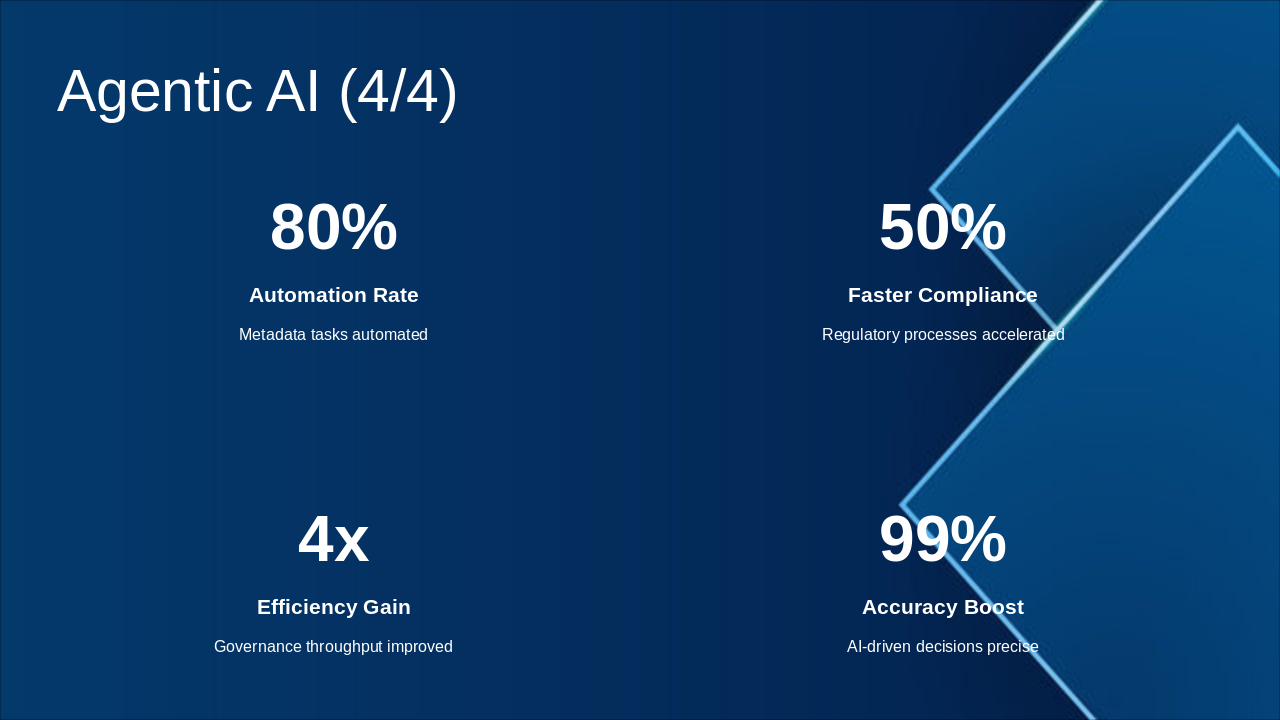
The Agentic AI slide showcases key performance stats, including 80% automation of metadata tasks and 50% faster regulatory compliance. It also highlights a 4x efficiency gain in governance throughput and 99% accuracy for AI-driven decisions.

Agentic AI (4/4)

  • 80%: Automation Rate
  • Metadata tasks automated

  • 50%: Faster Compliance
  • Regulatory processes accelerated

  • 4x: Efficiency Gain
  • Governance throughput improved

  • 99%: Accuracy Boost
  • AI-driven decisions precise

Slide 29 - Agentic AI (4/4)
Slide 30 of 43

Slide 30 - The Modern Metadata Management Platform: Architecture, Governance & Agentic AI

This section header slide introduces Section 09: "Banking-Specific Requirements" in the presentation on the modern metadata management platform. Its subtitle emphasizes tailoring for BCBS 239, KYC/AML compliance, and financial risk management.

The Modern Metadata Management Platform: Architecture, Governance & Agentic AI

09

Banking-Specific Requirements

Tailored for BCBS 239, KYC/AML Compliance, and Financial Risk Management

Source: Financial Services Presentation

Speaker Notes
Emphasize how metadata governance addresses banking regulations like BCBS 239 for risk data aggregation, KYC/AML compliance, and financial data architecture requirements. Transition to maturity model.
Slide 30 - The Modern Metadata Management Platform: Architecture, Governance & Agentic AI
Slide 31 of 43

Slide 31 - Banking Requirements (1/3)

This slide, titled "Banking Requirements (1/3)," outlines essential compliance with BCBS 239 risk data principles. It emphasizes timely risk aggregation, robust metadata governance, data lineage tracking, AI-automated quality controls, and integrated risk management systems.

Banking Requirements (1/3)

  • Comply with BCBS 239 risk data principles
  • Ensure timely, accurate enterprise risk aggregation
  • Implement robust metadata governance for reporting
  • Enable comprehensive data lineage tracking
  • Automate quality controls via agentic AI
  • Support integrated risk management systems

Source: BCBS 239 Risk Data Aggregation

Slide 31 - Banking Requirements (1/3)
Slide 32 of 43

Slide 32 - Banking Requirements (2/3)

This slide details banking requirements for tracking KYC/AML metadata across the data lifecycle, enabling real-time lineage and updates, and ensuring audit-ready transaction metadata. It also generates instant compliance reports and supports automated AML risk assessments.

Banking Requirements (2/3)

  • Tracks KYC/AML metadata across data lifecycle
  • Enables real-time lineage and updates
  • Generates instant compliance reports
  • Supports automated AML risk assessments
  • Ensures audit-ready transaction metadata

Source: KYC/AML Compliance

Speaker Notes
Emphasize real-time metadata tracking for KYC/AML, enabling proactive compliance and instant reporting to meet regulatory demands like BCBS 239.
Slide 32 - Banking Requirements (2/3)
Slide 33 of 43

Slide 33 - Banking Requirements (3/3)

This slide, "Banking Requirements (3/3)", outlines key compliance features for banking. It integrates BCBS 239 risk data aggregation, supports KYC/AML metadata governance, enables AI-driven real-time monitoring, and aligns with regulations.

Banking Requirements (3/3)

!Image

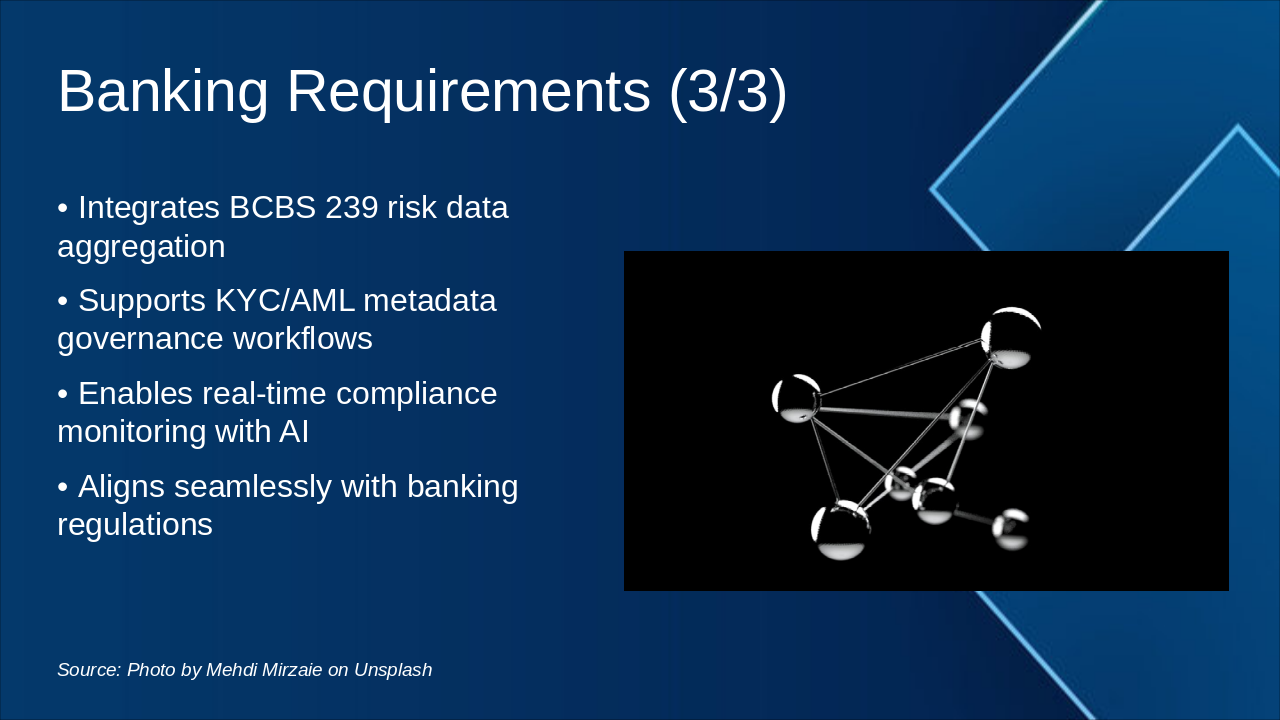
  • Integrates BCBS 239 risk data aggregation
  • Supports KYC/AML metadata governance workflows
  • Enables real-time compliance monitoring with AI
  • Aligns seamlessly with banking regulations

Source: Photo by Mehdi Mirzaie on Unsplash

Slide 33 - Banking Requirements (3/3)
Slide 34 of 43

Slide 34 - Maturity Model

This slide serves as the section header for Section 10, titled "Maturity Model." It introduces an assessment framework designed to benchmark and advance metadata governance capabilities.

Maturity Model

10

Maturity Model

Assessment framework to benchmark and advance metadata governance capabilities

Source: Financial Services Presentation

Speaker Notes
Introduce the Maturity Model as a strategic assessment framework to evaluate current metadata capabilities and guide progression towards enterprise-grade maturity.
Slide 34 - Maturity Model
Slide 35 of 43

Slide 35 - Maturity Model (1/2)

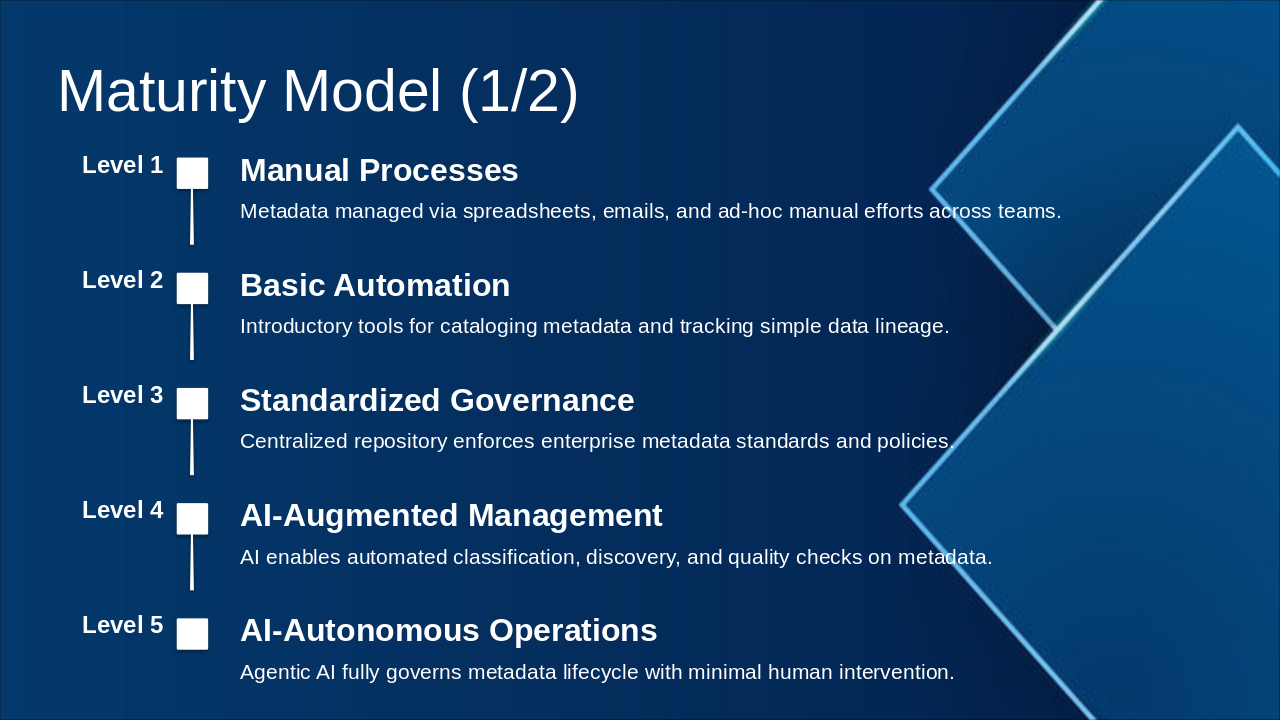
The slide outlines a Maturity Model timeline (1/2) for metadata management, starting at Level 1 with manual processes via spreadsheets and emails, advancing to Level 2's basic automation for cataloging and lineage tracking. It progresses to Level 3's standardized governance with centralized repositories, Level 4's AI-augmented classification and quality checks, and Level 5's fully autonomous AI governance of the metadata lifecycle.

Maturity Model (1/2)

Level 1: Manual Processes Metadata managed via spreadsheets, emails, and ad-hoc manual efforts across teams. Level 2: Basic Automation Introductory tools for cataloging metadata and tracking simple data lineage. Level 3: Standardized Governance Centralized repository enforces enterprise metadata standards and policies. Level 4: AI-Augmented Management AI enables automated classification, discovery, and quality checks on metadata. Level 5: AI-Autonomous Operations Agentic AI fully governs metadata lifecycle with minimal human intervention.

Slide 35 - Maturity Model (1/2)
Slide 36 of 43

Slide 36 - Maturity Model (2/2)

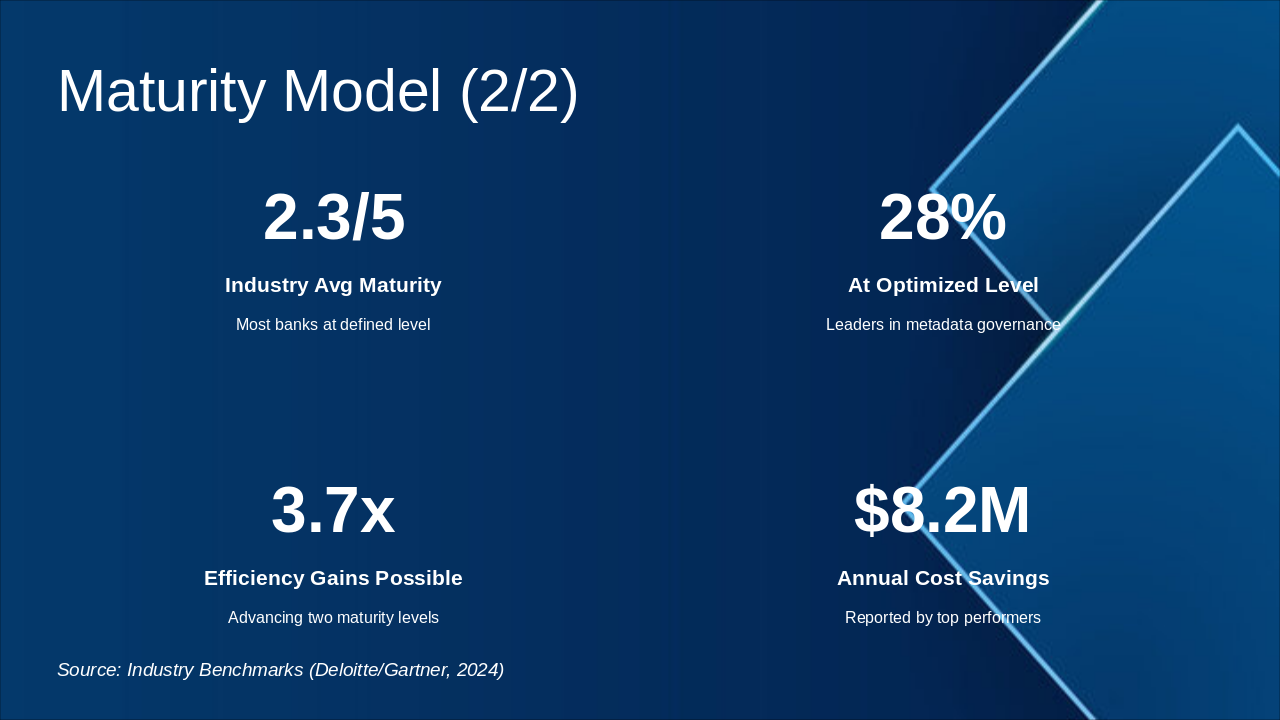
The industry average maturity is 2.3/5, with most banks at the defined level and only 28% at the optimized level as metadata governance leaders. Advancing two maturity levels enables 3.7x efficiency gains and $8.2M in annual cost savings for top performers.

Maturity Model (2/2)

  • 2.3/5: Industry Avg Maturity
  • Most banks at defined level

  • 28%: At Optimized Level
  • Leaders in metadata governance

  • 3.7x: Efficiency Gains Possible
  • Advancing two maturity levels

  • $8.2M: Annual Cost Savings

Reported by top performers Source: Industry Benchmarks (Deloitte/Gartner, 2024)

Speaker Notes
Emphasize benchmarks for self-assessment; discuss paths from average to optimized maturity, tying to BCBS 239 compliance gains.
Slide 36 - Maturity Model (2/2)
Slide 37 of 43

Slide 37 - The Modern Metadata Management Platform: Architecture, Governance & Agentic AI

This section header slide introduces Section 11 titled "Business Value" in the presentation "The Modern Metadata Management Platform: Architecture, Governance & Agentic AI." Its subtitle emphasizes "Quantified Outcomes Driving Enterprise ROI and Compliance Excellence."

The Modern Metadata Management Platform: Architecture, Governance & Agentic AI

11

Business Value

Quantified Outcomes Driving Enterprise ROI and Compliance Excellence

Source: Financial Services Presentation

Speaker Notes
Focus on key metrics like ROI, compliance cost reductions, and efficiency gains from metadata governance and Agentic AI.
Slide 37 - The Modern Metadata Management Platform: Architecture, Governance & Agentic AI
Slide 38 of 43

Slide 38 - Business Value (1/2)

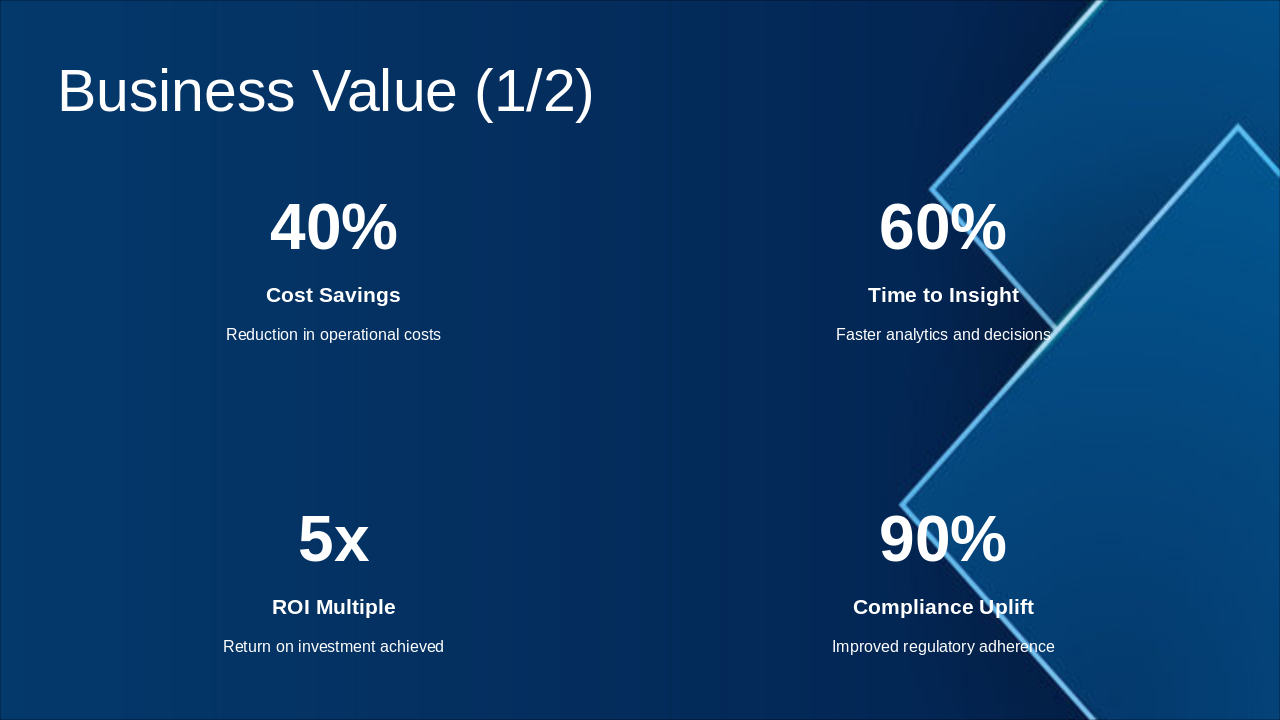
The "Business Value (1/2)" slide showcases key metrics: 40% cost savings from reduced operational costs and 60% faster time to insight for analytics and decisions. It also highlights a 5x ROI multiple and 90% compliance uplift for improved regulatory adherence.

Business Value (1/2)

  • 40%: Cost Savings
  • Reduction in operational costs

  • 60%: Time to Insight
  • Faster analytics and decisions

  • 5x: ROI Multiple
  • Return on investment achieved

  • 90%: Compliance Uplift
  • Improved regulatory adherence

Slide 38 - Business Value (1/2)
Slide 39 of 43

Slide 39 - Business Value (2/2)

This slide outlines key business values, including driving enterprise agility through real-time metadata adaptability and enabling innovation via agentic AI orchestration. It also accelerates compliance mastery (e.g., BCBS 239, KYC/AML), maximizes ROI on data investments, and positions for AI-driven market leadership.

Business Value (2/2)

  • Drives enterprise agility with real-time metadata adaptability
  • Enables innovation through agentic AI orchestration
  • Accelerates compliance mastery (BCBS 239, KYC/AML)
  • Maximizes strategic ROI on data investments
  • Positions for AI-driven market leadership
Slide 39 - Business Value (2/2)
Slide 40 of 43

Slide 40 - Implementation Roadmap

This slide serves as the section header for Section 12, titled "Implementation Roadmap." It includes the subtitle "Phased Rollout Strategy for Enterprise-Wide Deployment and Compliance."

Implementation Roadmap

12

Implementation Roadmap

Phased Rollout Strategy for Enterprise-Wide Deployment and Compliance

Speaker Notes
Emphasize the strategic phased rollout to ensure compliance and minimal disruption in financial services.
Slide 40 - Implementation Roadmap
Slide 41 of 43

Slide 41 - Roadmap (1/2)

This slide presents the first half of the roadmap timeline, spanning Q1 to Q4 2025. It outlines completing metadata assessment for BCBS 239 compliance in Q1, establishing governance with KYC/AML in Q2, deploying the core platform with initial Agentic AI in Q3, and optimizing AI capabilities in Q4.

Roadmap (1/2)

Q1 2025: Complete Metadata Assessment Audit current metadata landscape and identify BCBS 239 compliance gaps. Q2 2025: Establish Governance Framework Define policies, roles, and integrate KYC/AML requirements. Q3 2025: Deploy Core Platform Implement reference architecture with initial Agentic AI features. Q4 2025: Optimize AI Capabilities Refine agents, scale operations, and hit key milestones.

Source: Implementation Roadmap

Speaker Notes
Emphasize risk-minimized phased rollout tailored for financial services compliance.
Slide 41 - Roadmap (1/2)
Slide 42 of 43

Slide 42 - Roadmap (2/2)

This slide, "Roadmap (2/2)", details the timeline starting with H2 2025 implementation of Agentic AI modules and testing. It continues through H1-H2 2026 governance optimization, BCBS 239 compliance, enterprise rollout, performance monitoring, plus ongoing maturity assessments and enhancements.

Roadmap (2/2)

!Image

  • H2 2025: Implement Agentic AI modules with testing
  • H1 2026: Optimize governance, achieve BCBS 239 compliance
  • H2 2026: Enterprise rollout and performance monitoring
  • Ongoing: Maturity assessment and continuous enhancement

Source: Wikipedia

Slide 42 - Roadmap (2/2)
Slide 43 of 43

Slide 43 - Closing

The Closing slide, a conclusion, prominently displays the tagline "Partner for Metadata Excellence." Its subtitle urges viewers to "Contact us today to transform your metadata strategy" and closes with "Thank you!"

Closing

Partner for Metadata Excellence.

Contact us today to transform your metadata strategy. Thank you!

Source: The Modern Metadata Management Platform: Architecture, Governance & Agentic AI

Speaker Notes
Emphasize partnership value, share contact details (e.g., email, LinkedIn), invite questions, and thank the audience.
Slide 43 - Closing

Discover More Presentations

Explore thousands of AI-generated presentations for inspiration

Browse Presentations
Powered by AI

Create Your Own Presentation

Generate professional presentations in seconds with Karaf's AI. Customize this presentation or start from scratch.

Create New Presentation

Powered by Karaf.ai — AI-Powered Presentation Generator