Satellite Comms: Fundamentals to Future Trends (45 chars)

Generated from prompt:

Create a 30-slide presentation on the topic 'Satellite Communication and its Application'. The presentation should be informative and suitable for an awareness session, covering the fundamentals, working principles, types of satellites, communication technologies, orbits, frequency bands, satellite subsystems, earth stations, applications in various sectors (telecommunication, broadcasting, navigation, weather forecasting, remote sensing, defense, IoT, etc.), advantages, challenges, and future trends like LEO constellations and 6G integration. Include visuals and clear slide titles.

30-slide awareness presentation on satellite communication: fundamentals, types/orbits/bands, subsystems, earth stations, applications (telecom, broadcasting, navigation, weather, remote sensing, defe

December 16, 202530 slides
Slide 1 of 30

Slide 1 - Satellite Communication and its Applications

This title slide features the main topic "Satellite Communication and its Applications." It includes a subtitle noting an "Informative Awareness Session" by presenter [Your Name].

Satellite Communication and its Applications

Informative Awareness Session Presenter: [Your Name]

Source: satellite imagery background

Speaker Notes
Welcome slide introducing the topic with a professional satellite image backdrop.
Slide 1 - Satellite Communication and its Applications
Slide 2 of 30

Slide 2 - Presentation Agenda

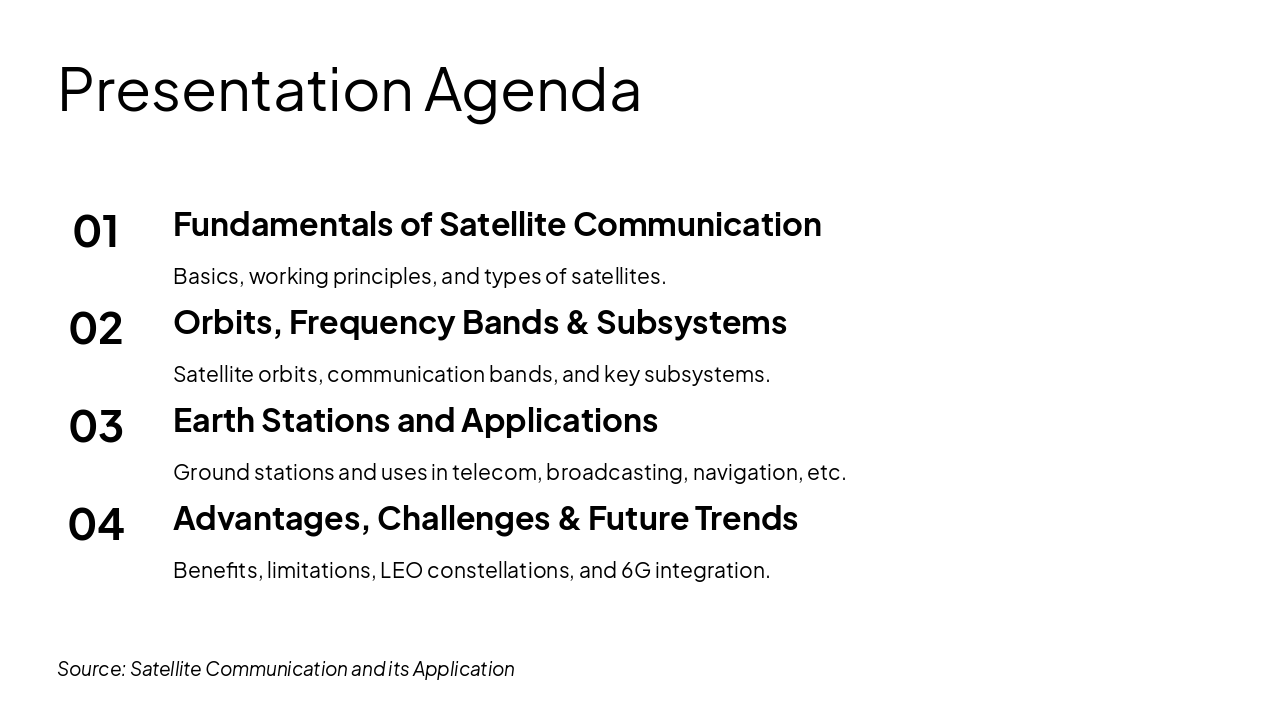
This agenda slide outlines a presentation on satellite communication with four key sections: Fundamentals (basics, principles, types), Orbits/Frequency Bands/Subsystems, Earth Stations/Applications (telecom, broadcasting, navigation), and Advantages/Challenges/Future Trends (LEO, 6G). It provides a structured progression from core concepts to practical uses and emerging developments.

Presentation Agenda

  1. Fundamentals of Satellite Communication
  2. Basics, working principles, and types of satellites.

  3. Orbits, Frequency Bands & Subsystems
  4. Satellite orbits, communication bands, and key subsystems.

  5. Earth Stations and Applications
  6. Ground stations and uses in telecom, broadcasting, navigation, etc.

  7. Advantages, Challenges & Future Trends

Benefits, limitations, LEO constellations, and 6G integration. Source: Satellite Communication and its Application

Speaker Notes
Introduce the overall structure of the 30-slide presentation.
Slide 2 - Presentation Agenda
Slide 3 of 30

Slide 3 - Fundamentals of Satellite Communication

This slide serves as the section header for "Fundamentals of Satellite Communication," labeled as section 01. Its subtitle highlights exploring the definition, history, and role in global connectivity.

Fundamentals of Satellite Communication

01

Fundamentals of Satellite Communication

Exploring Definition, History, and Role in Global Connectivity

Source: Presentation on Satellite Communication and its Applications

Speaker Notes
Key concepts: Definition, brief history, importance in global connectivity.
Slide 3 - Fundamentals of Satellite Communication
Slide 4 of 30

Slide 4 - What is Satellite Communication?

Satellite communication is a wireless technology that uses satellites to relay signals. It enables seamless global coverage anywhere on Earth via line-of-sight transmission through space.

What is Satellite Communication?

  • Wireless technology using satellites as signal relays
  • Enables seamless global coverage anywhere on Earth
  • Relies on line-of-sight transmission through space

Source: Fundamentals of Satellite Communication

Speaker Notes
Introduce the basic definition and key characteristics. Emphasize global reach and relay function.
Slide 4 - What is Satellite Communication?
Slide 5 of 30

Slide 5 - Satellite Communication Basics Visual

This slide visually explains satellite communication basics, depicting the uplink where a ground station transmits a signal to the satellite. The satellite then relays and amplifies the signal, sending it back via downlink to a receiving station.

Satellite Communication Basics Visual

!Image

  • Uplink: Ground station transmits signal to satellite.
  • Satellite relays and amplifies the incoming signal.
  • Downlink: Satellite beams signal to receiving station.

Source: Communications satellite

Slide 5 - Satellite Communication Basics Visual
Slide 6 of 30

Slide 6 - Working Principles

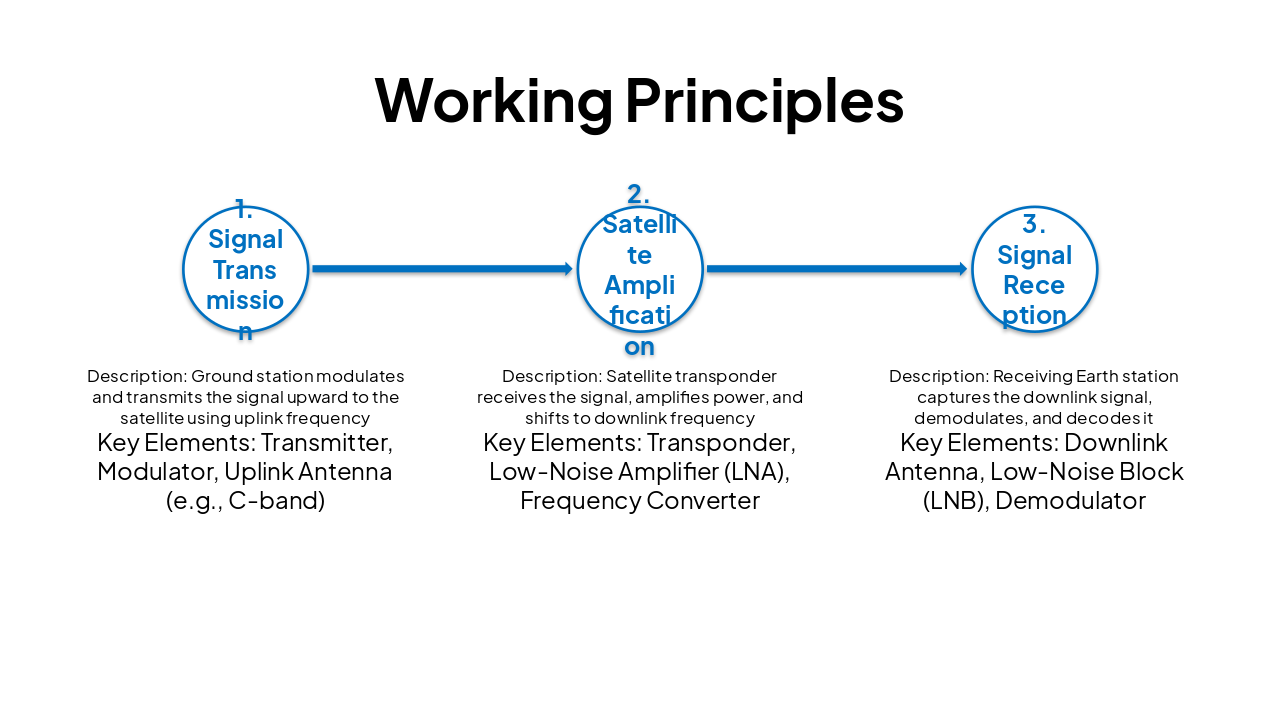
The slide outlines a three-step workflow for satellite communication principles. Step 1 transmits modulated signals from a ground station via uplink antenna; Step 2 amplifies and frequency-shifts them at the satellite transponder; Step 3 receives and demodulates the downlink at an Earth station, with key elements like antennas, LNAs, and modulators.

Working Principles

{ "headers": [ "Step", "Description", "Key Elements" ], "rows": [ [ "1. Signal Transmission", "Ground station modulates and transmits the signal upward to the satellite using uplink frequency", "Transmitter, Modulator, Uplink Antenna (e.g., C-band)" ], [ "2. Satellite Amplification", "Satellite transponder receives the signal, amplifies power, and shifts to downlink frequency", "Transponder, Low-Noise Amplifier (LNA), Frequency Converter" ], [ "3. Signal Reception", "Receiving Earth station captures the downlink signal, demodulates, and decodes it", "Downlink Antenna, Low-Noise Block (LNB), Demodulator" ] ] }

Slide 6 - Working Principles
Slide 7 of 30

Slide 7 - Types of Satellites

This section header slide introduces the topic "Types of Satellites." Its subtitle specifies "Classification by Purpose and Orbit."

Types of Satellites

Classification by Purpose and Orbit

Slide 7 - Types of Satellites
Slide 8 of 30

Slide 8 - Satellite Types

The slide "Satellite Types" lists four main categories of satellites in bullet points. They include communication satellites for telecom and broadcasting, navigation satellites like GPS for positioning, Earth observation satellites for remote sensing, and weather satellites for forecasting.

Satellite Types

  • Communication satellites for telecom and broadcasting
  • Navigation satellites (e.g., GPS) for positioning
  • Earth observation satellites for remote sensing
  • Weather and meteorological satellites for forecasting
Slide 8 - Satellite Types
Slide 9 of 30

Slide 9 - Satellite Types Illustration

The slide illustrates three satellite orbit types: Geostationary (GEO) at 35,786 km with a fixed position, Medium Earth Orbit (MEO) from 2,000-35,000 km for navigation, and Low Earth Orbit (LEO) below 2,000 km for low-latency constellations. It features an image highlighting these distinctions.

Satellite Types Illustration

!Image

  • Geostationary Orbit (GEO): 35,786 km altitude, fixed position.
  • Medium Earth Orbit (MEO): 2,000-35,000 km, navigation systems.
  • Low Earth Orbit (LEO): Below 2,000 km, low latency constellations.

Source: Wikipedia

Speaker Notes
Visual representation of GEO, MEO, and LEO satellites with icons.
Slide 9 - Satellite Types Illustration
Slide 10 of 30

Slide 10 - Orbits and Frequency Bands

This section header slide is titled "Orbits and Frequency Bands." Its subtitle, "Orbital paths and spectrum usage," introduces key concepts in satellite orbits and radio frequency allocation.

Orbits and Frequency Bands

Orbits and Frequency Bands

Orbital paths and spectrum usage.

Slide 10 - Orbits and Frequency Bands
Slide 11 of 30

Slide 11 - Satellite Orbits

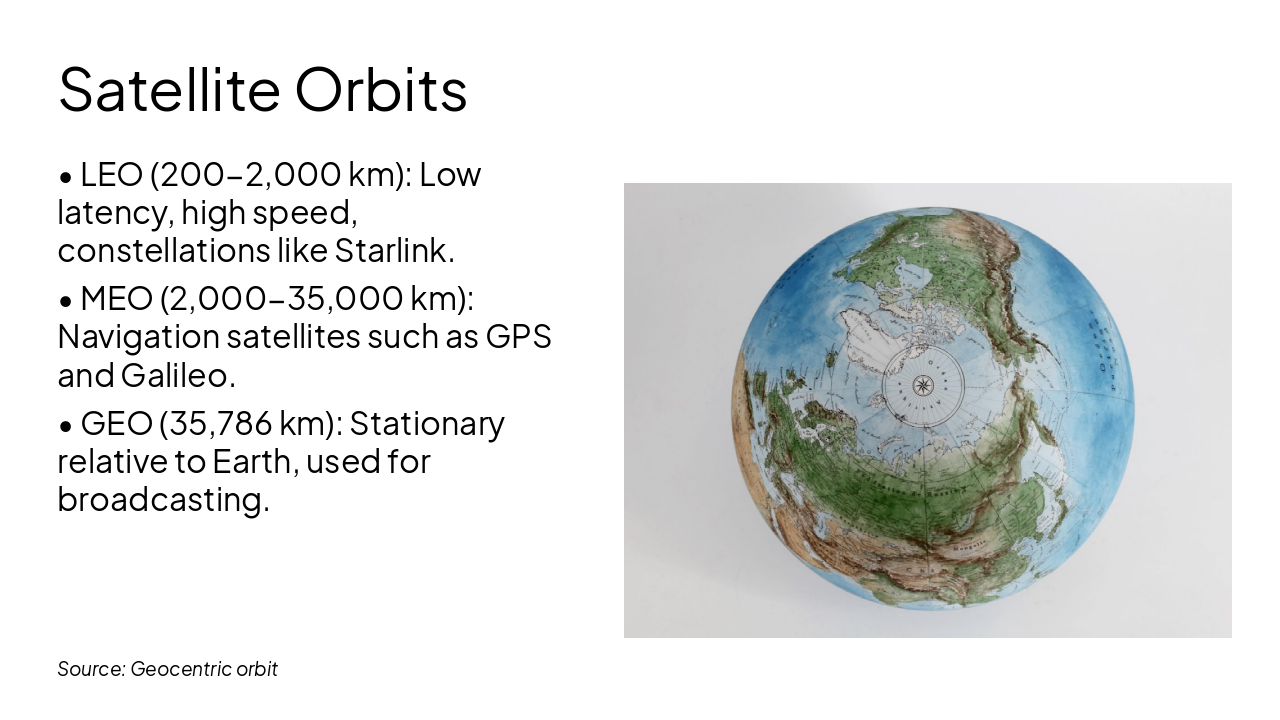
The slide "Satellite Orbits" depicts three main types: LEO (200-2,000 km) for low-latency, high-speed constellations like Starlink; MEO (2,000-35,000 km) for navigation satellites like GPS and Galileo; and GEO (35,786 km) for stationary broadcasting. It highlights their altitudes and primary applications visually.

Satellite Orbits

!Image

  • LEO (200-2,000 km): Low latency, high speed, constellations like Starlink.
  • MEO (2,000-35,000 km): Navigation satellites such as GPS and Galileo.
  • GEO (35,786 km): Stationary relative to Earth, used for broadcasting.

Source: Geocentric orbit

Slide 11 - Satellite Orbits
Slide 12 of 30

Slide 12 - Frequency Bands in Satcom

This slide features a table on Satcom frequency bands, listing L through Ka with their GHz ranges (1-2 to 26-40) and typical uses. Applications span mobile/GPS, telemetry, broadcasting, military imaging, DTH TV/broadband, and high-throughput satcom/5G backhaul.

Frequency Bands in Satcom

{ "headers": [ "Band", "Frequency Range (GHz)", "Typical Uses" ], "rows": [ [ "L", "1-2", "Mobile, GPS, GNSS" ], [ "S", "2-4", "Telemetry, Weather radar" ], [ "C", "4-8", "Broadcasting, Maritime VSAT" ], [ "X", "8-12", "Military, Defense imaging" ], [ "Ku", "12-18", "DTH TV, Broadband internet" ], [ "Ka", "26-40", "High-throughput satcom, 5G backhaul" ] ] }

Source: Satellite Communication Standards

Slide 12 - Frequency Bands in Satcom
Slide 13 of 30

Slide 13 - Satellite Subsystems

This slide serves as a section header titled "Satellite Subsystems." Its subtitle highlights the core components of a satellite.

Satellite Subsystems

Satellite Subsystems

Core components of a satellite.

Slide 13 - Satellite Subsystems
Slide 14 of 30

Slide 14 - Key Subsystems

The "Key Subsystems" slide presents a feature grid of five essential satellite components with icons and descriptions. These include Transponders for signal relay, Antennas for microwave comms, Solar Power for energy supply, Propulsion for orbit maneuvers, and TT&C for operations.

Key Subsystems

{ "features": [ { "icon": "šŸ“”", "heading": "Transponders", "description": "Receive, amplify, and retransmit signals to Earth stations." }, { "icon": "šŸ›°ļø", "heading": "Antennas", "description": "Transmit and receive microwave signals for comms links." }, { "icon": "ā˜€ļø", "heading": "Solar Power", "description": "Solar panels and batteries supply continuous energy." }, { "icon": "šŸš€", "heading": "Propulsion", "description": "Thrusters enable orbit control and maneuvers." }, { "icon": "šŸ“Š", "heading": "TT&C", "description": "Telemetry, tracking, and command for operations." } ] }

Slide 14 - Key Subsystems
Slide 15 of 30

Slide 15 - Satellite Subsystem Flow

The Satellite Subsystem Flow slide outlines a four-step workflow: Power Generation via solar panels and batteries for continuous power, Command & Control for receiving commands and managing operations, Signal Processing for data demodulation and correction, and Transmission for amplifying and beaming signals to Earth. Each step details its function and key role in supporting reliable satellite communication.

Satellite Subsystem Flow

{ "headers": [ "Step", "Description", "Key Role" ], "rows": [ [ "Power Generation", "Solar panels convert sunlight to electricity; batteries store excess for eclipses.", "Supplies power to all subsystems, ensuring continuous operation." ], [ "Command & Control", "Receives ground commands via uplink; monitors health and executes maneuvers.", "Manages satellite operations and responds to instructions." ], [ "Signal Processing", "Demodulates uplink signals, processes data (encoding, error correction).", "Prepares payload data for accurate downlink transmission." ], [ "Transmission", "Amplifies processed signals and beams them to Earth stations.", "Delivers communication data reliably to users." ] ] }

Source: Satellite Communication and its Application Presentation

Speaker Notes
This slide illustrates the sequential flow of key satellite subsystems, highlighting the power generation as the starting point that enables command control, signal processing, and finally transmission. Emphasize the interdependence of these subsystems for reliable satellite operation.
Slide 15 - Satellite Subsystem Flow
Slide 16 of 30

Slide 16 - Earth Stations

This section header slide, titled "Earth Stations" (Section 08), introduces key satellite communication elements. Its subtitle defines earth stations as ground-based infrastructure for transmitting and receiving satellite signals.

Earth Stations

08

Earth Stations

Ground-based infrastructure for transmitting and receiving satellite signals.

Speaker Notes
Highlight the importance of earth stations as ground-based infrastructure in satellite communication systems.
Slide 16 - Earth Stations
Slide 17 of 30

Slide 17 - Earth Station Components

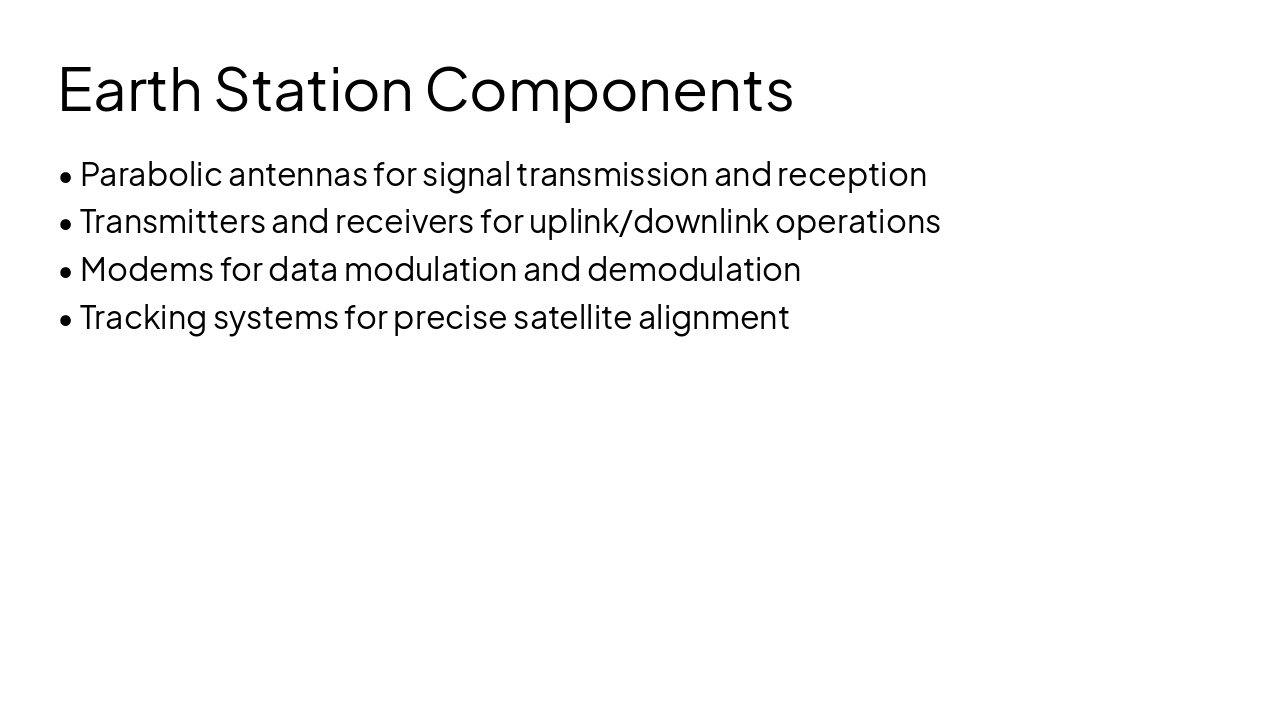
Earth station components primarily consist of parabolic antennas for signal transmission and reception, along with transmitters and receivers for uplink/downlink operations. Modems manage data modulation and demodulation, while tracking systems ensure precise satellite alignment.

Earth Station Components

  • Parabolic antennas for signal transmission and reception
  • Transmitters and receivers for uplink/downlink operations
  • Modems for data modulation and demodulation
  • Tracking systems for precise satellite alignment
Slide 17 - Earth Station Components
Slide 18 of 30

Slide 18 - Earth Station Visual

This slide features a visual of earth stations in satellite communications. It illustrates VSAT terminals for small-scale links, hub stations managing remote sites, and large parabolic dishes for transmitting and receiving signals.

Earth Station Visual

!Image

  • VSAT terminals enable small-scale satellite links.
  • Hub stations manage multiple remote earth stations.
  • Large parabolic dishes transmit and receive signals.

Source: satellite earth station

Slide 18 - Earth Station Visual
Slide 19 of 30

Slide 19 - Applications Across Sectors

This slide serves as the header for Section 06, titled "Applications Across Sectors." It features a subtitle highlighting real-world uses in telecommunication, broadcasting, navigation, weather, and defense.

Applications Across Sectors

06

Applications Across Sectors

Real-world uses in telecommunication, broadcasting, navigation, weather, and defense.

Source: Satellite Communication Presentation

Speaker Notes
Overview of real-world applications across key sectors like telecom, broadcasting, navigation, and more.
Slide 19 - Applications Across Sectors
Slide 20 of 30

Slide 20 - Telecom & Broadcasting

Satellite telecom provides backhaul for remote networks, reliable connectivity in underserved areas, and supports voice/data services, disaster recovery, and maritime/aeronautical communications. Satellite broadcasting delivers DTH TV and radio to wide audiences, bypassing terrestrial limits for rural reach and ensuring high-quality content with nationwide coverage.

Telecom & Broadcasting

TelecomBroadcasting
Satellite telecom enables backhaul for remote networks and mobile coverage. Provides reliable connectivity in underserved areas, supports voice/data services, disaster recovery, and maritime/aeronautical communications.Satellite broadcasting delivers DTH TV and radio to wide audiences. Direct-to-home services bypass terrestrial limits, perfect for rural reach. Ensures high-quality content, live events, and nationwide coverage.
Slide 20 - Telecom & Broadcasting
Slide 21 of 30

Slide 21 - Navigation & Weather

GNSS systems like GPS and Galileo enable precise global positioning, while meteorology satellites provide real-time weather forecasts. These technologies support aviation, maritime, and personal navigation, aid disaster prediction and climate monitoring, and enhance safety and efficiency across sectors.

Navigation & Weather

  • GNSS (GPS, Galileo) enables precise global positioning
  • Meteorology satellites deliver real-time weather forecasts
  • Supports aviation, maritime, and personal navigation needs
  • Aids disaster prediction and climate monitoring efforts
  • Enhances safety and efficiency across sectors
Slide 21 - Navigation & Weather
Slide 22 of 30

Slide 22 - Remote Sensing Applications

The slide "Remote Sensing Applications" illustrates satellite imagery uses via an image and bullet points. It covers crop health monitoring, disaster detection (floods, wildfires, earthquakes), precision agriculture with yield prediction, and tracking environmental changes and land use.

Remote Sensing Applications

!Image

  • Satellite imagery for crop health monitoring
  • Disaster detection: floods, wildfires, earthquakes
  • Precision agriculture and yield prediction
  • Environmental changes and land use tracking

Source: Remote sensing

Slide 22 - Remote Sensing Applications
Slide 23 of 30

Slide 23 - Defense & IoT

The "Defense & IoT" slide highlights satellite applications in two key areas. Defense uses include secure, jam-resistant communications and high-resolution surveillance for military operations in remote or hostile environments, while IoT benefits from reliable connectivity for remote devices enabling environmental monitoring, asset tracking, and smart agriculture.

Defense & IoT

Defense ApplicationsIoT Applications
Satellites enable secure, jam-resistant communications for military operations and high-resolution surveillance for real-time intelligence in remote or hostile environments.Provides reliable connectivity for IoT devices in remote areas lacking terrestrial networks, enabling environmental monitoring, asset tracking, and smart agriculture.
Slide 23 - Defense & IoT
Slide 24 of 30

Slide 24 - Satellite Applications Impact

The "Satellite Applications Impact" slide showcases key statistics on satellite usage. It highlights over 6 billion global satellite TV subscribers, 70% reliance on satellites for maritime communications, and 50% of rural internet access via satellites.

Satellite Applications Impact

  • 6B+: TV Subscribers
  • Global satellite TV users

  • 70%: Maritime Communications
  • Relies on satellites

  • 50%: Rural Internet
  • Access via satellite

Slide 24 - Satellite Applications Impact
Slide 25 of 30

Slide 25 - Satellite Communication and its Application

This section header slide, part of "Satellite Communication and its Application," is titled "Advantages and Challenges." Its subtitle provides an overview of key advantages and challenges in satellite communication systems.

Satellite Communication and its Application

Advantages and Challenges

Overview of key advantages and challenges in satellite communication systems

Source: Awareness Session

Speaker Notes
Overview of pros and cons in satellite communication.
Slide 25 - Satellite Communication and its Application
Slide 26 of 30

Slide 26 - Advantages

Satellite communication provides global coverage for remote areas and reliable backup during disasters or outages. It delivers high bandwidth for data-intensive applications while enabling mobility for vehicles, ships, and aircraft.

Advantages

  • Global coverage reaches remote and underserved areas
  • Reliable backup during natural disasters and outages
  • High bandwidth supports data-intensive applications
  • Enables mobility for vehicles, ships, and aircraft
Slide 26 - Advantages
Slide 27 of 30

Slide 27 - Challenges

The "Challenges" slide lists key issues in satellite technology. These include high latency in GEO satellites, costly launches, spectrum interference, space debris risks, and limited bandwidth availability.

Challenges

  • High latency in GEO satellites
  • Costly satellite launches
  • Spectrum interference issues
  • Space debris risks
  • Limited bandwidth availability
Slide 27 - Challenges
Slide 28 of 30

Slide 28 - Expert Quote on Satcom

This slide presents an expert quote on Satcom titled "Expert Quote on Satcom." Brahima Sanou, former Director of the Telecommunication Development Bureau at ITU, states that satellites bridge the digital divide by delivering high-speed internet, education, and essential services to remote communities worldwide, fostering global inclusion.

Expert Quote on Satcom

> Satellites bridge the digital divide, delivering high-speed internet, education, and essential services to remote and underserved communities worldwide, fostering global inclusion.

— Brahima Sanou, Former Director, Telecommunication Development Bureau, ITU

Source: ITU Telecommunication Development Bureau

Slide 28 - Expert Quote on Satcom
Slide 29 of 30

Slide 29 - Future Trends

This slide serves as the section header for Section 10, titled "Future Trends." It features the subtitle "Emerging Technologies: LEO Constellations and 6G Integration."

Future Trends

10

Future Trends

Emerging Technologies: LEO Constellations and 6G Integration

Speaker Notes
Discuss emerging technologies like LEO constellations and 6G integration.
Slide 29 - Future Trends
Slide 30 of 30

Slide 30 - Future: LEO & 6G

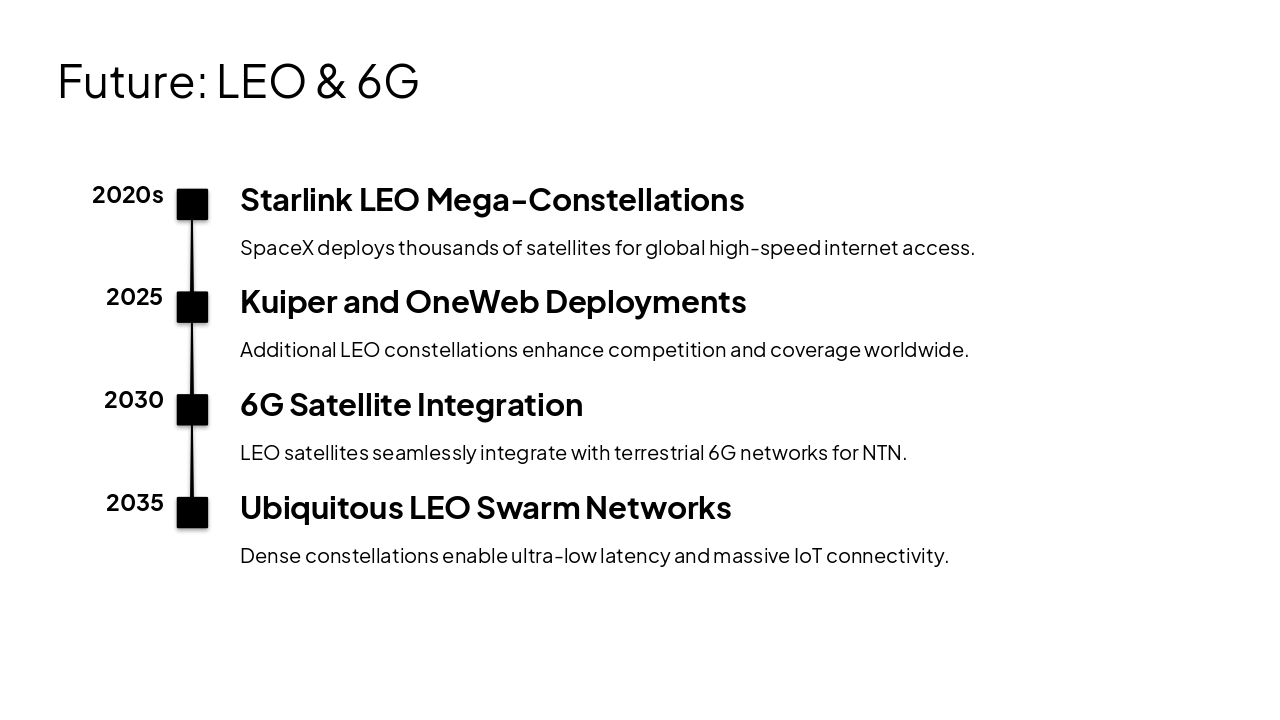
The timeline depicts the future of LEO satellite constellations, beginning with Starlink's mega-deployments in the 2020s for global high-speed internet and Kuiper/OneWeb expansions in 2025 for enhanced coverage. It progresses to 6G satellite integration by 2030 and ubiquitous LEO swarms by 2035 enabling ultra-low latency and massive IoT connectivity.

Future: LEO & 6G

2020s: Starlink LEO Mega-Constellations SpaceX deploys thousands of satellites for global high-speed internet access. 2025: Kuiper and OneWeb Deployments Additional LEO constellations enhance competition and coverage worldwide. 2030: 6G Satellite Integration LEO satellites seamlessly integrate with terrestrial 6G networks for NTN. 2035: Ubiquitous LEO Swarm Networks Dense constellations enable ultra-low latency and massive IoT connectivity.

Slide 30 - Future: LEO & 6G

Discover More Presentations

Explore thousands of AI-generated presentations for inspiration

Browse Presentations
Powered by AI

Create Your Own Presentation

Generate professional presentations in seconds with Karaf's AI. Customize this presentation or start from scratch.

Create New Presentation

Powered by Karaf.ai — AI-Powered Presentation Generator