Unlocking 'Induce': Etymology & Usage

Generated from prompt:

An academic PowerPoint presentation explaining the English word 'induce' — including its etymology, definitions, usages, collocations, and example sentences. The tone should be formal and educational, suitable for a 5-minute lecture.

An 8-slide academic PowerPoint on 'induce': etymology from Latin "inducere" (lead in), definitions (persuade, cause effect), usages, collocations, examples (e.g., induce emotions/hallucinations), and

December 13, 20258 slides
Slide 1 of 8

Slide 1 - The Word 'Induce'

This title slide is headed "The Word 'Induce'." Its subtitle promises an academic overview of the word's etymology, definitions, usages, collocations, and examples.

The Word 'Induce'

An Academic Overview of Etymology, Definitions, Usages, Collocations, and Examples

Source: Academic Lecture

Speaker Notes
5-minute formal educational overview.
Slide 1 - The Word 'Induce'
Slide 2 of 8

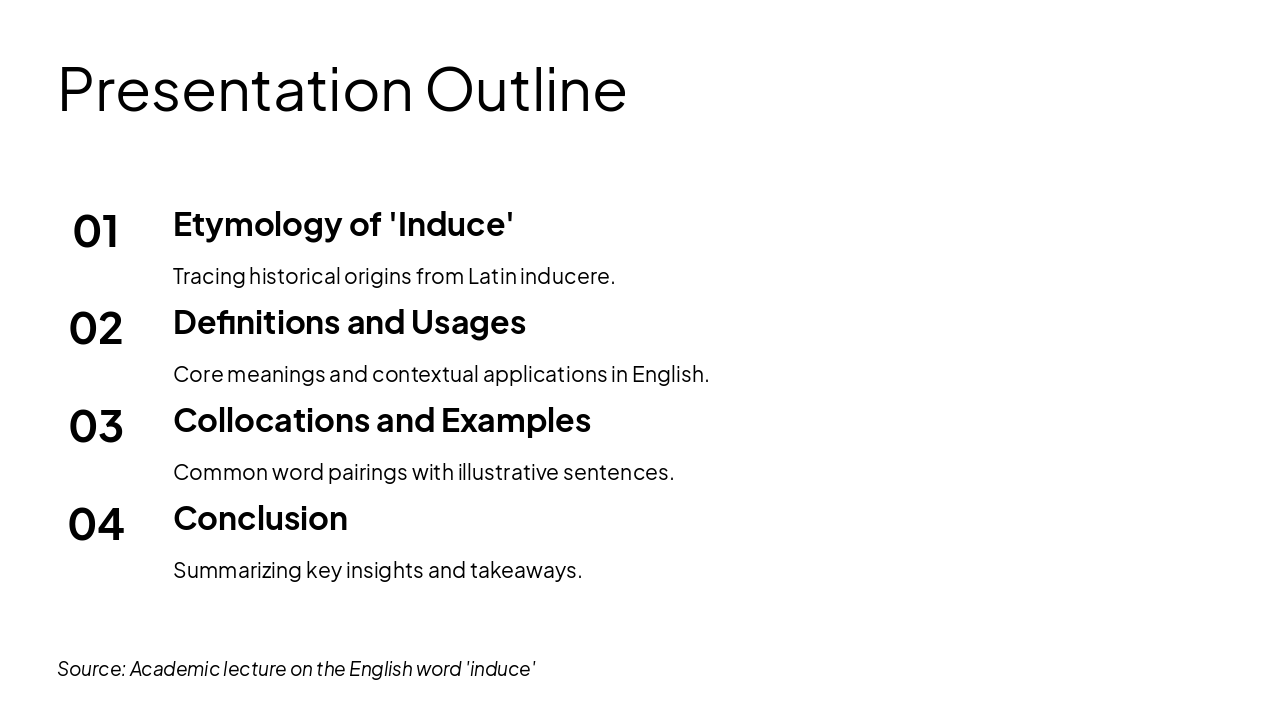
Slide 2 - Presentation Outline

This agenda slide outlines the structure of a presentation on the word "induce." It covers etymology from Latin origins, definitions and usages in English, collocations with examples, and key takeaways in the conclusion.

Presentation Outline

  1. Etymology of 'Induce'
  2. Tracing historical origins from Latin inducere.

  3. Definitions and Usages
  4. Core meanings and contextual applications in English.

  5. Collocations and Examples
  6. Common word pairings with illustrative sentences.

  7. Conclusion

Summarizing key insights and takeaways. Source: Academic lecture on the English word 'induce'

Speaker Notes
Present this slide to outline the structure, setting expectations for a concise 5-minute educational talk.
Slide 2 - Presentation Outline
Slide 3 of 8

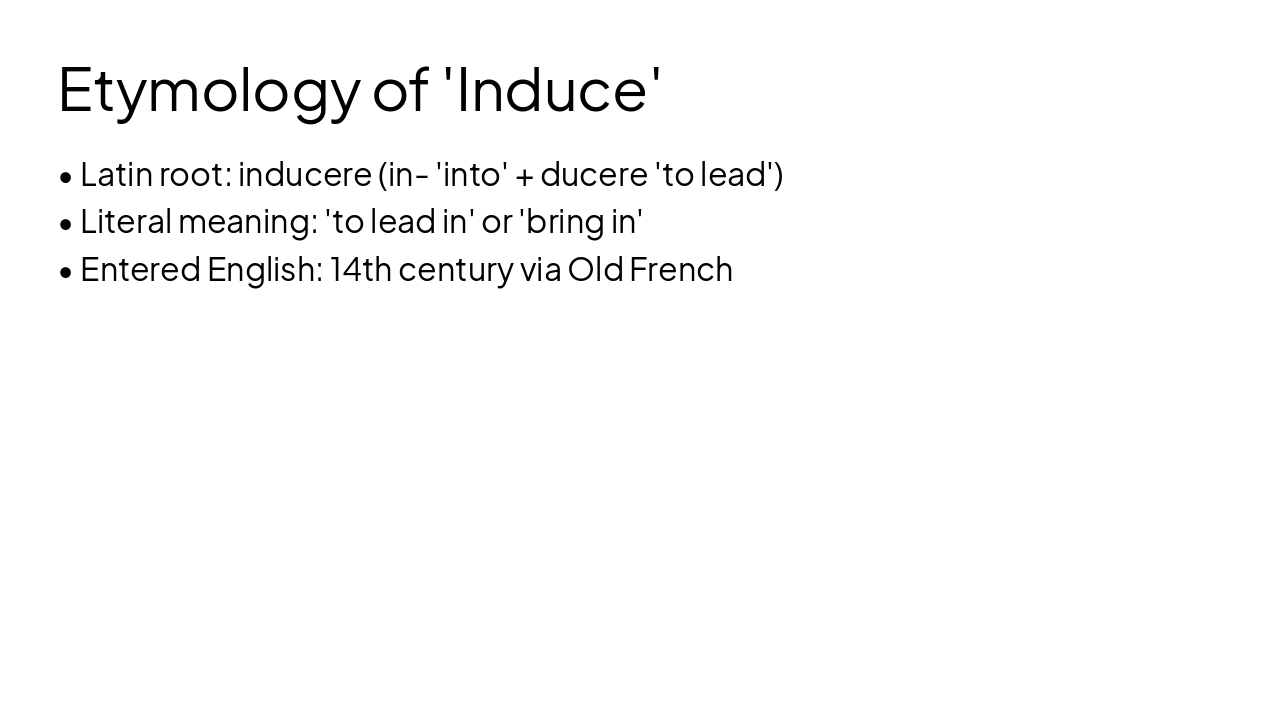
Slide 3 - Etymology of 'Induce'

The word "induce" derives from the Latin root inducere, combining in- ("into") and ducere ("to lead"), with a literal meaning of "to lead in" or "bring in." It entered English in the 14th century via Old French.

Etymology of 'Induce'

  • Latin root: inducere (in- 'into' + ducere 'to lead')
  • Literal meaning: 'to lead in' or 'bring in'
  • Entered English: 14th century via Old French
Slide 3 - Etymology of 'Induce'
Slide 4 of 8

Slide 4 - Key Definitions

The "Key Definitions" slide outlines the primary meanings of "induce." It covers persuading or influencing action, causing a reaction or effect, and in medicine/science, initiating labor or voltage.

Key Definitions

  • To persuade or influence someone to act
  • To cause or produce a reaction or effect
  • In medicine/science: to initiate labor or voltage
Slide 4 - Key Definitions
Slide 5 of 8

Slide 5 - Usages in Context

The slide "Usages in Context" contrasts formal and scientific/medical uses of "induce." Formally, it persuades beliefs through evidence; technically, it causes reactions or states like chemicals sparking reactions or drugs inducing sleep.

Usages in Context

Formal UsageScientific & Medical Usages

| The evidence induced belief.

In formal discourse, 'induce' means to persuade or influence someone to adopt a particular belief or opinion through reasoning or evidence. | Chemicals induce reactions. Drugs induce sleep.

In technical fields, 'induce' refers to causing or bringing about a specific reaction, process, or physiological state. |

Slide 5 - Usages in Context
Slide 6 of 8

Slide 6 - Common Collocations

The slide "Common Collocations" features a table listing nouns/phrases paired with the verb "induce." Examples include induce labor, induce vomiting, induce sleep, and induce change.

Common Collocations

{ "headers": [ "Noun/Phrase", "Example" ], "rows": [ [ "Labor", "Induce labor" ], [ "Vomiting", "Induce vomiting" ], [ "Sleep", "Induce sleep" ], [ "Change", "Induce change" ] ] }

Slide 6 - Common Collocations
Slide 7 of 8

Slide 7 - Example Sentences

This bullet slide, titled "Example Sentences," provides three examples of the verb "induced" in different contexts. They illustrate inducing emotions via a speech, hallucinations via drugs, and critical thinking via a teacher.

Example Sentences

  • The speech induced strong emotions in the audience.
  • Certain drugs can induce hallucinations.
  • The teacher induced students to think critically.
Slide 7 - Example Sentences
Slide 8 of 8

Slide 8 - Key Takeaways

The Key Takeaways slide summarizes that "induce" implies leading or causing something. It advises mastering its nuances for precise English use and ends with "Questions?"

Key Takeaways

'Induce' implies leading or causing.

Master its nuances for precise English use.

Questions?

Source: English Word: Induce

Speaker Notes
Closing message (6 words): Master its nuances for precise English use. Call-to-action (5 words): Questions? Practice in sentences.
Slide 8 - Key Takeaways

Discover More Presentations

Explore thousands of AI-generated presentations for inspiration

Browse Presentations
Powered by AI

Create Your Own Presentation

Generate professional presentations in seconds with Karaf's AI. Customize this presentation or start from scratch.

Create New Presentation

Powered by Karaf.ai — AI-Powered Presentation Generator