Samsung vs. Wadhwa: Parallel Imports Case

Generated from prompt:

Case Study Presentation: Parallel Importation of Goods — Samsung Electronics vs. Kapil Wadhwa (2012) Slide 1: Title Slide - Title: Case Study on Parallel Importation of Goods - Subtitle: Samsung Electronics Co. Ltd. vs. Kapil Wadhwa & Ors (2012) - Presented by: [Your Name] - Subject: Intellectual Property Law / Business Law Slide 2: Introduction - Brief overview of the concept of parallel importation - Explanation of how it applies in international trade - Objective of the case study Slide 3: Background of the Case - Samsung Electronics: a global brand with regional market divisions - Kapil Wadhwa: importer and reseller in India - Nature of dispute: importation of Samsung printers not meant for Indian market Slide 4: Legal Issue - Whether parallel importation amounts to trademark infringement under Indian law - Relevant legal provisions: Trade Marks Act, 1999 (Sections 29, 30) Slide 5: Arguments by Samsung - Claimed trademark infringement and unauthorized use - Asserted that imported goods were not meant for Indian consumers - Concern over brand image and quality control Slide 6: Arguments by Kapil Wadhwa - Asserted that genuine goods can be freely resold once legally purchased - Relied on the principle of international exhaustion of trademark rights Slide 7: Court’s Decision - Delhi High Court’s findings - Initially favored Samsung but reversed in appeal - Held that parallel importation of genuine goods is not trademark infringement Slide 8: Key Legal Principle — Exhaustion Doctrine - National vs. International exhaustion - India’s position after this case: international exhaustion recognized Slide 9: Impact of the Case - Implications for brand owners and importers - How it shaped Indian IP law and parallel trade policies Slide 10: Conclusion - Summary of key takeaways - Significance of Samsung vs. Kapil Wadhwa in trademark jurisprudence - Final thoughts on balancing IP protection and market competition

Case study on 2012 Delhi HC ruling: Parallel importation of genuine Samsung printers ≠ trademark infringement. Affirmed international exhaustion doctrine, balancing IP protection with free trade for i

December 16, 20255 slides
Slide 1 of 5

Slide 1 - Case Study on Parallel Importation of Goods

This title slide presents a case study on the parallel importation of goods. The subtitle highlights the 2012 case of Samsung Electronics Co. Ltd. vs. Kapil Wadhwa & Ors.

Case Study on Parallel Importation of Goods

Samsung Electronics Co. Ltd. vs. Kapil Wadhwa & Ors (2012)

Source: Samsung Electronics Co. Ltd. vs. Kapil Wadhwa & Ors (2012)

Speaker Notes
Presented by: [Your Name] Intellectual Property Law / Business Law
Slide 1 - Case Study on Parallel Importation of Goods
Slide 2 of 5

Slide 2 - Introduction & Background

This slide introduces parallel importation of genuine goods via unauthorized channels, Samsung's global brand with regional divisions, and Kapil Wadhwa's import of non-Indian Samsung printers to India. The objective is to analyze related trademark infringement claims.

Introduction & Background

  • Parallel importation: genuine goods via unauthorized international channels.
  • Samsung: global brand with regional market divisions.
  • Kapil Wadhwa: imported non-Indian Samsung printers to India.
  • Objective: analyze trademark infringement claims.
Slide 2 - Introduction & Background
Slide 3 of 5

Slide 3 - Legal Issue & Arguments

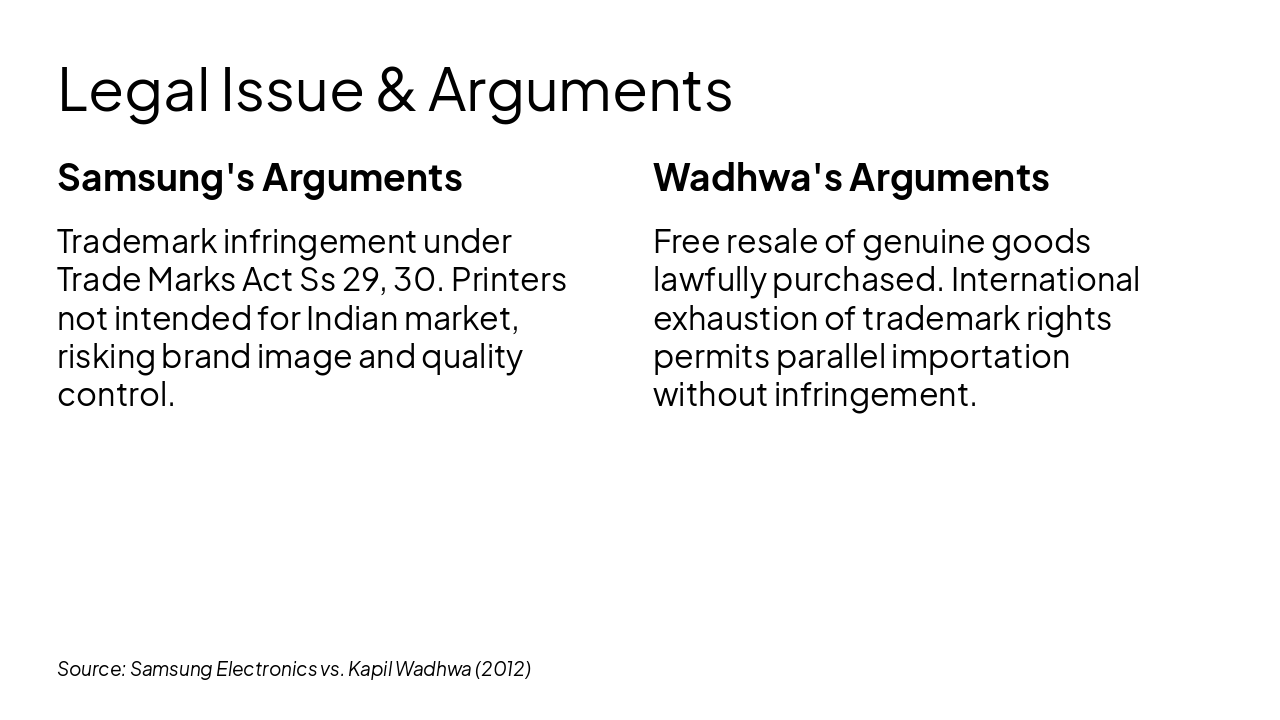
Samsung argues trademark infringement under Trade Marks Act Sections 29 and 30, as the printers were not intended for the Indian market and risk brand image and quality control. Wadhwa counters with free resale of genuine, lawfully purchased goods, citing international exhaustion of trademark rights that permits parallel importation without infringement.

Legal Issue & Arguments

Samsung's ArgumentsWadhwa's Arguments
Trademark infringement under Trade Marks Act Ss 29, 30. Printers not intended for Indian market, risking brand image and quality control.Free resale of genuine goods lawfully purchased. International exhaustion of trademark rights permits parallel importation without infringement.

Source: Samsung Electronics vs. Kapil Wadhwa (2012)

Slide 3 - Legal Issue & Arguments
Slide 4 of 5

Slide 4 - Court’s Decision & Key Principle

The Delhi High Court initially favored Samsung but reversed its decision on appeal. Parallel imports of genuine goods do not constitute trademark infringement, as India follows international exhaustion rather than national exhaustion.

Court’s Decision & Key Principle

  • Delhi HC initially favored Samsung; reversed on appeal.
  • Parallel import of genuine goods ≠ TM infringement.
  • India adopts international exhaustion (vs. national).

Source: Samsung Electronics vs. Kapil Wadhwa (2012)

Speaker Notes
Emphasize reversal on appeal and adoption of international exhaustion.
Slide 4 - Court’s Decision & Key Principle
Slide 5 of 5

Slide 5 - Impact & Conclusion

The slide concludes that international exhaustion enables parallel trade benefiting importers and consumers while shaping Indian IP law to balance protection and competition. It emphasizes promoting market access to unlock markets via the exhaustion doctrine and calls to discuss IP strategies now.

Impact & Conclusion

• Enables parallel trade, benefits importers/consumers

  • Shapes Indian IP law: Balances protection & competition

Key takeaway: Int'l exhaustion promotes market access

Closing: Unlock markets with exhaustion doctrine.

Call-to-action: Discuss IP strategies now.

Source: Samsung Electronics vs. Kapil Wadhwa (2012)

Slide 5 - Impact & Conclusion

Discover More Presentations

Explore thousands of AI-generated presentations for inspiration

Browse Presentations
Powered by AI

Create Your Own Presentation

Generate professional presentations in seconds with Karaf's AI. Customize this presentation or start from scratch.

Create New Presentation

Powered by Karaf.ai — AI-Powered Presentation Generator