AI-Driven Digital Evidence & Financial Forensics Platform (5

Generated from prompt:

Create a presentation using the provided PPT template titled 'PROJECT PPT FORMAT' with the following content: Title Of the Project: Digital Evidence Extraction and Financial Trail Analysis Platform Student Register Number: 221030247 Student Name: Mahir Sharma Include slides for each of the following sections: - About the Project - Existing System - Proposed System - Software and Hardware Required - DFD / ER Diagram / Architecture Design - Table Design - Module Description (M1–M5) - Module 1: Admission - Module 2: Document-to-Data Conversion - Module 3: Financial Trail Analysis - Module 4: Notice Generation - Module 5: OSINT Enrichment & Reporting - System Testing - Reports - Conclusion - Future Enhancement - References Use the uploaded 'PROJECT PPT FORMAT (1) (1).pptx' file as the visual and structural template for slide layout and design.

This PPT outlines an AI platform for digital evidence extraction, financial trail analysis, and forensic reporting. Covers existing/proposed systems, modules (admission, doc conversion, analysis, noti

December 13, 202518 slides
Slide 1 of 18

Slide 1 - Digital Evidence Extraction and Financial Trail Analysis Platform

This title slide presents the "Digital Evidence Extraction and Financial Trail Analysis Platform." It specifies a project presentation by student Mahir Sharma (Reg No: 221030247).

Digital Evidence Extraction and Financial Trail Analysis Platform

Project Presentation Student: Mahir Sharma Reg No: 221030247

Source: PROJECT PPT FORMAT (1) (1).pptx
Slide 1 - Digital Evidence Extraction and Financial Trail Analysis Platform
Slide 2 of 18

Slide 2 - Digital Evidence Extraction and Financial Trail Analysis Platform

This section header slide, titled "Digital Evidence Extraction and Financial Trail Analysis Platform," introduces Section 01: "About the Project." Its subtitle emphasizes automating data extraction, tracing financial flows, and enhancing forensic efficiency in investigations.

Digital Evidence Extraction and Financial Trail Analysis Platform

01

About the Project

Automating data extraction, tracing financial flows, and enhancing forensic efficiency in investigations.

Source: PROJECT PPT FORMAT (1) (1).pptx

Speaker Notes
Student: Mahir Sharma (221030247) Overview: Platform for extracting digital evidence and analyzing financial trails. Key objectives: automate data extraction, trace money flows, enhance forensic efficiency.
Slide 2 - Digital Evidence Extraction and Financial Trail Analysis Platform
Slide 3 of 18

Slide 3 - Existing System

The existing system relies on manual document scanning, data entry, and basic financial tracking, resulting in time-consuming and error-prone workflows. It lacks OSINT integration and scalability for large cases.

Existing System

  • Manual document scanning and data entry
  • Basic financial tracking only
  • Time-consuming manual workflows
  • Error-prone human processes
  • No OSINT integration
  • Poor scalability for large cases
Slide 3 - Existing System
Slide 4 of 18

Slide 4 - Proposed System

The Proposed System leverages AI-driven automated extraction, real-time financial analysis, and OSINT enrichment for efficient data handling. It delivers faster processing, accurate financial trails, automated reports, and scalable architecture.

Proposed System

  • AI-driven automated extraction
  • Real-time financial analysis
  • OSINT enrichment
  • Faster processing times
  • Accurate financial trails
  • Automated reports
  • Scalable architecture
Slide 4 - Proposed System
Slide 5 of 18

Slide 5 - Software and Hardware Required

The slide outlines required software, including Python, Tesseract OCR, TensorFlow, and PostgreSQL. It also lists hardware needs like a GPU server, 16GB RAM, SSD storage, plus AWS cloud for scalability.

Software and Hardware Required

{ "headers": [ "Category", "Requirements" ], "rows": [ [ "Software", "Python, Tesseract OCR, TensorFlow, PostgreSQL" ], [ "Hardware", "GPU Server, 16GB RAM, SSD Storage" ], [ "Cloud", "AWS for Scalability" ] ] }

Slide 5 - Software and Hardware Required
Slide 6 of 18

Slide 6 - DFD / ER Diagram / Architecture Design

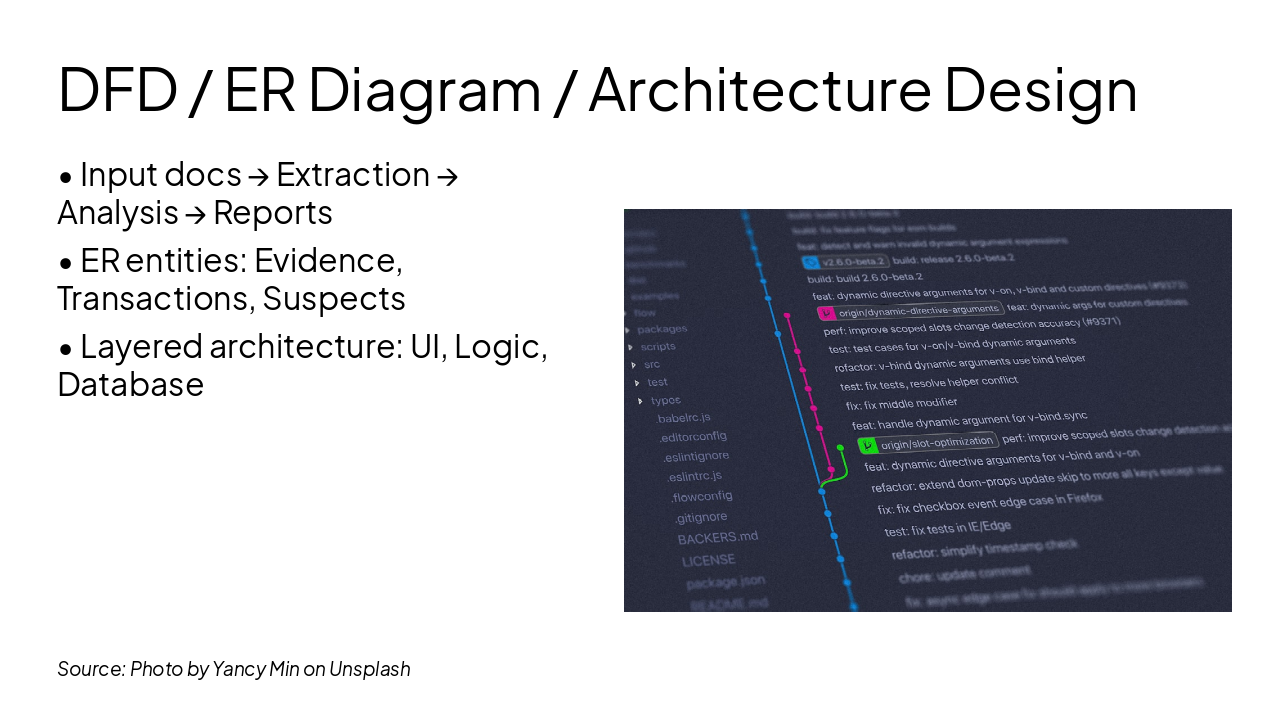
The slide outlines a Data Flow Diagram (DFD), ER diagram, and architecture design for a system processing documents. It depicts the flow from input docs to extraction, analysis, and reports; ER entities including Evidence, Transactions, and Suspects; and a layered architecture with UI, Logic, and Database.

DFD / ER Diagram / Architecture Design

!Image

  • Input docs → Extraction → Analysis → Reports
  • ER entities: Evidence, Transactions, Suspects
  • Layered architecture: UI, Logic, Database

Source: Photo by Yancy Min on Unsplash

Slide 6 - DFD / ER Diagram / Architecture Design
Slide 7 of 18

Slide 7 - Table Design

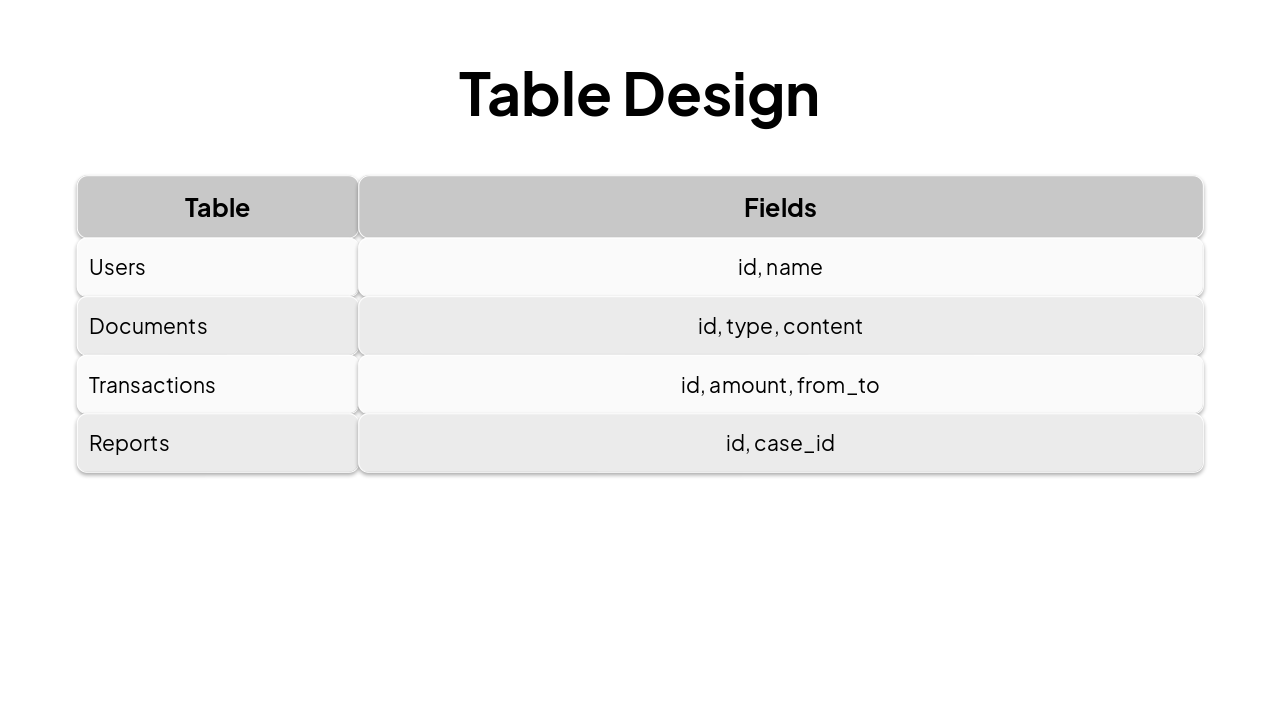
The "Table Design" slide outlines four database tables and their key fields. It lists Users (id, name), Documents (id, type, content), Transactions (id, amount, fromto), and Reports (id, caseid).

Table Design

{ "headers": [ "Table", "Fields" ], "rows": [ [ "Users", "id, name" ], [ "Documents", "id, type, content" ], [ "Transactions", "id, amount, fromto" ], [ "Reports", "id, caseid" ] ] }

Speaker Notes
Tables: Users (id, name), Documents (id, type, content), Transactions (id, amount, from_to), Reports (id, case_id). Relations: FK links for integrity.
Slide 7 - Table Design
Slide 8 of 18

Slide 8 - Module Description (M1–M5)

This agenda slide, titled "Module Description (M1–M5)", lists five key modules. They include M1: Admission, M2: Doc-to-Data, M3: Financial Trail, M4: Notice Gen, and M5: OSINT & Reporting.

Module Description (M1–M5)

  1. M1: Admission
  2. M2: Doc-to-Data
  3. M3: Financial Trail
  4. M4: Notice Gen
  5. M5: OSINT & Reporting

Source: Digital Evidence Extraction and Financial Trail Analysis Platform

Speaker Notes
High-level overview of core functionalities.
Slide 8 - Module Description (M1–M5)
Slide 9 of 18

Slide 9 - Module 1: Admission

Module 1: Admission facilitates user and case registration while capturing suspect details and case information. It validates input data accuracy, stores initial data securely, and enables ongoing case tracking.

Module 1: Admission

  • Facilitates user and case registration
  • Captures suspect details and case information
  • Validates accuracy of input data
  • Stores initial data securely
  • Enables ongoing case tracking
Slide 9 - Module 1: Admission
Slide 10 of 18

Slide 10 - Module 2: Document-to-Data Conversion

Module 2's Document-to-Data Conversion workflow outlines four phases: Document Input (scanning/uploading PDFs/images to raw files), OCR Extraction (raw files to text), NLP Parsing (text to entities & relations), and Structured Data (to JSON output). This process systematically transforms unstructured documents into structured, usable data.

Module 2: Document-to-Data Conversion

{ "headers": [ "Phase", "Description", "Inputs/Outputs" ], "rows": [ [ "Document Input", "Scan or upload documents", "PDFs/Images → Raw files" ], [ "OCR Extraction", "Extract text using Optical Character Recognition", "Raw files → Extracted text" ], [ "NLP Parsing", "Parse text to identify entities and relations", "Extracted text → Entities & Relations" ], [ "Structured Data", "Generate structured output", "Entities & Relations → JSON/Structured Data" ] ] }

Source: Scan docs -> OCR extraction -> NLP parsing -> structured data (entities, relations). Handles PDFs, images.

Speaker Notes
This module automates the conversion of unstructured documents like PDFs and images into structured data by extracting text via OCR and parsing entities/relations with NLP.
Slide 10 - Module 2: Document-to-Data Conversion
Slide 11 of 18

Slide 11 - Module 3: Financial Trail Analysis

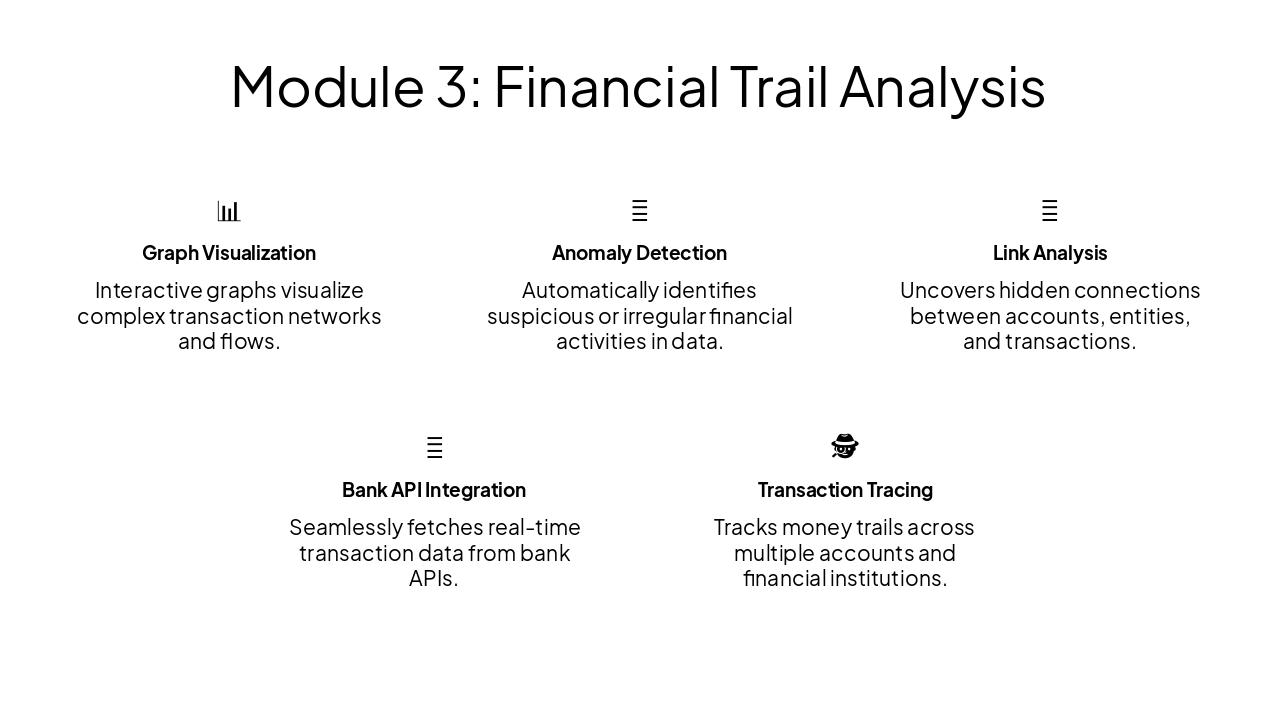
Module 3: Financial Trail Analysis showcases five key features for investigating transaction networks. These include interactive graph visualization, anomaly detection, link analysis, bank API integration, and transaction tracing to uncover hidden financial connections and irregularities.

Module 3: Financial Trail Analysis

{ "features": [ { "icon": "📊", "heading": "Graph Visualization", "description": "Interactive graphs visualize complex transaction networks and flows." }, { "icon": "🚨", "heading": "Anomaly Detection", "description": "Automatically identifies suspicious or irregular financial activities in data." }, { "icon": "🔗", "heading": "Link Analysis", "description": "Uncovers hidden connections between accounts, entities, and transactions." }, { "icon": "🔌", "heading": "Bank API Integration", "description": "Seamlessly fetches real-time transaction data from bank APIs." }, { "icon": "🕵️", "heading": "Transaction Tracing", "description": "Tracks money trails across multiple accounts and financial institutions." } ] }

Slide 11 - Module 3: Financial Trail Analysis
Slide 12 of 18

Slide 12 - Module 4: Notice Generation

Module 4: Notice Generation auto-generates legal notices from analysis findings using customizable templates and personalizes them with case-specific details. It integrates digital signatures for authenticity and facilitates compliant delivery and tracking.

Module 4: Notice Generation

  • Auto-generates legal notices from analysis findings
  • Employs customizable templates for notice types
  • Personalizes content with case-specific details
  • Integrates digital signatures for authenticity
  • Facilitates compliant notice delivery and tracking
Slide 12 - Module 4: Notice Generation
Slide 13 of 18

Slide 13 - Module 5: OSINT Enrichment & Reporting

The slide highlights OSINT sources from social media (Twitter, Facebook, LinkedIn) and web platforms (news, forums, public records) to gather supplementary data on entities in digital evidence and financial trails. It also covers integrating OSINT for data enrichment, building interactive dashboards with visuals, and generating automated reports for analysis and stakeholder presentation.

Module 5: OSINT Enrichment & Reporting

OSINT SourcesData Enrichment & Reporting
Leverage open-source intelligence from social media (Twitter, Facebook, LinkedIn) and web sources (news, forums, public records) to gather supplementary data on entities involved in digital evidence and financial trails.Integrate OSINT data to enrich datasets, create interactive dashboards with visuals (charts, graphs), and generate automated reports for comprehensive analysis and stakeholder presentation.
Slide 13 - Module 5: OSINT Enrichment & Reporting
Slide 14 of 18

Slide 14 - System Testing

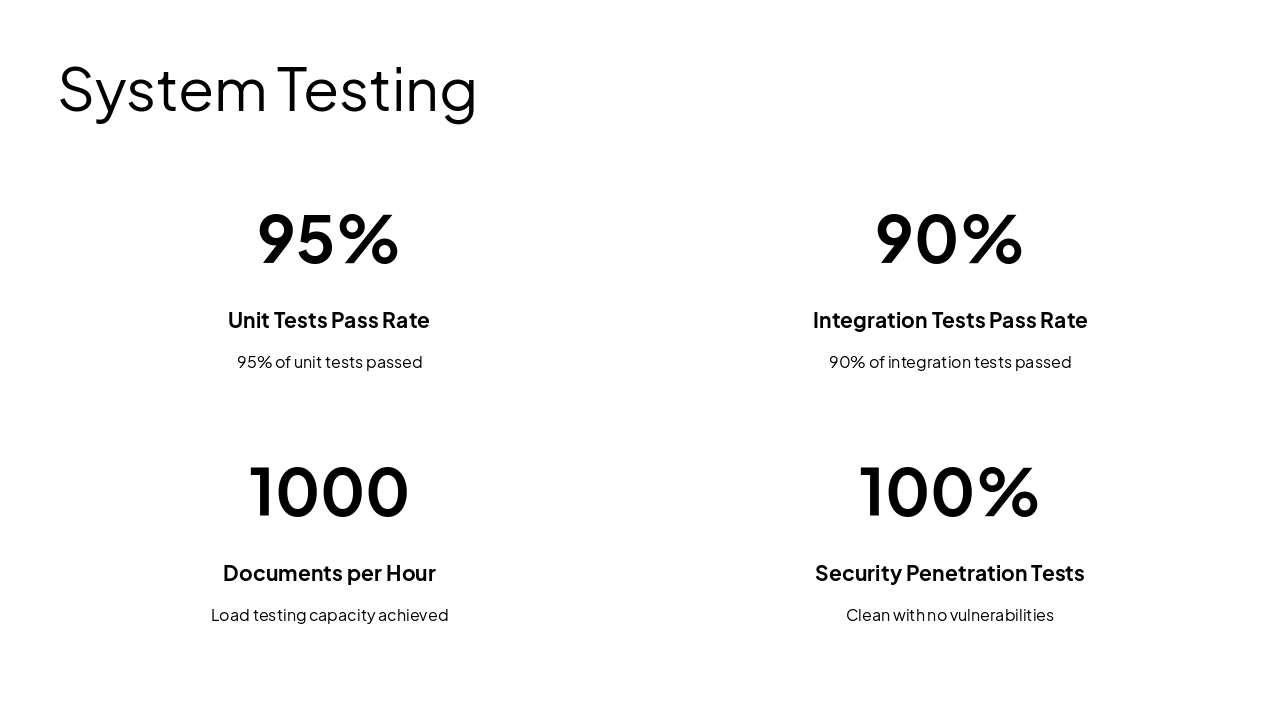
The System Testing slide reports a 95% unit tests pass rate and 90% integration tests pass rate. It also highlights a load testing capacity of 1000 documents per hour and 100% clean results from security penetration tests with no vulnerabilities.

System Testing

  • 95%: Unit Tests Pass Rate
  • 95% of unit tests passed

  • 90%: Integration Tests Pass Rate
  • 90% of integration tests passed

  • 1000: Documents per Hour
  • Load testing capacity achieved

  • 100%: Security Penetration Tests
  • Clean with no vulnerabilities

Slide 14 - System Testing
Slide 15 of 18

Slide 15 - Reports

The "Reports" slide highlights key reporting features via an image. It covers executive summaries of findings, detailed financial trails and audits, interactive visualizations/charts, and PDF/Excel exports.

Reports

!Image

  • Executive summary of key findings
  • Detailed financial trails and audits
  • Interactive visualizations and charts
  • Export reports to PDF/Excel

Source: Image from Wikipedia article "Data and information visualization"

Slide 15 - Reports
Slide 16 of 18

Slide 16 - Conclusion

The conclusion slide states that the platform revolutionizes digital forensics through its efficiency, accuracy, integration, and proven testing results. It thanks the audience for their attention and calls for discussions on deployment and implementation.

Conclusion

Platform revolutionizes digital forensics: efficient, accurate, integrated. Proven via testing.

Closing: Thank you for your attention!

Call to Action: Ready to deploy? Let's discuss implementation.

Source: Digital Evidence Extraction and Financial Trail Analysis Platform

Speaker Notes
Summarize key benefits: efficiency, accuracy, integration. Highlight testing success. End with thanks and invite questions.
Slide 16 - Conclusion
Slide 17 of 18

Slide 17 - Future Enhancement

The "Future Enhancement" slide proposes key upgrades for fraud detection and financial security. It includes AI predictions for proactive anomaly detection, blockchain for tamper-proof evidence storage, a mobile app for real-time field access, and advanced ML models.

Future Enhancement

  • Integrate AI predictions for proactive financial anomaly detection
  • Incorporate blockchain for secure, tamper-proof evidence storage
  • Develop mobile app for real-time field access and analysis
  • Deploy advanced ML models for enhanced fraud detection
Slide 17 - Future Enhancement
Slide 18 of 18

Slide 18 - References

The "References" slide lists essential sources for the presentation. It includes IEEE papers on digital forensics methodologies, OSINT tools and frameworks documentation, Python libraries official documentation, and AWS architecture and deployment guides.

References

  • IEEE papers on digital forensics methodologies
  • OSINT tools and frameworks documentation
  • Python libraries official documentation
  • AWS architecture and deployment guides
Slide 18 - References

Discover More Presentations

Explore thousands of AI-generated presentations for inspiration

Browse Presentations
Powered by AI

Create Your Own Presentation

Generate professional presentations in seconds with Karaf's AI. Customize this presentation or start from scratch.

Create New Presentation

Powered by Karaf.ai — AI-Powered Presentation Generator